Know your settings
- DP Event
- Published on 18 December 2025
- Generated on 19 March 2026
- DPE 03/25
- 5 minute read
Incident
1 Overview
This DP incident was reported by the operators of a DP equipment class 2 offshore supply vessel, which was undertaking loadout operations from a drilling rig. The vessel was operating with all thrusters (4of) and all generators (4of) connected to open bus.
The OSV had an initial heading of 228° and the environmental conditions were good with wind 8.8 kts from 140.4°, DP current 2.8 kts to 030.8° and Hs 1.0 metre.
Selected into DP were 2 DGNSS and 2 RADius.
2 What happened?
The vessel had commenced operations alongside the rig by the forward crane, but then had been requested to move out whilst the rig required to change heading. The heading change was conducted and at 05:20 the OSV was back alongside, changing position to by the Aft Crane.
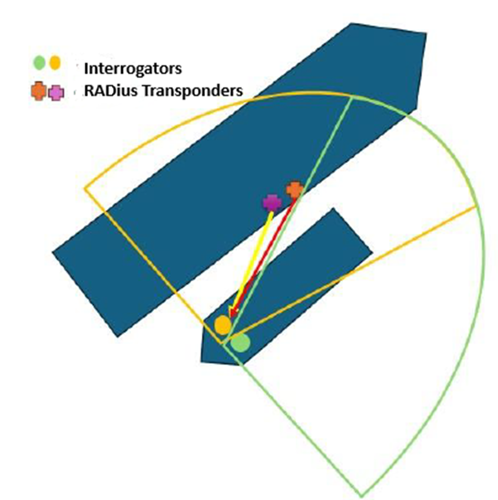
As the vessel moved alongside the rig, the first DP alarm activated “Radius 1 no reply”. The transponder 150 was recalibrated on Radius Interrogator 2 and the vessel maintained position with both Radius transponders (150 & 180) configured to Radius Interrogator 2, in Follow Target mode.
DP alarm “Follow target not possible” activated, indicating that follow target was not possible if none of the selected mobile targets are online and enabled.
Over the course of the next 8 minutes there began a jumping of both transponders between Radius interrogators 1 and 2.
- 05:31:05 to 05:34:27, vessel was in Follow Target, but without any mobile target selected, as transponders 150 and 180 were being interrogated by Radius Interrogator 2 and set as fixed.
- 05:34:30 Transponder 150 calibrated on Radius Interrogator 1, while this transponder was also select on Interrogator 2, but not being used.
- 05:34:54 Transponder 180 calibrated on Radius Interrogator 1, while this transponder was also select on Interrogator 2. At this time, the transponders interrogated by Interrogator 2 have weight zero, and are no longer being considered for position keeping.
- 05:35:24 At this point, only the mobile targets were selected for Follow Target, on Radius Interrogator 1.
- 05:35:27 Due to rig movements based on the mobile transponders on it, vessel’s setpoint was updated.
- 05:35:39 – Here again the vessel’s setpoint was updated.
- 05:36:09, alarm on Radius 1, no reply for transponder 150, losing it on DP. Also, the vessel experienced a heading deviation of 3.2 degrees, while finalising the new setpoint due to targets movements. The transponder 150 was again calibrated on Radius interrogator 2 as fixed.
When vessel was still stabilising in position and heading, the setpoint was updated successively due to targets movements. Heading deviated up to 6.1 degrees, while the transponders were switching between the different interrogators.
At 05:39:06 the DPO changed from Follow Target mode to AutoPos mode, with transponders selected on Interrogator 1 as mobile, and transponder 150 not being used by Interrogator 2 as fixed.
- 05:39:09 DPO set a new heading setpoint.
- 05:39:12 DPO again set a new heading setpoint.
At this point the DPO chose to abandon the operation, DPO de-selected the Surge and Yaw axis, and took over the command of the vessel in Joystick mode on DP and commenced sailing the vessel away from the rig. Unfortunately upon leaving, the vessel made contact with the rig.
3 Findings
On investigation, the following was found:
- Incorrect system configuration: The DPO configured the transponders to be tracked by two different interrogators with conflicting settings. While Interrogator 1 was set to track the transponders as mobile, Interrogator 2 treated them as fixed. This improper configuration caused instability, as the transponders were switching between the two interrogators incorrectly.
- Lack of familiarity or understanding of the system: The operator may not have fully understood the implications of configuring the transponders differently between the two interrogators. This lack of understanding led to a configuration that caused instability and impacted the performance of the DP system.
- The procedure does not include information stating that the configuration made by the operator should not be performed. This means that the procedure may not have clearly indicated that configuring the transponders in this conflicting way (tracking them with two interrogators using different settings) is incorrect or should be avoided. Without this guidance, the operator may not have been aware that this configuration could lead to system instability and performance issues.
- It was necessary to update the DP Manuals, field entry checklists , CAMO and ASOG.
4 Conclusion
When the incident was investigated, the DP logged data showed that when the transponders were tracked by Interrogator 1, the targets were set to be used as a Mobile target (and as such were available for use in Follow Target), while the same targets were also set to be tracked by Interrogator 2 but used as a Fixed targets together with the GPS. Since the targets were a little unstable and jumping between being tracked by Interrogator 1 and 2, it created challenges for the DP system.
It is not recommended to track the same Radius target on both Interrogators if they are set up differently. In order to mitigate against such reoccurrence, a line within the ASOG to check the RADius tracking settings should be included.
Latest DP incidents
-
Simultaneous Operations
A DP Incident report highlighting the importance of maintaining focus during time on the DP desk
DPE 03/25
18 December 2025
Incident
-
Importance of familiarisation and paying attention
The importance of maintaining full attention during the operator's time on the DP desk can never be underestimated, or forgotten
DPE 03/25
18 December 2025
Incident
-
Worst case failure preparedness
Operators must be prepared for worst case failures
DPE 03/25
18 December 2025
Incident
-
Know your settings
This Dynamic Positioning (DP) incident involved a DP equipment class 2 offshore supply vessel (OSV) during loadout operations from a drilling rig.
DPE 03/25
18 December 2025
Incident
-
DP drill scenario
DP emergency drill scenarios are included to assist DP vessel management and DPOs / Engineers and ETOs to conduct DP drills onboard.
DPE 03/25
18 December 2025
Drill Scenario
The case studies and observations above have been compiled from information received by IMCA. All vessel, client, and operational data has been removed from the narrative to ensure anonymity. Case studies are not intended as guidance on the safe conduct of operations, but rather to assist vessel managers, DP operators, and technical crew.
IMCA makes every effort to ensure both the accuracy and reliability of the information, but it is not liable for any guidance and/or recommendation and/or statement herein contained.
Any queries should be directed to DP team at IMCA. Share your DP incidents with IMCA online. Sign-up to receive DP event bulletins straight to your email.