Simultaneous Operations
- DP Event
- Published on 18 December 2025
- Generated on 19 March 2026
- DPE 03/25
- 5 minute read
Incident
1 Overview
The DP equipment class 2 vessel was engaged with air diving operations, on risers under the hull of a FPSO's turret. The FPSO was lying close to her natural heading to the environment, with two DP equipment Class 2 AHTS vessels engaged in simultaneous pullback operations to hold the FPSO on her heading to minimise yaw within +/-2°.
The vessel was operating with all five thrusters operating and 3 of 5 generators connected to 3 open bus sections.
The environment data just prior to the incident was shown as visibility good, initial heading 315°, significant wave height 1.5m, wind speed 10 knots from 225° and real current 0.8 knots to 090°.
The weather forecast for the duration of the dive operations had been consulted, with predicted wind gusts at 10m of 15knots and at 50m of 16knots. As this was a known area for squalls the risk of squalls occurring was given as between 30-50% over the next 12 hours.
As per company specific project policy for DP operations in close proximity to FPSO:
For all DP operations in close proximity to the FPSO, the FPSO’s heading will be closely monitored by the DPO. For all critical operations when the vessel is in close proximity to the FPSO, the FPSO’s heading should be kept within +/-2 of the required heading by the control tugs under the direction of the tow master on the FPSO. Should the heading drift more than 2º, then the tow master should advise the DSV immediately, and take corrective action with the tugs.
Should the DPO be advised that the FPSO’s heading has drifted more than 4° from the target heading or has realised the same through their own visual observations, then the divers should be recalled to the basket and the ROV to the TMS immediately. The tow master should be contacted on VHF to report on the status of the heading control, If the FPSO’s heading hasn’t been corrected by the time the divers have returned to the basket, then the dive should be abandoned and the vessel moved away to a safe distance from the FPSO.
Should the tugs lose control of the FPSO’s heading, then the DSV should be moved outside of the FPSO’s swinging circle by the quickest means possible without endangering the divers or the vessel’s equipment.
Immediately prior to every dive the DPO should contact the tow master on VHF to test communications and to receive confirmation on the FPSO’s heading and the status of the heading control.
A close radar and visual watch should be kept for any dense cloud formations that are likely to indicate approaching squalls. A sudden change in the wind direction, and increase in wind speed should be considered a strong indicator that a squall is close by, and the divers should be recalled to the basket. If the wind speed is above 20kts and still rising, then the dive should be abandoned and the vessel moved outside of the FPSO’s swinging circle in a controlled fashion.
If any emergency action is taken by the vessel, then this should be communicated to the FPSO Control Room on VHF.
2 What happened?
09:25hrs – Air divers at surface; FPSO advised by VHF.
09:28hrs – DPO noticed that the FPSO was 16° off required heading. Reported to FPSO & DSV OCM. The Client Rep contacted FPSO requesting explanation. DSV moved 2m away from FPSO to increase clearance.
09:40hrs – Commenced lights & comms checks for next dive.
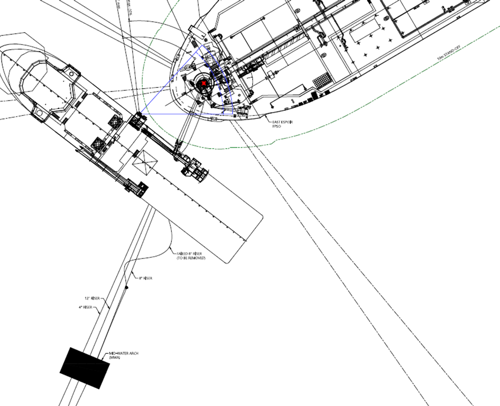
09:43hrs – Tugs lost control of FPSO's heading. Wind veering northerly and increasing sharply. FPSO closing on the DSV. DPO activated Yellow Alert and commences moving DSV to port away from the FPSO.
Stbd taut wire lifted off seabed. ROV recovering to deck.
09:44hrs – Master on the Bridge. Wind gusting 52kts. DSV moving to port and turning heading to stbd to move away from the FPSO. FPSO advises DSV that the tugs have lost control of the FPSO's heading.
09:45hrs – ROV on deck.
09:50hrs – DSV 200m clear of FPSO & continues to move farther away. Yellow Alert off. Stbd Taut Wire recovered to deck.
09:55hrs – DSV outside FPSO swinging circle.
10:00hrs – Vessel all stopped 300m from FPSO turret position. Air basket clump weights recovered to deck & secured. Commence standing-by on Client instructions.
3 Findings
On investigation, the following was found:
- Wind veered 90 degrees and increased rapidly to 52kts with localised squall.
- AHTSs lost control of the FPSO's heading, such that the FPSO closed on the DSV rapidly.
- The FPSO made light contact on the knuckle of the DSV starboard quarter.
- The DSV was already undertaking evasive manoeuvres away from the FPSO, due to the observance of the DPO. This quick response limited the contact and damage to only scuffed paintwork.
- The Tow Master & tugs were not holding the FPSO within the parameters required by the project procedures, and did not advise the DSV immediately when they lost control of the FPSO's heading.
- Thankfully no divers were in the water at the time of the incident
4 Conclusions
Following the investigation the DPO was commended for the prompt actions taken and the incident highlighted the importance of maintaining focus during time on the DP desk. On todays Navigation Bridges it may seem difficult to zone out the noise and influences of others around, but incidents like the squall can and do happen in a blink of an eye.
Prior to the vessel returning to work the Master debriefed the Bridge Team after the event, conducted "drive-away" DP drills, and produced a Standing Order reinforcing the actions to be taken in the event of a re-occurrence.
The crew of the DSV were prepared, but when conducted in simultaneous operations it is important to also be prepared as a field. Communication drills and tabletop exercises were conducted along with the Tow Master & tugs, to ensure preparedness for any future incidents that may arise.
Latest DP incidents
-
Simultaneous Operations
A DP Incident report highlighting the importance of maintaining focus during time on the DP desk
DPE 03/25
18 December 2025
Incident
-
Importance of familiarisation and paying attention
The importance of maintaining full attention during the operator's time on the DP desk can never be underestimated, or forgotten
DPE 03/25
18 December 2025
Incident
-
Worst case failure preparedness
Operators must be prepared for worst case failures
DPE 03/25
18 December 2025
Incident
-
Know your settings
This Dynamic Positioning (DP) incident involved a DP equipment class 2 offshore supply vessel (OSV) during loadout operations from a drilling rig.
DPE 03/25
18 December 2025
Incident
-
DP drill scenario
DP emergency drill scenarios are included to assist DP vessel management and DPOs / Engineers and ETOs to conduct DP drills onboard.
DPE 03/25
18 December 2025
Drill Scenario
The case studies and observations above have been compiled from information received by IMCA. All vessel, client, and operational data has been removed from the narrative to ensure anonymity. Case studies are not intended as guidance on the safe conduct of operations, but rather to assist vessel managers, DP operators, and technical crew.
IMCA makes every effort to ensure both the accuracy and reliability of the information, but it is not liable for any guidance and/or recommendation and/or statement herein contained.
Any queries should be directed to DP team at IMCA. Share your DP incidents with IMCA online. Sign-up to receive DP event bulletins straight to your email.