Finger injury: diver caught finger in bell door
- Safety Flash
- Published on 9 November 2018
- Generated on 18 July 2025
- IMCA SF 25/18
- 2 minute read
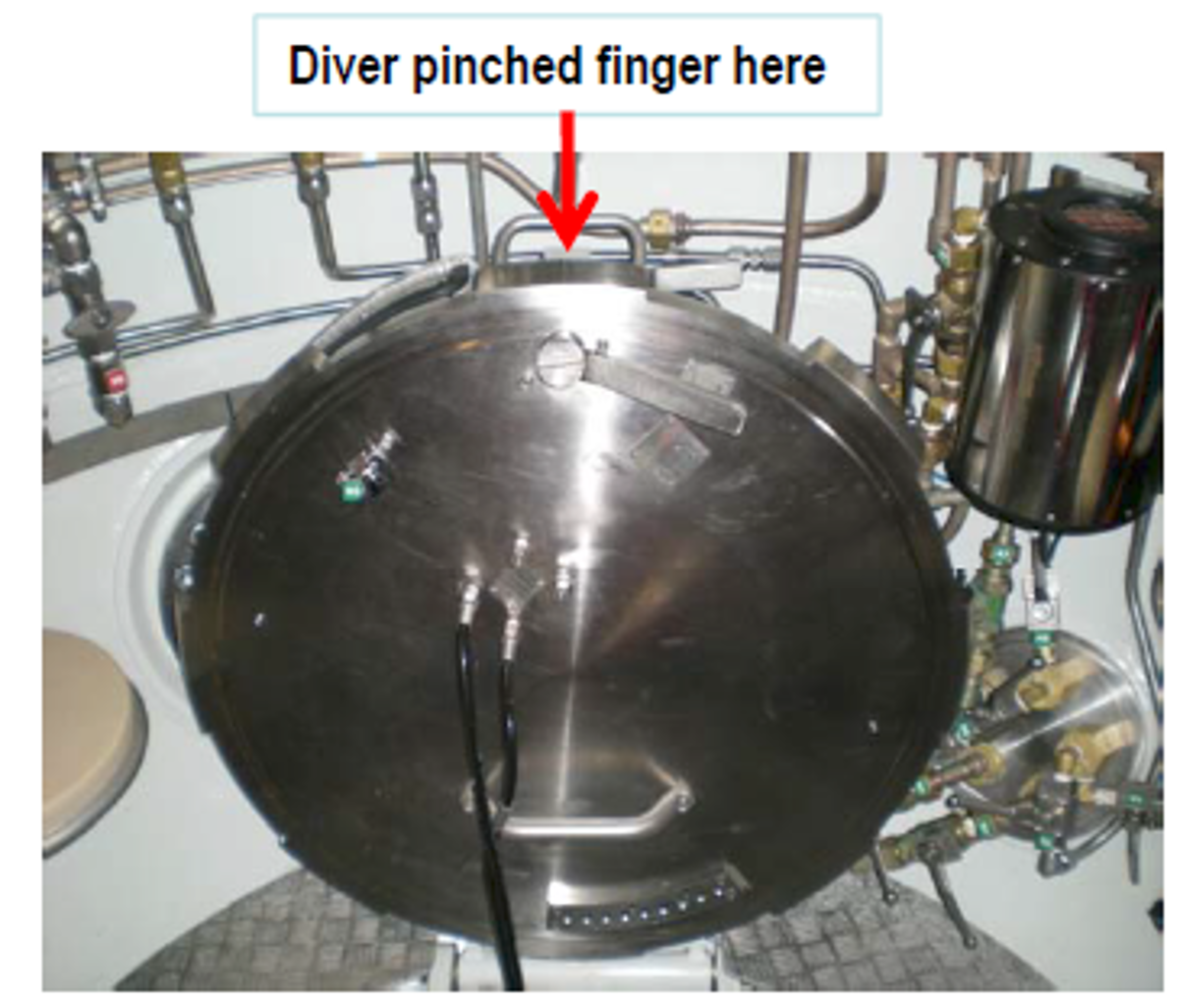
A diver suffered an injury when his finger got caught between the top of the bell door and the retaining latch.
What happened?
The incident occurred at the end of the dive, when both divers had been recovered to the bell and were preparing for return to surface. The dive team were attempting to close the bell door; however, the racked umbilical was stopping the door from fully closing. Diver 1 placed his hand on top of the door and leant onto it to steady himself as he tried to reposition the umbilical. At that point, the door moved back slightly, pinching his finger between the top of the door and the retaining latch. He suffered a deep cut to his finger which lead to him being decompressed from the system as a precaution against possible infection.
What went wrong?
The investigation for this incident highlighted a number of contributory factors:
- Incorrectly stored umbilical interfering with the closing of the bell door.
- Lack of awareness/perception of risk.
- Lack of hazard markings on the pinch point location.
What actions were taken? What lessons were learned?
- There needs to be a thorough check of work areas for potential pinch points, and where these cannot be removed, ensure that they are physically highlighted and identified in task risk assessments (TRAs), and communicated to all personnel during toolbox talks (TBTs).
- There was a review of equipment stowage in the bell, which resulted in the repositioning of the bell scrubber, improved stowage of rebreather and repositioning of divers’ seats within the bell.
Incidents relating to the failure of bell door components have not been included here.
Remember that the safety flash archive can be interrogated using any search term. Browse to https://www.imca-int.com/resources/safety/safety-flashes/ and search for 'hand' and 'pinch' for a wider and deeper selection of incidents relating to pinch points and hands.
IMCA Safety Flashes summarise key safety matters and incidents, allowing lessons to be more easily learnt for the benefit of the entire offshore industry.
The effectiveness of the IMCA Safety Flash system depends on the industry sharing information and so avoiding repeat incidents. Incidents are classified according to IOGP's Life Saving Rules.
All information is anonymised or sanitised, as appropriate, and warnings for graphic content included where possible.
IMCA makes every effort to ensure both the accuracy and reliability of the information shared, but is not be liable for any guidance and/or recommendation and/or statement herein contained.
The information contained in this document does not fulfil or replace any individual's or Member's legal, regulatory or other duties or obligations in respect of their operations. Individuals and Members remain solely responsible for the safe, lawful and proper conduct of their operations.
Share your safety incidents with IMCA online. Sign-up to receive Safety Flashes straight to your email.