High voltage breaker trip
- DP Event
- Published on 10 August 2017
- Generated on 17 September 2026
- DPE 03/17
- 2 minute read
Observation
One of the wires from a breaker had chaffed on the inside of the box resulting in a short and evidence of arcing to ground.
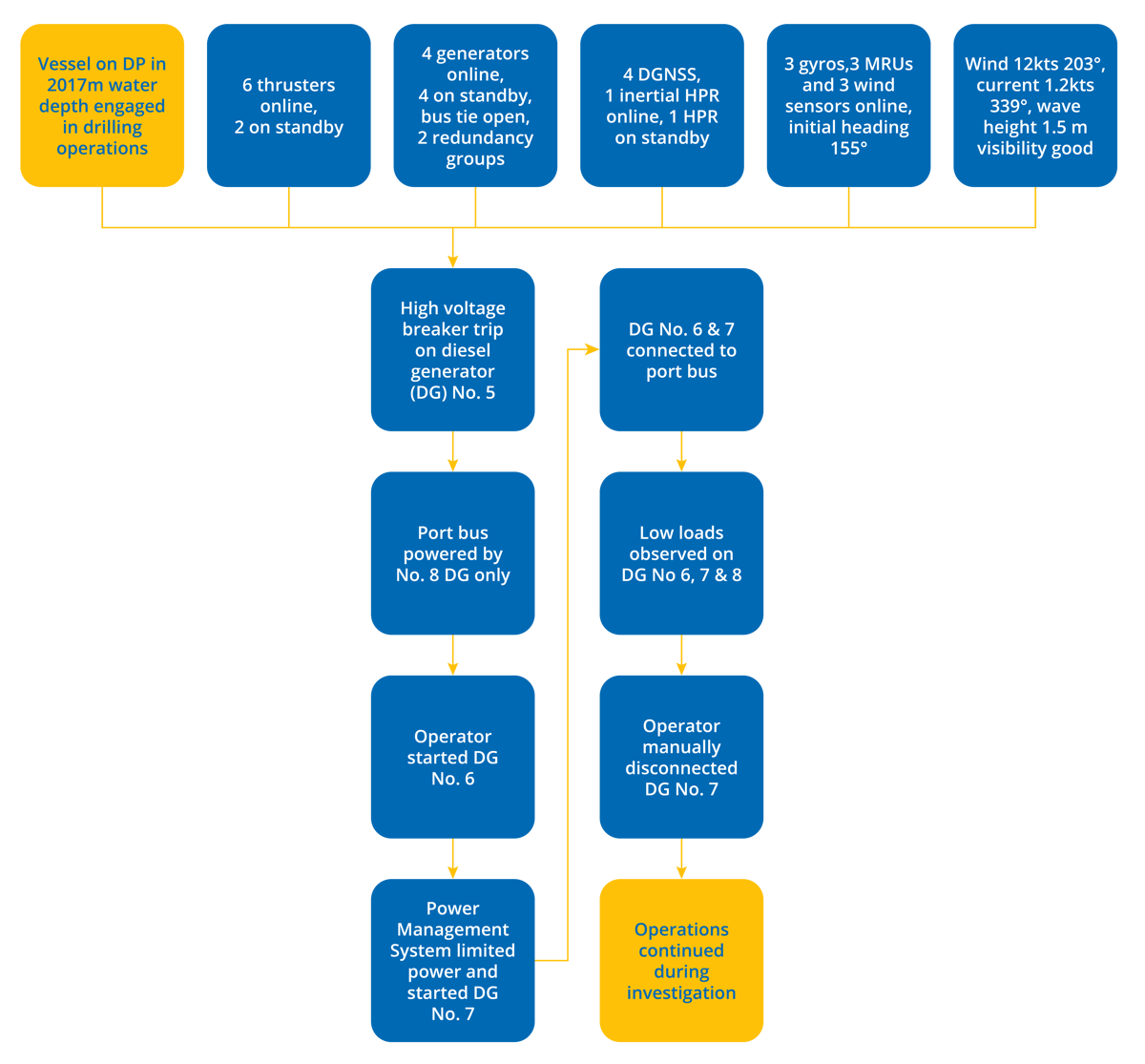
Comments
Investigation started at the breaker for DG No.5 in the port switchgear room.
The breaker showed tripped and there was a fault present on the auto voltage regulator (AVR). DG No.5 was locked out and investigation continued, the AVR breaker ‘S1’ was found tripped. Further investigating found that one of the wires from this breaker had chaffed on the inside of the box and resulted in a short and evidence of arcing to ground. The damaged wires were replaced and the rest of the wires in the junction box adjusted to avoid future problems.
After replacing the worn wires and test running the engine it was noticed that the load indicator on the PMS panel was showing a negative reading, which was incorrect. This signal was a feedback from the breaker module and was in fact sending a false milliamp signal to the PMS. Racked the breaker out to perform a hard reset, the kilowatt signal from the relay went to zero.
DG No.5 was run, tested and connected to the 11kV bus, all in proper working order.
Considerations
- The investigation explained that the AVR breaker trip caused the DG No.5 breaker to open presumably as a result of a reactive power (kVar) protection scheme. It seems from the investigation notes that there wasno connection between the original fault and the negative active power (kW) signal.
- Similar wire checks should be made on all other engines.
- Having four DGNSS enabled in the DP controller is not a good practice as the total ‘DGNSS weight’ is reducing the ‘acoustic weight’ to insignificant.
- The DP alert status should be initiated in accordance with activity specific operating guidelines.
Latest DP incidents
-
Know your equipment, or at least where to find the answers
During an update in the Follow Target Mode, the crew noticed an anomaly with joystick control.
DPE 02/26
1 September 2026
Observation
-
New equipment, unexpected consequences
During the operation, a loss of DGNSS correction signals was experienced across multiple vessel DGNSS units.
DPE 02/26
1 September 2026
Incident
-
A chain of small failures leads to a major consequence
While conducting cargo operations on DP a vessel experienced a partial blackout caused by an unexpected shutdown of generator 3
DPE 02/26
1 September 2026
Incident
-
Holding position, losing references
While approaching a turret-moored, weather-vaning offshore installation (FPSO), in preparation for cargo operations, a DP equipment class 2 vessel experienced significant rolling of up to 15–20° due to a long-period swell close to the vessel’s natural roll period, resulting in a resonance effect
DPE 02/26
1 September 2026
Observation
-
DP drill scenario – Loss of seawater cooling pump redundancy
Exercise scenario – Loss of seawater cooling pump redundancy
DPE 02/26
1 September 2026
Drill Scenario
The case studies and observations above have been compiled from information received by IMCA. All vessel, client, and operational data has been removed from the narrative to ensure anonymity. Case studies are not intended as guidance on the safe conduct of operations, but rather to assist vessel managers, DP operators, and technical crew.
IMCA makes every effort to ensure both the accuracy and reliability of the information, but it is not liable for any guidance and/or recommendation and/or statement herein contained.
Any queries should be directed to DP team at IMCA. Share your DP incidents with IMCA online. Sign-up to receive DP event bulletins straight to your email.