Hybrid system won't accept load
- DP Event
- Published on 11 May 2026
- Generated on 23 September 2026
- DPE 01/26
- 6 minute read
Undesired event
A DP equipment class 2 vessel was engaged in operations whilst holding position on auto DP, when this undesired event occurred.
1 Overview
The DP equipment class 2 vessel was engaged in operations whilst holding position on auto DP.
The weather conditions were good during the operations, with the vessel operating on low loads on two of six engines. The position was being maintaining with 4 of the vessel’s 5 thrusters online and selected to DP and the vessel was operating in open AC bus-tie configuration and closed DC bus-tie configuration.
The environment data just prior to the incident was shown as visibility good, initial heading 357°, swell 2 m and wind speed 6 knots.
2 What happened?
Due to the good conditions and low loads the decision was made to switch from two engines running and connected (DG1 & DG5) to Hybrid mode with DG1 and two Energy Storage Systems (ESS) active.
Using one engine and two ESS, is a normal operation for the hybrid system and used many times.
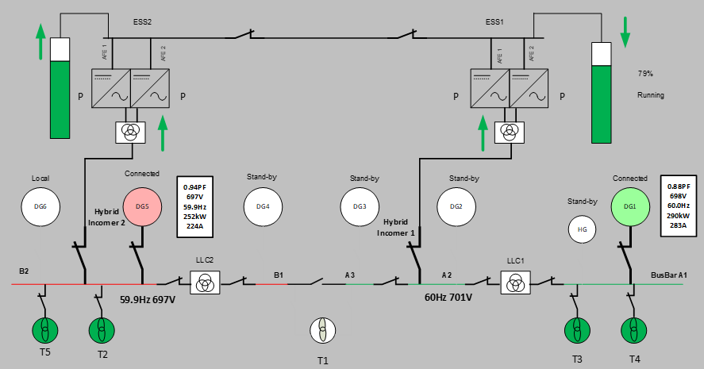
During de-loading of DG5 the Hybrid Incomer 2 breaker tripped and caused a blackout of Busbar B2. This resulted in loss of thruster 2 and thruster 5, until DG5 was reconnected to B2, restoring power.
Station keeping on DP was maintained at all time.
3 Findings
The OEM was requested to undertake a thorough investigation of the event, to identify the cause and restore faith in the system before the vessel could use the Hybrid configuration again on DP.
The service technician confirmed that the event occurred when the vessel was operating with open AC switchboard and closed DC switchboard.
The OEM identified:
- Hybrid incomer 2 breaker had been tripped by the Generator Protection Unit (GPU) by protection setting ML-1240 G f< - Gen low-frequency 1.
- Checking the Protection setting table for the vessel, the documentation described that this ML-1240 should not be activated in any of the Hybrid GPUs.
- The technician verified GPU back-up files in the system, they indicated that the following protection settings were activated:
- +V108 (ESS1) – ML-1210 – Gen high-frequency 1 – 110% – 1.5 s – Activated
- +V108 (ESS1) – ML-1240 – Gen low-frequency 1 – 90% 1 s – Disabled
- +V128 (ESS2) – ML-1210 – Gen high-frequency 1 – 110% – 1.5 s – Activated
- +V128 (ESS2) – ML-1240 – Gen low-frequency 1 – 90% 1 s – Activated
- +V108 (ESS1) – ML-1210 – Gen high-frequency 1 – 110% – 1.5 s – Activated
- This explained why the ESS2 breaker tripped but did not explain why the frequency dropped below 54 Hz.
Continued testing in the OEM simulator ashore, it revealed a timing issue in the Energy Management System (EMS) could on occasions cause the ESS Analog Front Ends (AFEs) to change mode for an instance during unloading and disconnection of the last connected generator.
To explain this case, it is crucial to understand the correct behaviour of the system.
When ESS is connected in parallel with DG5, both AFEs are in “Power mode” indicated as “P” in the figure 3, and DG5 is maintaining the frequency [60 Hz] on the system. When DG5 is unloading, the AFEs are switched to “Frequency mode” indicated as “Fs” in figure 4, ESS2 is then taking over and controlling the frequency [60 Hz] on the system and the active power is transferred from DG5 to ESS2.
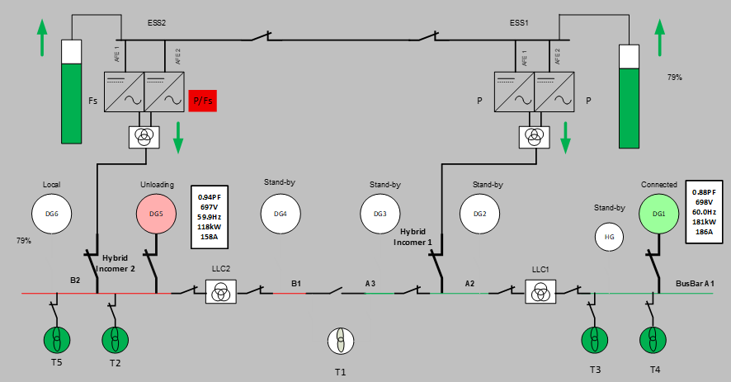
When DG5 has unloaded down to 100 kW, the Power Management System (PMS) will disconnect DG5 from the switchboard. ESS2 is then remaining in “Fs” mode and maintaining the frequency of the system and supplying the necessary power.
The timing issue uncovered in the code caused the ESS to temporarily change from “Frequency mode” to “Power mode” when the last connected generator goes from “Unloading” to “Disconnected”.
The event duration changed from during simulator testing, based on the cycle time in the PLCs. During some tests it was not observed, and in other tests it was clearly observed. When the switch occurred, there was not anything maintaining the correct frequency on the system and the frequency would start to drop. When ESS then switches back to “Frequency mode”, it will experience an undershoot of the frequency and try and restore the correct frequency.
4 Conclusion
A correction in the EMS programs was made and tested in the simulator, prior to the technician visiting the vessel.
The scenario was re-tested at quay side before any corrections to the system were made. During testing it was noticed that ESS2 AFE2 switched from “Frequency mode” to “Power mode” when DG5 went from “Unloading” to “Disconnected”, but ESS2 AFE1 remained in “Frequency mode”. This indicated the timing issue were not only happening in the simulator, but also onboard. Though they were unable to replicate the full extent of the event where the HSS incomer breaker tripped, it was enough to prove the theory.
Adjustments were made in line with what had been discovered at the simulator and confirmed onboard.
Corrected the +V108 and +V128 GPU parameter according to the Protection setting table:
+V108 (ESS1) – ML-1210 – Gen high-frequency 1 – 110% – 1.5 s – Disabled
+V108 (ESS1) – ML-1240 – Gen low-frequency 1 – 90% 1 s – Disabled
+V128 (ESS2) – ML-1210 – Gen high-frequency 1 – 110% – 1.5 s – Disabled
+V128 (ESS2) – ML-1240 – Gen low-frequency 1 – 90% 1 s – Disabled
Finally the AFE unloading limit was adjusted from 25 kW to 50 kW to improve reliability. All generators have a 100kW limit before opening the switchboard breakers. The hybrid system had been previously adjusted to 50 kW, therefore it was adjusted to 100 kW to correspond with the generator limits.
The vessel has been operating for over four years with an ESS and it was normal operation for the vessel to operate in DP in the Hybrid configuration. The event showed that faults in settings can lie undetected for years of operation but may eventually show themselves. Full testing and checking of all settings is imperative, especially when systems are updated or retrofitted, not only by the OEM but by the vessel operators, so they know their vessel’s workings inside and out.
Latest DP incidents
-
Know your equipment, or at least where to find the answers
During an update in the Follow Target Mode, the crew noticed an anomaly with joystick control.
DPE 02/26
1 September 2026
Observation
-
New equipment, unexpected consequences
During the operation, a loss of DGNSS correction signals was experienced across multiple vessel DGNSS units.
DPE 02/26
1 September 2026
Incident
-
A chain of small failures leads to a major consequence
While conducting cargo operations on DP a vessel experienced a partial blackout caused by an unexpected shutdown of generator 3
DPE 02/26
1 September 2026
Incident
-
Holding position, losing references
While approaching a turret-moored, weather-vaning offshore installation (FPSO), in preparation for cargo operations, a DP equipment class 2 vessel experienced significant rolling of up to 15–20° due to a long-period swell close to the vessel’s natural roll period, resulting in a resonance effect
DPE 02/26
1 September 2026
Observation
-
DP drill scenario – Loss of seawater cooling pump redundancy
Exercise scenario – Loss of seawater cooling pump redundancy
DPE 02/26
1 September 2026
Drill Scenario
The case studies and observations above have been compiled from information received by IMCA. All vessel, client, and operational data has been removed from the narrative to ensure anonymity. Case studies are not intended as guidance on the safe conduct of operations, but rather to assist vessel managers, DP operators, and technical crew.
IMCA makes every effort to ensure both the accuracy and reliability of the information, but it is not liable for any guidance and/or recommendation and/or statement herein contained.
Any queries should be directed to DP team at IMCA. Share your DP incidents with IMCA online. Sign-up to receive DP event bulletins straight to your email.