Inadequate shallow water lay-up reactivation procedures
- DP Event
- Published on 30 November 2018
- Generated on 29 October 2026
- DPE 04/18
- 1 minute read
Undesired event
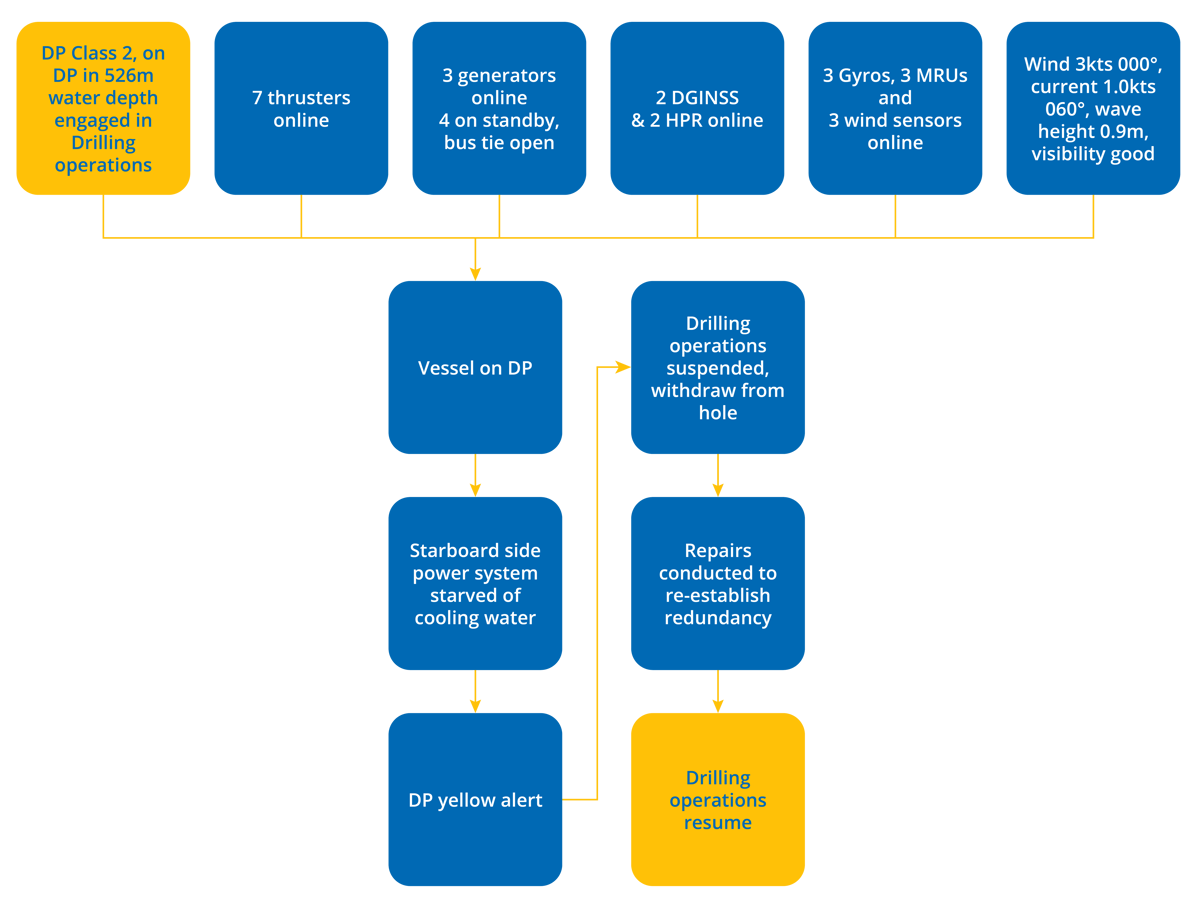
The heat exchange system was poorly designed, without redundancy for half the switchboard. This was compounded by turbidity and silt in the cooling system.
Comments
The heat exchange system is poorly designed and without redundancy for half of the switchboard. Design flaws were compounded by the introduction of turbidity and silt into the cooling system.
The vessel was idle for some time in shallow water and the systems were not adequately preserved.
There was biological fouling taking place on the heat exchangers. Although multiple heat exchanger cleanings had occurred, the system was not adequately flushed to remove the fouling.
Considerations
- The report indicates that although the cooling systems were cleaned prior to reactivation they had not been properly flushed and were therefore unable to perform to full capacity.
- It is important that all redundant systems are able to perform to full capacity following loss of a redundant group. If not, there is a potential to exceed the WCFDI following a failure.
- Performance tests should be part of the reactivation procedures after an idle period in shallow water.
Latest DP incidents
-
The domino effect
The event demonstrates the importance of maintaining the approved DP power configuration, addressing known defects before equipment is relied upon during DP operations, and ensuring DP personnel understand how changes to the generating arrangement can affect redundancy and failure propagation
DPE 03/26
19 October 2026
Incident
-
Lost in calibration
During activity associated with calibration of a vessel Vertical Reference Unit (VRU), the DP control system experienced degradation of its attitude reference arrangement. Shortly afterwards, the vessel generated an Off Position Warning followed by an Off Position Alarm
DPE 03/26
19 October 2026
Incident
-
Watch what you are pressing
While transiting away from a wind farm, the Master of a DP equipment class 2 vessel observed that the vessel was operating in Backup Mode and queried this with the bridge team and attending electrician
DPE 03/26
19 October 2026
Incident
-
DP drill scenario – Consequence Analysis Class DP2 & DP3
DP drill scenario – Consequence Analysis Class DP2 & DP3
DPE 03/26
19 October 2026
Drill Scenario
-
The UPS and downs
While a vessel was transiting in DP mode, the DPO observed the loss of Gyros 2 and 3 together with alarms from a 230V backup power supply. The telephone system remained powered but was inoperable.
DPE 03/26
19 October 2026
Incident
The case studies and observations above have been compiled from information received by IMCA. All vessel, client, and operational data has been removed from the narrative to ensure anonymity. Case studies are not intended as guidance on the safe conduct of operations, but rather to assist vessel managers, DP operators, and technical crew.
IMCA makes every effort to ensure both the accuracy and reliability of the information, but it is not liable for any guidance and/or recommendation and/or statement herein contained.
Any queries should be directed to DP team at IMCA. Share your DP incidents with IMCA online. Sign-up to receive DP event bulletins straight to your email.