Load sharing imbalance causes loss of position
- DP Event
- Published on 29 March 2017
- Generated on 21 September 2026
- DPE 01/17
- 2 minute read
Incident
The vessel’s DP operations manual and well specific operating guidelines (WSOG) must be questioned.
Comments
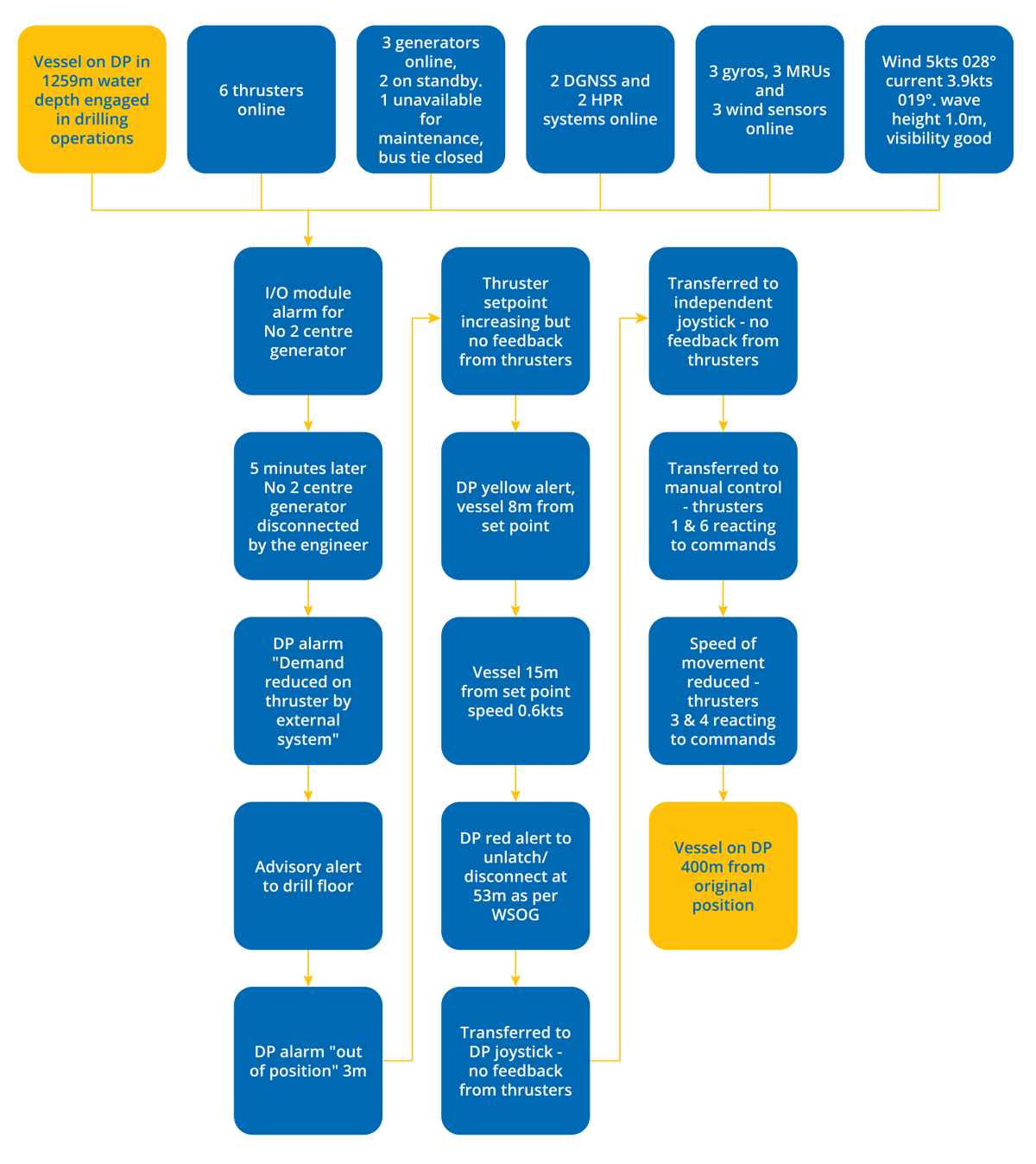
The power plant was configured to work in closed bus mode. No.2 port, No.2 centre and No.2 starboard generator were online. No.1 port and No.1 centre generator were on standby. No.1 starboard generator was on long term isolation due to turbocharger overhaul.
The vessel’s power management system (PMS) developed a fault in an I/O module for No.2 centre generator. This fault caused the generator circuit breaker status to freeze in the ‘closed’ position. The alarm indicated a generator fault causing the engineer to disconnect the faulty generator.
The breaker opened on the generator and due to the fault on the I/O module the status of the breaker was still showing connected and a load sharing imbalance was noticed by the PMS which attempted to correct it. As the disconnected generator could not take any load, the imbalance persisted and the PMS drove the bus frequency down to the point where it triggered the frequency based thrust limitation function on all thrusters leading to loss of position and an emergency disconnect.
Considerations
- It is recommended that the failure modes and effects analysis (FMEA) should consider the PMS interface so that this type of failure mode is identified.
- It would appear the PMS was not properly tested for operations in closed bus tie operations.
- The fact that frequency issues occurred suggests advance generator protection was either not present or not functioning correctly.
- The vessel’s DP operations manual and well specific operating guidelines (WSOG) must be questioned.
- The value of the current factor (3.9kts) should be questioned.
- It should be noted that when thrusters are operated via the IJS they are still under the control of the PMS.
Latest DP incidents
-
Know your equipment, or at least where to find the answers
During an update in the Follow Target Mode, the crew noticed an anomaly with joystick control.
DPE 02/26
1 September 2026
Observation
-
New equipment, unexpected consequences
During the operation, a loss of DGNSS correction signals was experienced across multiple vessel DGNSS units.
DPE 02/26
1 September 2026
Incident
-
A chain of small failures leads to a major consequence
While conducting cargo operations on DP a vessel experienced a partial blackout caused by an unexpected shutdown of generator 3
DPE 02/26
1 September 2026
Incident
-
Holding position, losing references
While approaching a turret-moored, weather-vaning offshore installation (FPSO), in preparation for cargo operations, a DP equipment class 2 vessel experienced significant rolling of up to 15–20° due to a long-period swell close to the vessel’s natural roll period, resulting in a resonance effect
DPE 02/26
1 September 2026
Observation
-
DP drill scenario – Loss of seawater cooling pump redundancy
Exercise scenario – Loss of seawater cooling pump redundancy
DPE 02/26
1 September 2026
Drill Scenario
The case studies and observations above have been compiled from information received by IMCA. All vessel, client, and operational data has been removed from the narrative to ensure anonymity. Case studies are not intended as guidance on the safe conduct of operations, but rather to assist vessel managers, DP operators, and technical crew.
IMCA makes every effort to ensure both the accuracy and reliability of the information, but it is not liable for any guidance and/or recommendation and/or statement herein contained.
Any queries should be directed to DP team at IMCA. Share your DP incidents with IMCA online. Sign-up to receive DP event bulletins straight to your email.