Thruster fault
- DP Event
- Published on 30 June 2016
- Generated on 12 August 2026
- DPE 02/16
- 1 minute read
Undesired event
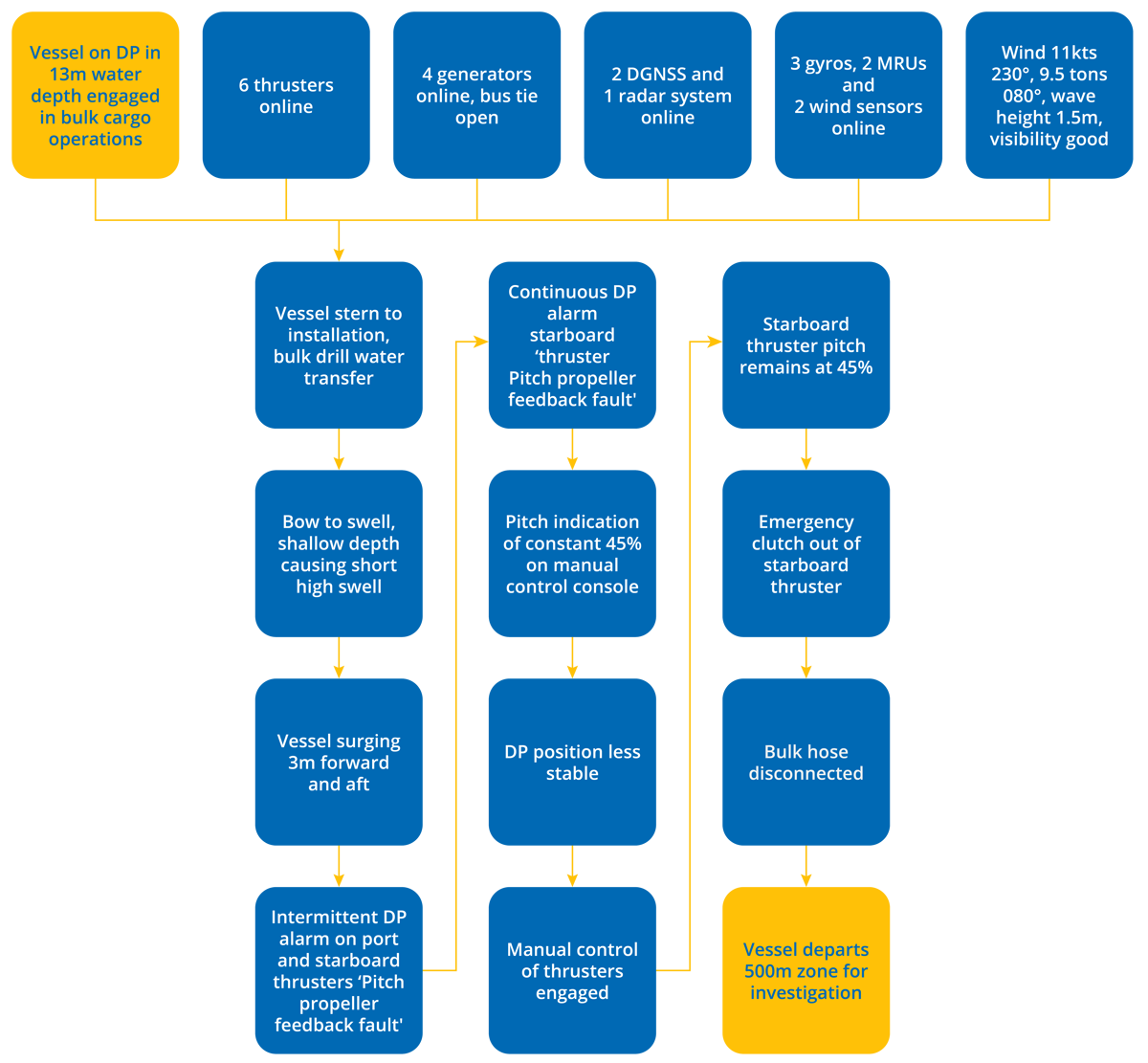
All available means should be used to identify the faulty thruster and then shut it down, as deselecting it from the DP system might not be effective.
Considerations
- All available means should be used to identify the faulty thruster and then shut it down, as deselecting it from the DP system might not be effective.
- Depending on the time frame, it is recommended that the bulk transfer hose is disconnected prior to engaging manual control of thrusters.
- It should be noted that on a vessel that utilises main propellers for DP, pitch should fail safe to zero. This is because the second propeller, working astern, would not be able to compensate for the erroneous thruster working ahead.
Latest DP incidents
-
Think twice. Press once!
On a DP equipment class 2 supply vessel engaged in drilling, an incident occurred due to lack of operational knowledge
DPE 01/26
11 May 2026
Incident
-
Network issues, not a thing of the past
A DP equipment class 3 vessel was engaged in saturation diving activities, with two divers in the water when this DP incident occurred.
DPE 01/26
11 May 2026
Incident
-
All swept up
A DP equipment class 2 vessel was engaged in rock placement operations, within close proximity to a structure, when this event occurred.
DPE 01/26
11 May 2026
Undesired event
-
Hybrid system won't accept load
A DP equipment class 2 vessel was engaged in operations whilst holding position on auto DP, when this undesired event occurred
DPE 01/26
11 May 2026
Undesired event
-
DP drill scenario – Loss of main DP system UPS
The objective of this scenario is to identify risks and impacts of losing the main DP system uninterruptible power supply, possibilities to reduce that risk and suitable actions to be taken if such an occurrence happened.
DPE 01/26
11 May 2026
Drill Scenario
The case studies and observations above have been compiled from information received by IMCA. All vessel, client, and operational data has been removed from the narrative to ensure anonymity. Case studies are not intended as guidance on the safe conduct of operations, but rather to assist vessel managers, DP operators, and technical crew.
IMCA makes every effort to ensure both the accuracy and reliability of the information, but it is not liable for any guidance and/or recommendation and/or statement herein contained.
Any queries should be directed to DP team at IMCA. Share your DP incidents with IMCA online. Sign-up to receive DP event bulletins straight to your email.