Worn components create unwanted thrust
- DP Event
- Published on 25 August 2021
- Generated on 15 March 2026
- DPE 03/21
- 2 minute read
Incident
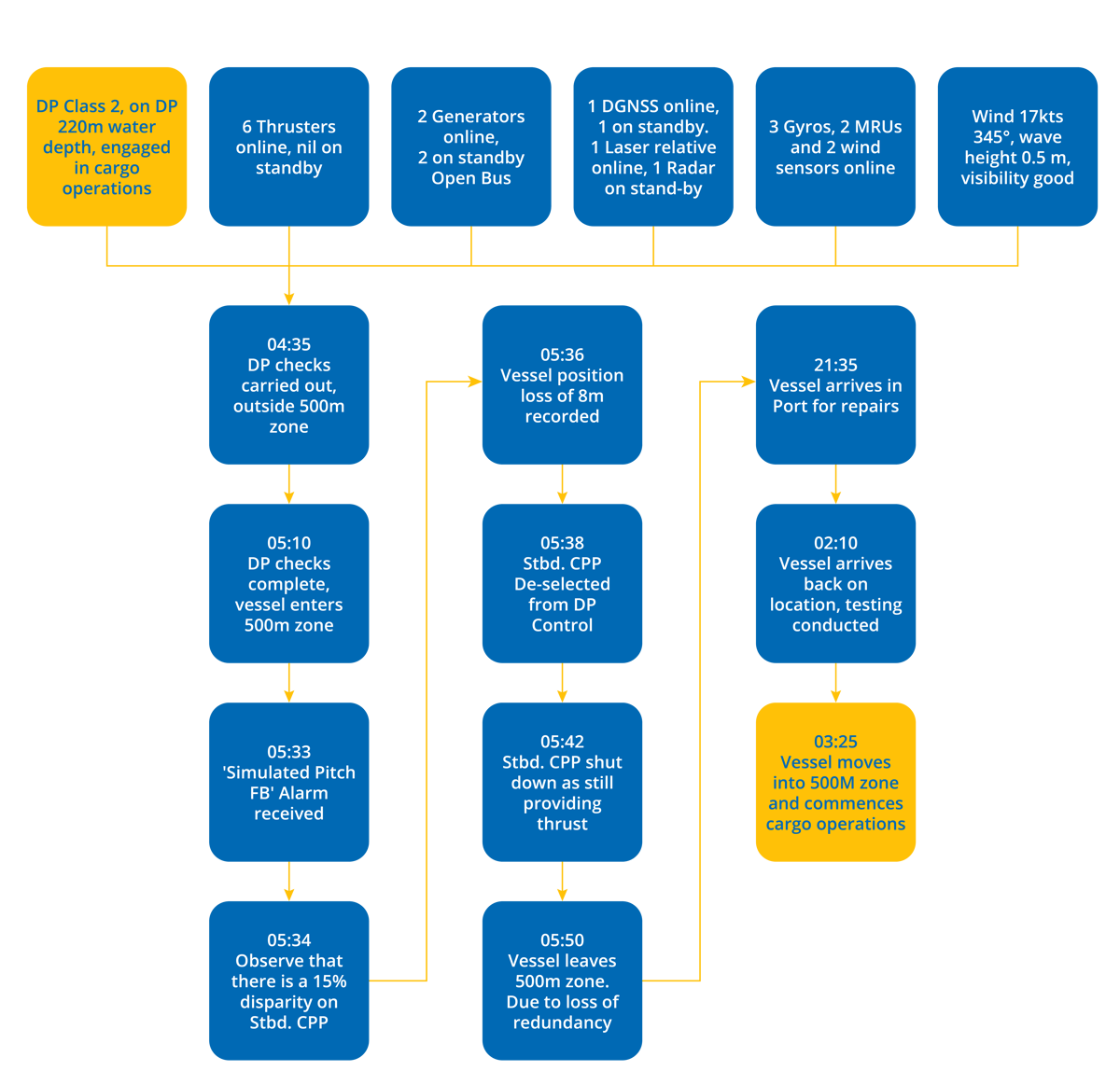
A worn key within the coupling of the step motor caused unwanted travel of the thruster pitch. The vessel was forced to return to port.
Comments
It was found that a worn key within the coupling of the step motor (providing feedback) caused unwanted travel of the thruster pitch. The vessel was forced to return to port to source a spare part, a ‘used but good’ part was located and fitted.
Considerations
- In most direct driven CPP systems there are some failures that can lead to uncontrolled thrust and the
emergency stop needs to be employed by the DPO, before the excursion becomes too significant. DPOs should not hesitate to use the emergency stop on thrusters if thruster alarms indicate a thruster control issue. - Use of a “second hand” part might be acceptable as a temporary stop gap measure, provided that the part is still within specification.
- This event highlights the need to annually check and test controllable pitch propellers.
IMCA M190 Chapter 4.0 Paragraph 4.10:
“There are many ways in which a variable speed thruster can fail, but the failure effects are generally safe. For vessels with variable speed thrusters of proven reliability, it may be acceptable to carry out the control loop wire break tests on a rolling programme where all tests are carried out over a five-year period. Controllable pitch propellers should be tested annually.“ - Although not related to the event, the number of references is inadequate. IMO MSC Circ. 645, IMO MSC.1 Circ. 1580, and IMCA M252, Guidance on position reference systems and sensors for DP operations guidance documents state that for DP 2 or 3 operations:
“There is a requirement for three independent position references based on two different principles to be simultaneously available during operation.”
Latest DP incidents
-
Simultaneous Operations
A DP Incident report highlighting the importance of maintaining focus during time on the DP desk
DPE 03/25
18 December 2025
Incident
-
Importance of familiarisation and paying attention
The importance of maintaining full attention during the operator's time on the DP desk can never be underestimated, or forgotten
DPE 03/25
18 December 2025
Incident
-
Worst case failure preparedness
Operators must be prepared for worst case failures
DPE 03/25
18 December 2025
Incident
-
Know your settings
This Dynamic Positioning (DP) incident involved a DP equipment class 2 offshore supply vessel (OSV) during loadout operations from a drilling rig.
DPE 03/25
18 December 2025
Incident
-
DP drill scenario
DP emergency drill scenarios are included to assist DP vessel management and DPOs / Engineers and ETOs to conduct DP drills onboard.
DPE 03/25
18 December 2025
Drill Scenario
The case studies and observations above have been compiled from information received by IMCA. All vessel, client, and operational data has been removed from the narrative to ensure anonymity. Case studies are not intended as guidance on the safe conduct of operations, but rather to assist vessel managers, DP operators, and technical crew.
IMCA makes every effort to ensure both the accuracy and reliability of the information, but it is not liable for any guidance and/or recommendation and/or statement herein contained.
Any queries should be directed to DP team at IMCA. Share your DP incidents with IMCA online. Sign-up to receive DP event bulletins straight to your email.