Fall from height during mooring due to rope tension reaction
- Safety Flash
- Published on 13 February 2026
- Generated on 27 September 2026
- IMCA SF 03/26
- 2 minute read
Rope became entangled with the propellor during mooring operations of a tanker causing the operator to lose balance and fall onto the lower platform.
What happened?
During mooring operations of a tanker, a worker ashore was securing the after-spring line on a Quick Release Mooring Hook (QRMH) located on a dolphin platform on the jetty. While performing the task, some rope slack remained near the propeller. The rope became entangled with the propellor, creating over-tension as it was already secured to the QRMH. The dolphin platform bent towards the vessel’s aft under the propeller’s force until the line parted. It then snapped back in the opposite direction, causing the operator to lose balance and fall onto the lower platform about 1.8 meters below. Although fall protection was in place, the operator was kneeling and slipped through the gap. Fortunately, the incident resulted only in minor scratches and no serious injury.
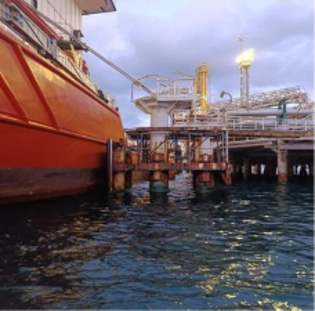 |
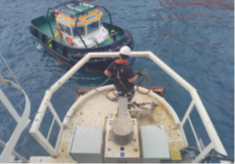 |
| The dolphin platform from astern | Overhead view of the dolphin platform |
What went wrong?
- Rope slack was left near the vessel’s propeller during mooring.
- Propeller movement created an unexpected load on the mooring line.
- The worker’s position (kneeling) reduced stability and escape reaction time.
- The fall protection barrier height (approximately 1.5 m) was insufficient to prevent a fall from kneeling position.
- Communication and coordination between pilot and mooring crew could have been more effective.
What are the lessons?
- Maintain clear communication between the vessel bridge, pilot, and mooring teams.
- Do not allow mooring lines to remain slack or close to the propeller.
- Use Stop Work Authority if there isn’t sufficient communication to understand what is going on.
- Keep out of the snap back zone when mooring ropes are under tension.
Actions taken
- Improve fall-protection design in this context, to cover kneeling positions.
- Reinforced awareness training on safe body positioning and balance during line handling.
Members may wish to refer to:
Related Safety Flashes
-
IMCA SF 21/25
17 November 2025
-
-
IMCA SF 12/14
14 July 2014
IMCA Safety Flashes summarise key safety matters and incidents, allowing lessons to be more easily learnt for the benefit of the entire offshore industry.
The effectiveness of the IMCA Safety Flash system depends on the industry sharing information and so avoiding repeat incidents. Incidents are classified according to IOGP's Life Saving Rules.
All information is anonymised or sanitised, as appropriate, and warnings for graphic content included where possible.
IMCA makes every effort to ensure both the accuracy and reliability of the information shared, but is not be liable for any guidance and/or recommendation and/or statement herein contained.
The information contained in this document does not fulfil or replace any individual's or Member's legal, regulatory or other duties or obligations in respect of their operations. Individuals and Members remain solely responsible for the safe, lawful and proper conduct of their operations.
Share your safety incidents with IMCA online. Sign-up to receive Safety Flashes straight to your email.