Person fell in engine room and injured head
- Safety Flash
- Published on 6 March 2025
- Generated on 20 October 2026
- IMCA SF 04/25
- 2 minute read
An oiler sustained head injuries while working alone in the engine room.
What happened?
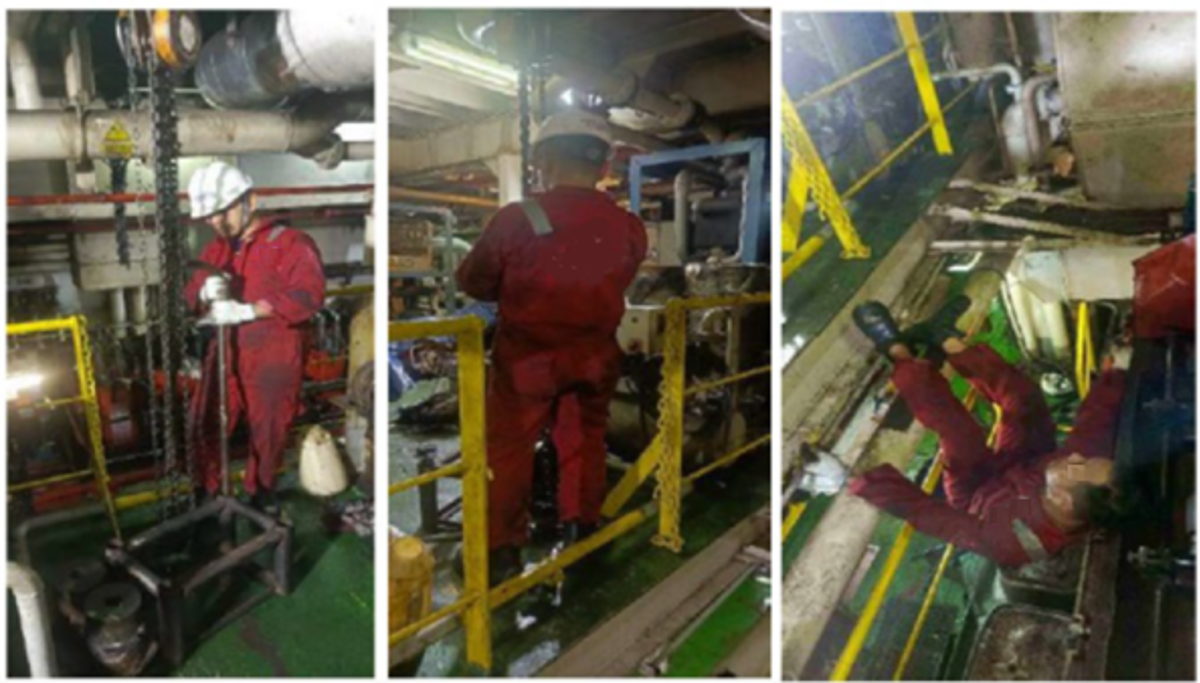
An oiler was injured when working alone in the engine room. He was moving a heavy cylinder head into position so that it could be lifted using a chain block. He used a pipe to pivot the cylinder to move it. At the same time, he was standing in an elevated area and his back was facing a lower area. The pipe he was holding to move the cylinder slipped and he fell backwards. He sustained head injuries.
What went wrong, what was the cause?
The complexity and seriousness of the task, and the potential for injury in doing it alone, were underestimated.
- The person had performed similar tasks many times before and felt that he could do the job on his own.
- There was no barrier behind him when he was working on an unprotected elevated area.
- The pipe used to lever the cylinder head was significantly smaller than the cylinder head hole and was not fully inserted.
- There was no on-site toolbox talk conducted for this activity to identify the potential hazard.
What were the lessons and actions?
- Never let familiarity of the job led to complacency, always follow safety protocols, even for tasks that seem routine.
- Avoid working alone where possible - work with a buddy on tasks that require it.
- Barrier off elevated areas so that no one CAN fall from them.
- Our member reiterated to their crews, the concept of the Toolbox talk. The Toolbox talk is of vital importance in improving safety and they are to be taken seriously, whether for routine or non-routine tasks.
Members may wish to refer to:
Related Safety Flashes
-
IMCA SF 11/12
26 October 2012
-
IMCA SF 27/21
1 October 2021
-
IMCA Safety Flashes summarise key safety matters and incidents, allowing lessons to be more easily learnt for the benefit of the entire offshore industry.
The effectiveness of the IMCA Safety Flash system depends on the industry sharing information and so avoiding repeat incidents. Incidents are classified according to IOGP's Life Saving Rules.
All information is anonymised or sanitised, as appropriate, and warnings for graphic content included where possible.
IMCA makes every effort to ensure both the accuracy and reliability of the information shared, but is not be liable for any guidance and/or recommendation and/or statement herein contained.
The information contained in this document does not fulfil or replace any individual's or Member's legal, regulatory or other duties or obligations in respect of their operations. Individuals and Members remain solely responsible for the safe, lawful and proper conduct of their operations.
Share your safety incidents with IMCA online. Sign-up to receive Safety Flashes straight to your email.