Towing wire parted
- Safety Flash
- Published on 3 March 2026
- Generated on 3 March 2026
- IMCA SF 04/26
- 2 minute read
A vessel was towing a barge when the towing wire parted.
What happened?
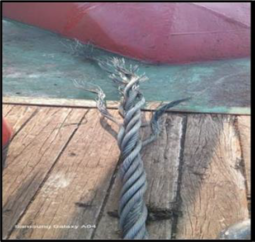
A vessel was towing a barge when the towing wire parted. Earlier on the same day, the same towing wire had snagged and was damaged. The damaged wire was reused for towing and eventually parted during manoeuvring.
What went right?
- The crew switched to the alternative work wire, allowing the towing operation to continue safely.
- Drug and Alcohol tests for the involved personnel were negative, and all crew had sufficient rest hours.
What went wrong?
- The towing wire was too long (150–180 m) for the shallow water depth of around 25m, which meant it sagged and dragged along the seabed, causing damage to the wire.
- The snagging caused significant damage to about 30 m of the wire, and the damaged wire continued to be used rather than being removed or replaced.
Lessons to be learnt
- Towing wires should be of an appropriate length for the waters in which they are used. Shorter wires should be used in shallow water to prevent contact with the seabed.
- Continuing to work with damaged equipment might appear to be a useful short-cut to save time and money, but can go seriously wrong. Stop and fix damaged equipment before continuing.
Related Safety Flashes
-
IMCA SF 03/15
3 March 2015
-
IMCA SF 29/17
7 November 2017
IMCA Safety Flashes summarise key safety matters and incidents, allowing lessons to be more easily learnt for the benefit of the entire offshore industry.
The effectiveness of the IMCA Safety Flash system depends on the industry sharing information and so avoiding repeat incidents. Incidents are classified according to IOGP's Life Saving Rules.
All information is anonymised or sanitised, as appropriate, and warnings for graphic content included where possible.
IMCA makes every effort to ensure both the accuracy and reliability of the information shared, but is not be liable for any guidance and/or recommendation and/or statement herein contained.
The information contained in this document does not fulfil or replace any individual's or Member's legal, regulatory or other duties or obligations in respect of their operations. Individuals and Members remain solely responsible for the safe, lawful and proper conduct of their operations.
Share your safety incidents with IMCA online. Sign-up to receive Safety Flashes straight to your email.