MSF: High potential near miss during FRC maintenance
- Safety Flash
- Published on 24 March 2026
- Generated on 27 September 2026
- IMCA SF 06/26
- 2 minute read
The Marine Safety Forum (MSF) has published Safety Alert 26-01 relating to an incident where there was an unplanned lowering of an FRC to the sea, and two crew members needed to jump clear.
What happened?
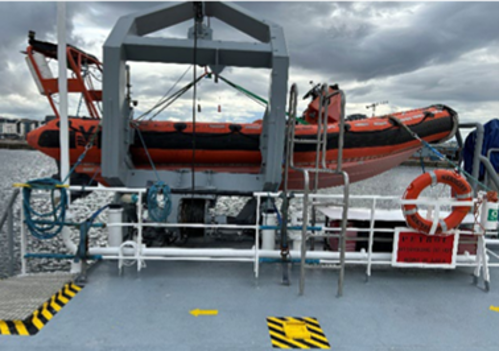
On a vessel, work was being conducted on a change-out of lifting slings on one of the Fast Rescue craft (FRC). This was considered a routine task that had been conducted many times at sea before, and it all appeared to be going well. During the change out of the lifting slings the FRC slipped from the davit cradle whilst two crew members were actually onboard the boat. The FRC went into an uncontrolled descent to sea with both crew members having to jump into the water clear of the falling boat. Both persons were recovered unharmed.
What went wrong?
- It was found that the FRC was only secured by the aft bowsing line;
- As the FRC came clear of the davit and started to fall, the stainless steel carabiner on the aft bowsing line failed.
- The task could have been planned and executed much better:
- Whilst it was considered a routine task, there was no written or formal procedure, and no risk assessment.
- Whilst a Toolbox talk was undertaken, this did not fully cover all the aspects of the work to be undertaken;.
- There ought have been a Permit to Work.
- The work was originally planned for the afternoon watch, however at short notice it was decided to attempt to try and complete the task in the morning.
Lessons to learn
- This was a complex and multi-faceted operation, with many different aspects; it ought not have been considered a “routine task”.
- Review all tasks that you consider to be routine, take the time to review and observe, don’t ever accept ‘we have always done it this way’ There might just be a safer alternative.
- Question complacency: “This is the way that we have always done it”? It’s OK to feel uneasy and uncomfortable about a task, and if necessary, STOP THE JOB.
- Did the task have to be conducted at sea? Could it have been done later when alongside?
In this case, one of the vessel owner’s actions was - don’t change FRC slings or davit wires while at sea.
Related Safety Flashes
-
IMCA SF 16/19
5 July 2019
-
-
IMCA SF 11/21
16 April 2021
-
IMCA Safety Flashes summarise key safety matters and incidents, allowing lessons to be more easily learnt for the benefit of the entire offshore industry.
The effectiveness of the IMCA Safety Flash system depends on the industry sharing information and so avoiding repeat incidents. Incidents are classified according to IOGP's Life Saving Rules.
All information is anonymised or sanitised, as appropriate, and warnings for graphic content included where possible.
IMCA makes every effort to ensure both the accuracy and reliability of the information shared, but is not be liable for any guidance and/or recommendation and/or statement herein contained.
The information contained in this document does not fulfil or replace any individual's or Member's legal, regulatory or other duties or obligations in respect of their operations. Individuals and Members remain solely responsible for the safe, lawful and proper conduct of their operations.
Share your safety incidents with IMCA online. Sign-up to receive Safety Flashes straight to your email.