MAIB: Catastrophic engine failure and subsequent fire
- Safety Flash
- Published on 23 July 2026
- Generated on 21 October 2026
- IMCA SF 13/26
- 2 minute read
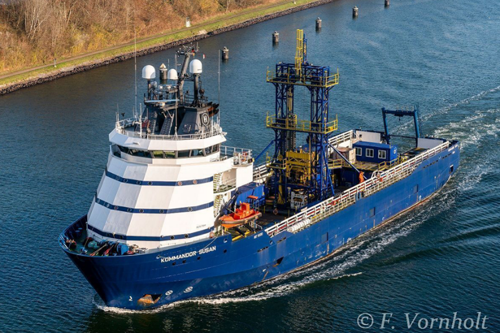
The UK’s Marine Accident Investigation Branch (MAIB) has published Accident Investigation Report 10/2026 into a catastrophic failure of a diesel generator engine on board the vessel Kommandor Susan.
What happened?
The site investigation vessel Kommandor Susan suffered a catastrophic failure of a diesel generator engine while conducting sea trials. The failure resulted in an engine room fire and a complete power blackout. The crew responded promptly, extinguishing the fire and mustering safely. The vessel lost propulsion and began drifting eastwards. Attempts to deploy anchors were unsuccessful because the anchor winches required electrical power to operate. Kommandor Susan was eventually returned to harbour with limited propulsion restored. There were no injuries.
What went wrong?
- The investigation found that the engine failure was caused by premature wear of bearings fitted during a major overhaul in 2019.
- These components were not approved by the engine original equipment manufacturer and exhibited weaker material bonding than genuine parts.
- The extended service intervals applied to the engines were valid only for original equipment manufacturer components, making the use of substitute parts a critical factor in the failure.
- The vessel’s former owner had minimal oversight of the overhaul process and assumed that original equipment manufacturer parts were used. This lack of verification meant that the presence of substitute components remained undiscovered and was not communicated to subsequent owners.
- Additionally, the vessel’s anchoring procedure did not account for the risk of power loss, leaving the anchors inoperable during the emergency.
Learnings
The MAIB notes that there was “a shortfall in oversight and contractor assurance by the vessel owner during overhaul, which allowed the non-genuine components to be installed.”
- Are parts and components used in critical systems approved by the original equipment manufacturer?
- Could there be unseen or unnoticed gaps in oversight or assurance of parts, components, processes and procedures?
- This may be particularly important where there has been a change of ownership, change of contract, or where responsibility and liability is shared by multiple entities – for example on a chartered vessel.
- Are risk assessments thorough enough to cover less likely but potentially very serious scenarios?
Related Safety Flashes
-
IMCA SF 24/24
17 December 2024
IMCA Safety Flashes summarise key safety matters and incidents, allowing lessons to be more easily learnt for the benefit of the entire offshore industry.
The effectiveness of the IMCA Safety Flash system depends on the industry sharing information and so avoiding repeat incidents. Incidents are classified according to IOGP's Life Saving Rules.
All information is anonymised or sanitised, as appropriate, and warnings for graphic content included where possible.
IMCA makes every effort to ensure both the accuracy and reliability of the information shared, but is not be liable for any guidance and/or recommendation and/or statement herein contained.
The information contained in this document does not fulfil or replace any individual's or Member's legal, regulatory or other duties or obligations in respect of their operations. Individuals and Members remain solely responsible for the safe, lawful and proper conduct of their operations.
Share your safety incidents with IMCA online. Sign-up to receive Safety Flashes straight to your email.