Hydraulic oil leak detected below moonpool
- Safety Flash
- Published on 1 October 2026
- Generated on 1 October 2026
- IMCA SF 17/26
- 2 minute read
During operations on a pipelay/construction vessel, a hydraulic oil leak was identified below the moonpool after the worktable doors were opened.
What happened?
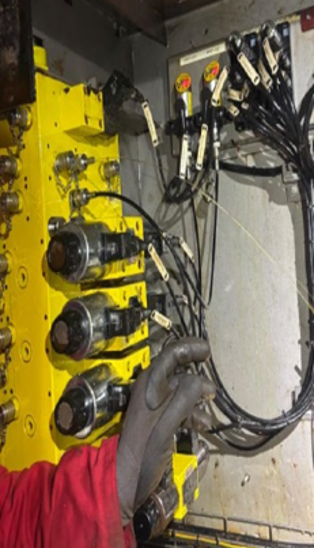
Operations were immediately stopped, and the main hydraulic power unit (HPU) was shut down and isolated. Investigation identified the source of the leak as a failed “minimess” monitoring hose at the termination/crimp fitting within the aft worktable door hydraulic control cabinet. Review of Supervisory Control and Data Acquisition (SCADA) data indicated a minor low-pressure alarm had activated earlier. However, visual inspection of the area below the moonpool doors had not been possible at that stage. It is estimated that approximately 185 litres of hydraulic oil were released during the event, of which approximately 35 litres were recovered, resulting in a confirmed loss of approximately 150 litres to sea.
Why did it happen?
- Asset lifecycle gaps: “Minimess” monitoring hoses of the kind that failed were not explicitly included within the flexible hose lifecycle management strategy and were treated as permanent fittings rather than consumable pressure retaining components.
- Inspection limitations: Routine planned maintenance consisted of visual inspection and torque checks only and could not verify hose crimp or termination integrity, the critical failure point.
- System configuration constraints: The hydraulic cabinet is inaccessible when the moonpool doors are closed, limiting early verification of alarm conditions during critical operations.
- Detection challenges: CCTV image quality, lighting conditions, and workload in the control room made gradual changes below the moonpool difficult to identify until the doors were opened.
Actions
- “Minimess” monitoring hoses were formally classified in the planned maintenance schedule as pressure retaining components with defined replacement intervals, and appropriate amendments were made to vessel procedures.
- An assessment was made of design options to see if it was possible to eliminate these hoses where feasible by direct sensor installation.
- Increased frequency of oil skimmer drills to improve readiness and familiarity with deployment.
Lessons
- Are all pressure retaining hoses clearly identified and managed with defined replacement intervals?
- Do planned maintenance tasks adequately verify critical failure points, not just visible condition?
- Are there operations and places where configuration limits inspection or detection capability?
- Do alarms that are considered “nuisance” or familiar still require escalation when verification is not possible?
- Are your spill response arrangements always appropriate?
Related Safety Flashes
-
IMCA SF 01/24
9 January 2024
-
IMCA SF 24/22
1 November 2022
-
IMCA SF 03/26
13 February 2026
IMCA Safety Flashes summarise key safety matters and incidents, allowing lessons to be more easily learnt for the benefit of the entire offshore industry.
The effectiveness of the IMCA Safety Flash system depends on the industry sharing information and so avoiding repeat incidents. Incidents are classified according to IOGP's Life Saving Rules.
All information is anonymised or sanitised, as appropriate, and warnings for graphic content included where possible.
IMCA makes every effort to ensure both the accuracy and reliability of the information shared, but is not be liable for any guidance and/or recommendation and/or statement herein contained.
The information contained in this document does not fulfil or replace any individual's or Member's legal, regulatory or other duties or obligations in respect of their operations. Individuals and Members remain solely responsible for the safe, lawful and proper conduct of their operations.
Share your safety incidents with IMCA online. Sign-up to receive Safety Flashes straight to your email.