Unsafe Lifting practices during dry dock
- Safety Flash
- Published on 17 September 2025
- Generated on 28 September 2026
- IMCA SF 17/25
- 2 minute read
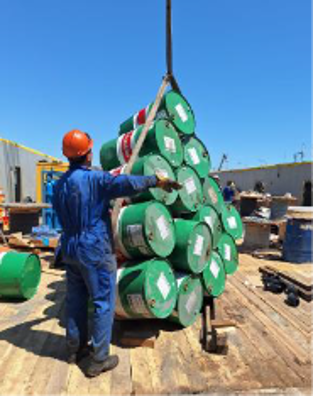
An unsafe attempt was made to lift 14 empty oil drums using only a web sling, without clamps, certified frames, or proper securing.
What happened?
During vessel repairs in a dry-dock, an unsafe attempt was made by employees of a dry-dock contractor to lift 14 empty oil drums using only a web sling, without clamps, certified frames, or proper securing. The job was stopped immediately, and a stand-down was held with contractors and vessel crew to stress safe lifting practices for personnel health and vessel integrity.
Why did it happen?
- Inadequate control of sub-contractors in dry dock
- There was no evidence of effective supervision of the dry dock contract personnel during the lifting operation.
- No detailed risk assessment nor proper toolbox talk (TBT) specific to the lifting task had been conducted. Roles, responsibilities and safe lifting methods were not clearly defined, nor communicated before work started.
- The dry-dock contractor’s lifting team underestimated the hazards associated with lifting unsecured drums. The potential for falling loads was not properly recognized, indicating lack of awareness regarding the consequences of unsafe lifting practices.
Lessons
- Better, more appropriate and closer supervision of lifting activities particularly those carried out by third-party personnel.
- Improve safety awareness and lifting training for dry-dock contractor’s lifting team and other third-party personnel.
- Ensure everyone understands the importance of pre-task risk assessment, toolbox talks and the Stop Work Authority.
Members may wish to refer to:
Related Safety Flashes
-
IMCA SF 10/15
16 July 2015
-
IMCA SF 32/21
25 November 2021
-
IMCA Safety Flashes summarise key safety matters and incidents, allowing lessons to be more easily learnt for the benefit of the entire offshore industry.
The effectiveness of the IMCA Safety Flash system depends on the industry sharing information and so avoiding repeat incidents. Incidents are classified according to IOGP's Life Saving Rules.
All information is anonymised or sanitised, as appropriate, and warnings for graphic content included where possible.
IMCA makes every effort to ensure both the accuracy and reliability of the information shared, but is not be liable for any guidance and/or recommendation and/or statement herein contained.
The information contained in this document does not fulfil or replace any individual's or Member's legal, regulatory or other duties or obligations in respect of their operations. Individuals and Members remain solely responsible for the safe, lawful and proper conduct of their operations.
Share your safety incidents with IMCA online. Sign-up to receive Safety Flashes straight to your email.