High potential near miss – Rescue boat davit failure (MSF)
- Safety Flash
- Published on 4 September 2019
- Generated on 24 September 2026
- IMCA SF 21/19
- 2 minute read
The Marine Safety Forum (MSF) has published Safety Alert 19-07 relating to a rescue boat davit failure during the boat’s periodic launch and testing.
What happened?
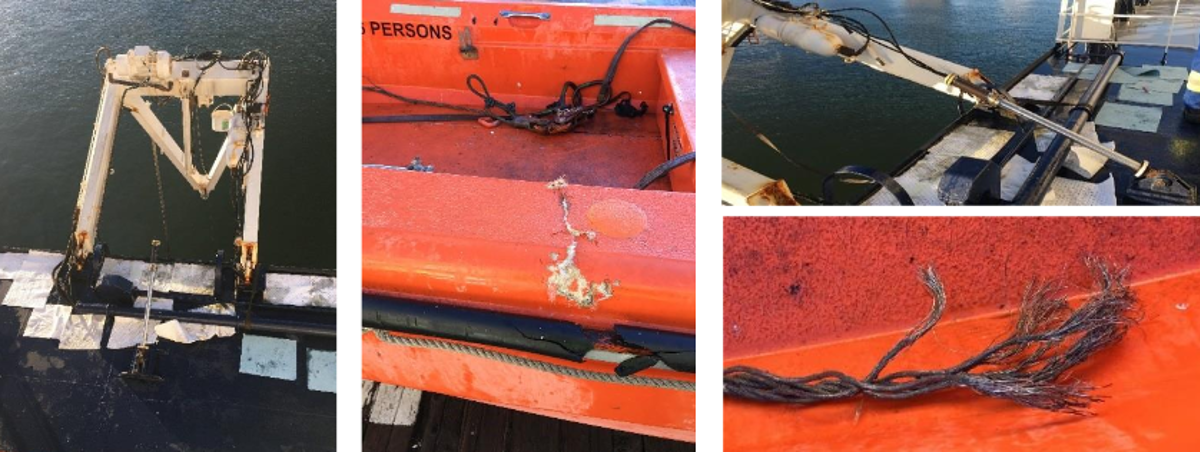
During the swinging out and lowering of the boat, the davit moved uncontrollably to the full extent of the piston, at which point the piston end cap separated from the piston and the davit carried on falling to the deck. On coming to a stop at the deck, the shock loading of the fall wire caused it to part and the rescue boat fell into the water.
There were no injuries as a result of this incident. The MSF notes that that this was due to the good practice of lowering the rescue boat unmanned to function test the davit and associated controls before boarding.
What went wrong?
The davit manufacturer and a local hydraulics expert were both unable to confirm the exact cause of the initial failure - however, a failure of one of the counterbalance valves or failure of the end cap itself were noted as the most probable first point of failure.
What actions were taken? What lessons were learned?
- The vessel owner made it mandatory for vessels to complete an unmanned test lowering of the davit and boat, function testing all controls, before conducting manned launch.
- Replacement of fall wires on rescue boats at 30-month intervals.
- At the five-yearly thorough examination, maintenance and testing of the rescue boat and davit, replacement of the counterbalance valves and piston end cap.
- Review of the maintenance and inspection requirements within vessel planned maintenance system (PMS) to ensure alignment with the manufacturer’s recommendations.
Note: The above actions were applicable to the submitting vessel owner in relation to their own maintenance and use of rescue boats and davits. The MSF recommends that all companies review their own procedures to asses potential for similar incidents.
Related Safety Flashes
-
IMCA SF 14/11
23 December 2011
-
IMCA SF 12/12
14 November 2012
-
IMCA SF 10/09
10 July 2009
IMCA Safety Flashes summarise key safety matters and incidents, allowing lessons to be more easily learnt for the benefit of the entire offshore industry.
The effectiveness of the IMCA Safety Flash system depends on the industry sharing information and so avoiding repeat incidents. Incidents are classified according to IOGP's Life Saving Rules.
All information is anonymised or sanitised, as appropriate, and warnings for graphic content included where possible.
IMCA makes every effort to ensure both the accuracy and reliability of the information shared, but is not be liable for any guidance and/or recommendation and/or statement herein contained.
The information contained in this document does not fulfil or replace any individual's or Member's legal, regulatory or other duties or obligations in respect of their operations. Individuals and Members remain solely responsible for the safe, lawful and proper conduct of their operations.
Share your safety incidents with IMCA online. Sign-up to receive Safety Flashes straight to your email.