Near-miss: corrosion-related failure of bolts used to secure lifeboat winches
- Safety Flash
- Published on 15 December 2015
- Generated on 6 October 2026
- IMCA SF 22/15
- 4 minute read
A member has reported a potentially serious near miss on one of their vessels, involving the lifeboat launching system.
What happened?
The incident concerned the failure of a number of bolts used to secure lifeboat winches to the deck. The use of the associated lifeboats either during trial launch or emergency use could well have resulted in a very serious incident.
During a vessel inspection, a severed bolt was observed in the vicinity of a lifeboat winch foundation plate. It was quickly established that the failed bolt was one of eight bolts forming part of the assembly used to secure the lifeboat winch foundation plate to the deck.
There are four lifeboats on board the vessel, each with a similar winch and foundation arrangement. Further investigation of the first winch foundation plate detected an additional four bolts that were severed but still retained within the foundation assembly – in summary, a total of five out of eight bolts had failed. This prompted an inspection of all the winch foundation units on the remaining lifeboats. On a second lifeboat three out of eight bolts were detected as being severed while still being retained in place on the assembly by the paint coating. The remaining two lifeboat winch foundation assemblies were found to have no bolt failures.
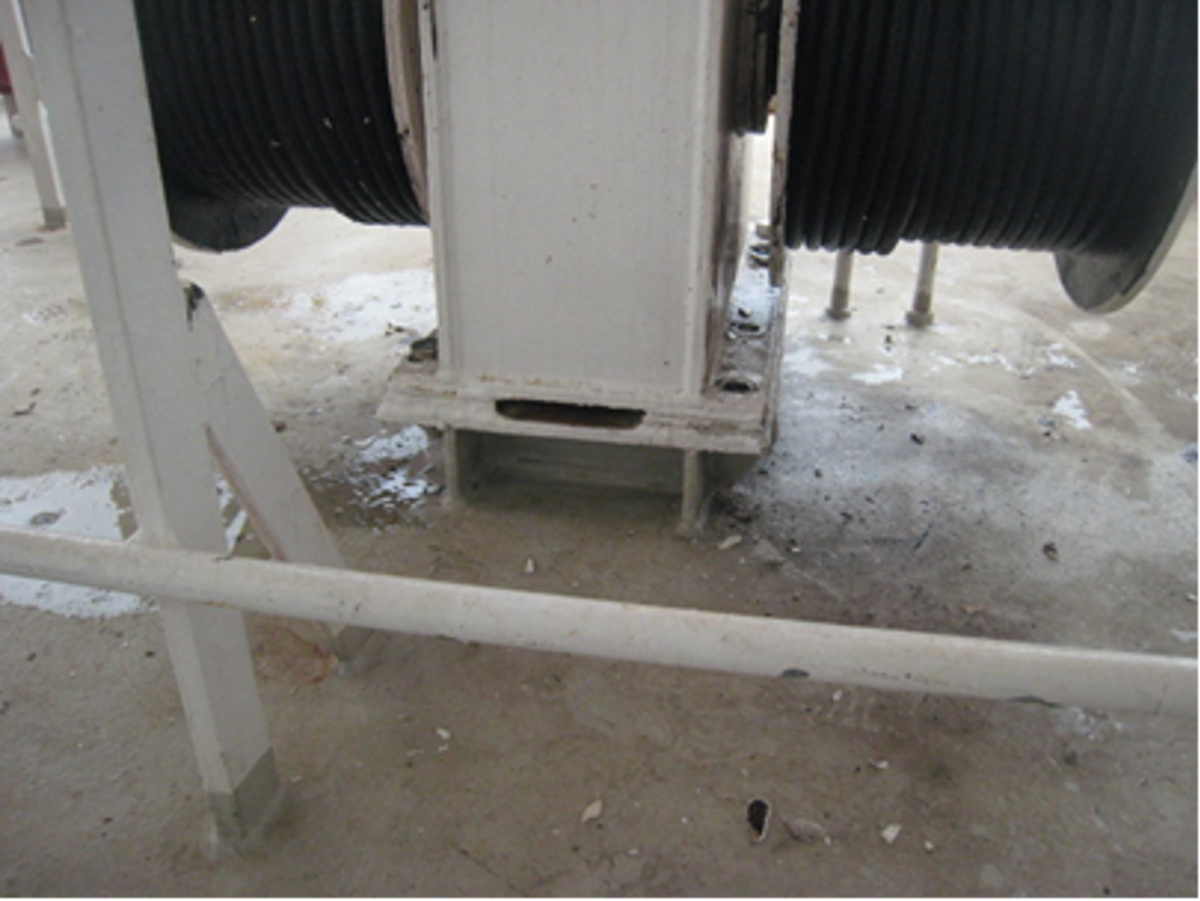
Winch foundation plate assembly (with some failed bolts removed)
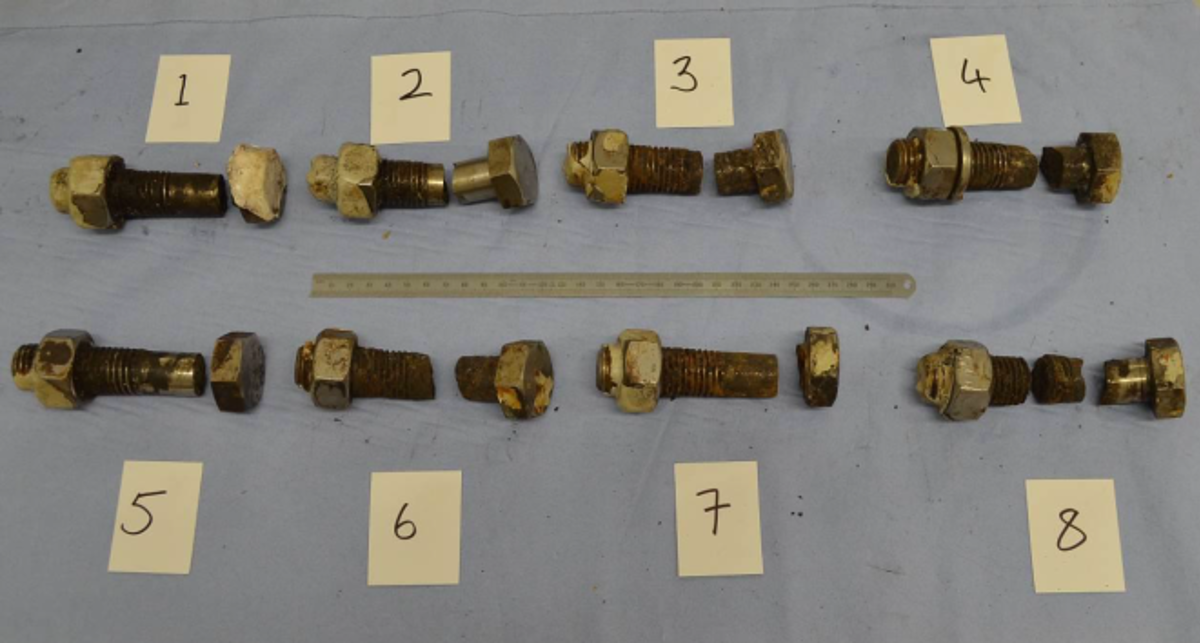
The condition of the severed bolts
Our member noted the following:
- There was no mention of inspection or replacement routines in the lifeboat manual supplied by the ship builder. The inspection and replacement actions outlined herein are now considered prudent by our member
- There was an almost identical failure of bolts identified and reported in a DNV casualty report issued in 2003. In that particular case the winch foundation failed and the lifeboat wires snapped, and a person was seriously injured in the incident.
Our member took the following immediate actions:
- A safety flash was issued to all company vessels instructing them to thoroughly examine similar lifeboat foundation plate hold down bolts
- The vessel on which this incident took place, all foundation hold down bolts on all four lifeboat winch foundations were replaced
- The severed bolts were taken onshore for metallurgical investigation to determine the root cause of the failure
- The ship builder and the supplier of the lifeboats were notified of the incident and invited to participate in the investigation.
A metallurgical investigation was performed by an independent, experienced testing company. Their conclusions are summarised thus:
- The bolts failed as a consequence of intergranular corrosion
- The chromium-manganese alloy from which these bolts were manufactured was not considered a suitable material for bolting in the marine environment
- The carbon content of the alloy used would make the material highly susceptible to grain boundary sensitisation and consequently to intergranular corrosion.
In short, the bolts supplied and installed (which had been in place for approximately eight years) were not suitable for use and had failed through corrosion.
Our member took the following longer term actions:
- All fleet vessels with similar winch foundation arrangements were to replace the existing bolts with grade 8.8 – Hot Dip Galvanized bolts and nuts as soon as possible
- All fleet vessels with similar winch foundation arrangements were to ensure that the bolts are replaced every five years with grade 8.8 Hot Dip Galvanized bolts and nuts immediately before the 110% load testing of lifeboats. This will become part of the five-yearly lifeboat ‘routine’
- Maintenance routines were revised to include the above changes
- The ship builder was asked to investigate their own quality control procedures for nuts and bolts used in critical areas
- The ship builder was asked to liaise with other ship owners for whom they had supplied similar davit foundation assemblies, to inform them of the situation and to ask them to check the condition of hold down bolts.
IMCA Safety Flashes summarise key safety matters and incidents, allowing lessons to be more easily learnt for the benefit of the entire offshore industry.
The effectiveness of the IMCA Safety Flash system depends on the industry sharing information and so avoiding repeat incidents. Incidents are classified according to IOGP's Life Saving Rules.
All information is anonymised or sanitised, as appropriate, and warnings for graphic content included where possible.
IMCA makes every effort to ensure both the accuracy and reliability of the information shared, but is not be liable for any guidance and/or recommendation and/or statement herein contained.
The information contained in this document does not fulfil or replace any individual's or Member's legal, regulatory or other duties or obligations in respect of their operations. Individuals and Members remain solely responsible for the safe, lawful and proper conduct of their operations.
Share your safety incidents with IMCA online. Sign-up to receive Safety Flashes straight to your email.