LTI: person injured when hook parted during lifting operations
- Safety Flash
- Published on 13 September 2021
- Generated on 10 October 2026
- IMCA SF 25/21
- 2 minute read
Two crew members were standing under a 3m-depth skid of a cable installation plough, calibrating it, when part of the rigging holding the plough parted, causing it to fall on them, injuring them both.
What happened?
The plough depth skid, weighing around 320 kg, was lifted at one end by the vessel crane; a fixed pad eye at the end of the skid was attached by a hook, sling and chain block. Suddenly the hook parted, and the depth skid fell down, knocking over both crewmen. Both landed badly; one of them sprained his leg; the other suffered a fractured wrist. Both were sent ashore by guard boat for medical treatment.
Subsequent medical check showed that one of them suffered fractures of the left wrist and radial head (below the elbow).
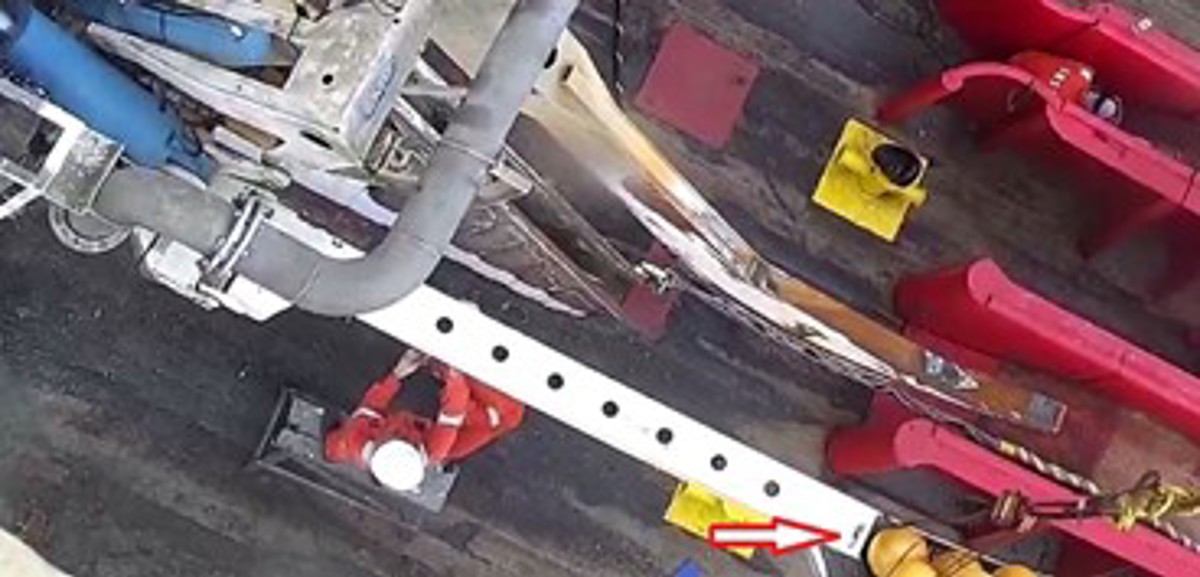
Crew working under the depth skid which is lifted by crane.
The red arrow shows the parted hook.
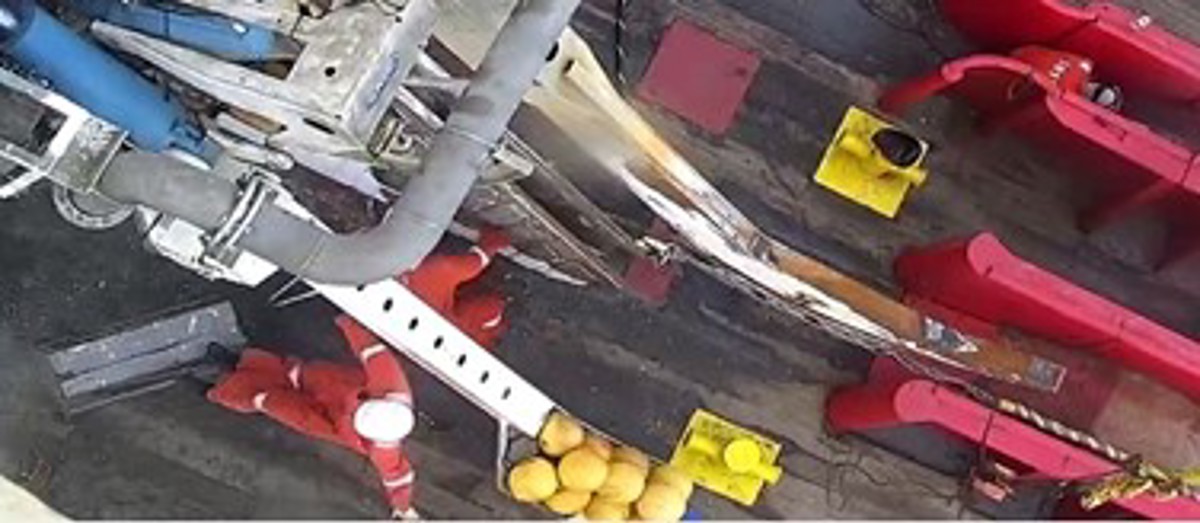
The skid in the fallen position
What went wrong?
- It was shown afterwards that because the pad eye on the plough depth skid was too small for a standard hook, the crew used an entirely inappropriate spring snap hook to link the skid and the sling.
- The two crew were in the wrong place – under the load, in the line of fire.

Actions
- Further crew training on correct lifting loose gear application, emphasising that unqualified loose gear should not be used for any lifting work.
- The pad eye was modified and tested so that a standard and properly qualified hook can be used.
- Hazard Identification and Risk Assessment form for plough operation was reviewed and revised to:
- include safe positioning of crew, and
- enhance supervision by requiring the team leader to check safety positioning.
- include safe positioning of crew, and
Related Safety Flashes
-
IMCA SF 29/18
21 December 2018
-
-
IMCA SF 03/18
31 January 2018
-
-
IMCA SF 01/15
16 January 2015
-
IMCA SF 13/11
25 November 2011
IMCA Safety Flashes summarise key safety matters and incidents, allowing lessons to be more easily learnt for the benefit of the entire offshore industry.
The effectiveness of the IMCA Safety Flash system depends on the industry sharing information and so avoiding repeat incidents. Incidents are classified according to IOGP's Life Saving Rules.
All information is anonymised or sanitised, as appropriate, and warnings for graphic content included where possible.
IMCA makes every effort to ensure both the accuracy and reliability of the information shared, but is not be liable for any guidance and/or recommendation and/or statement herein contained.
The information contained in this document does not fulfil or replace any individual's or Member's legal, regulatory or other duties or obligations in respect of their operations. Individuals and Members remain solely responsible for the safe, lawful and proper conduct of their operations.
Share your safety incidents with IMCA online. Sign-up to receive Safety Flashes straight to your email.