LTI: Three fingers badly cut while handling a long brass bar
- Safety Flash
- Published on 1 October 2021
- Generated on 1 October 2026
- IMCA SF 27/21
- 2 minute read
A crew member on a vessel suffered laceration on three fingers of the left hand while attempting to remove a brass bar from the storage rack. The injury caused an LTI.
What happened?
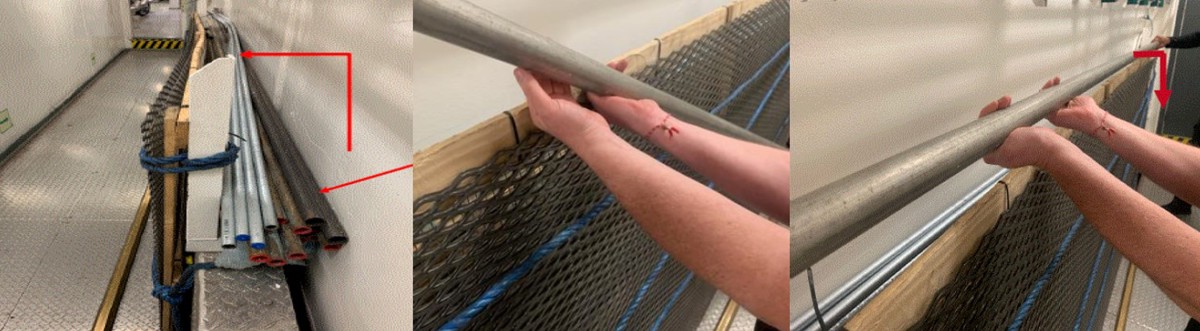
The crew member was removing a brass bar (3m long, 47 kg weight, 46 mm dia.) from the storage rack.
The brass bar was lying behind a wooden frame and behind two pieces of expanded metal mesh sheets.
Working alone, the injured person lifted the bar in stages to remove it from its storage. He first lifted the forward end of the bar which suddenly slipped, forcing his left hand downwards and against sharp edges on the steel wire mesh which, ripping into the skin under the weight of the bar, caused the injury.
Initial first aid was provided by vessel medic, but the decision was made to transfer him by helicopter to an onshore hospital for further treatment.
What went wrong?
- The injured person did not risk assess the job correctly, and misjudged the weight of the brass bar (47 kg).
- The injured person did not ask for help in moving the bar, deciding to work alone.
- The injured person was not wearing safety gloves during this job.
Lessons and actions
- Check and re-assess the suitability of storage for materials and equipment.
- Consider the adequacy of access, egress, lighting, ergonomics, stability influences such as weather and wind, lighting, and ergonomics.
- If lone working cannot be avoided wherever possible, ensure that when persons are working alone, this is adequately covered by Task Risk Assessments (TRAs).
- Wear gloves for work like this! The wearing of task specific Personal Protective Equipment (PPE) should be noted in the risk assessment, and reinforced at toolbox talks.
Related Safety Flashes
-
IMCA SF 25/18
9 November 2018
-
-
IMCA SF 30/17
12 December 2017
-
-
IMCA SF 28/16
18 October 2016
IMCA Safety Flashes summarise key safety matters and incidents, allowing lessons to be more easily learnt for the benefit of the entire offshore industry.
The effectiveness of the IMCA Safety Flash system depends on the industry sharing information and so avoiding repeat incidents. Incidents are classified according to IOGP's Life Saving Rules.
All information is anonymised or sanitised, as appropriate, and warnings for graphic content included where possible.
IMCA makes every effort to ensure both the accuracy and reliability of the information shared, but is not be liable for any guidance and/or recommendation and/or statement herein contained.
The information contained in this document does not fulfil or replace any individual's or Member's legal, regulatory or other duties or obligations in respect of their operations. Individuals and Members remain solely responsible for the safe, lawful and proper conduct of their operations.
Share your safety incidents with IMCA online. Sign-up to receive Safety Flashes straight to your email.