Lost in calibration
- DP Event
- Published on 19 October 2026
- Generated on 19 October 2026
- DPE 03/26
- 4 minute read
Incident
3.1 Overview
A DP equipment class 3 vessel was conducting gangway operations alongside an FPSO in a water depth of approximately 1,900 m. The vessel was operating in Auto DP with all six thrusters and both generators running, bus ties open with two redundant groups available. One radar-based and two laser-based position reference systems were selected to DP. Visibility was good, with a significant wave height of 0.5 m, wind speed of 10 knots and a DP current of 0.5 knots.
3.2 What happened?
During activity associated with calibration of a vessel Vertical Reference Unit (VRU), the DP control system experienced degradation of its attitude reference arrangement. Shortly afterwards, the vessel generated an Off Position Warning followed by an Off Position Alarm.
At 17:24:04, VRU 3 was selected into DP control. The position status subsequently returned to normal.
Despite recovery of the VRU sensor arrangement, the vessels movement relative to the installation resulted in gangway extension warnings, alarms and eventual automatic disconnect. The vessel entered a reduced redundancy condition and the operation was aborted.
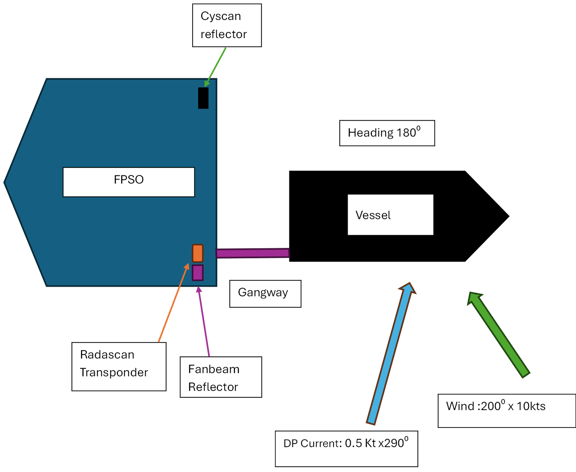
Vessel position, heading, environmental conditions and position reference arrangement
while connected to the FPSO
3.3 Observations
The available alarm history confirms:
- Off Position Warning occurred at 17:23:51.
- Off Position Alarm occurred at 17:23:55.
- VRU 3 became selected at 17:24:04.
- Position OK was achieved at 17:24:10.
The available alarm history does not identify:
- Which VRU(s) were selected immediately before the event.
- Whether any VRU was manually deselected.
- Whether any VRU was automatically rejected by sensor voting logic.
- Whether the active sensor was the unit undergoing calibration.
- Whether an incorrect VRU was inadvertently worked upon.
3.4 Findings
The root cause analysis identified the following:
- The work was not supported by adequate procedural controls or a sufficiently detailed risk assessment for maintenance on DP-critical equipment during live DP operations.
- The immediate cause was interruption of VRU signals during calibration, which caused the DP system to reject the affected sensors and resulted in a position excursion.
- Calibration was carried out on DP-critical equipment while the vessel remained in DP mode and connected to the FPSO.
- VRU No. 1 was inadvertently affected while VRU No. 2 was being calibrated because the units were located close together.
- Maintenance was permitted while the vessel was in DP and connected to a live asset, revealing an organisational and procedural gap.
- The event placed the vessel in a CAM Blue condition, reducing redundancy and increasing vulnerability.
- There was no clear prohibition on inspection, repair or maintenance of all DP-critical equipment during DP operations.
3.5 Conclusion
The incident was caused by calibration work on DP-critical equipment while the vessel remained in DP mode and connected to the FPSO. Inadvertent interference with an adjacent VRU interrupted the sensor inputs, causing the DP system to reject the affected units, reduce redundancy to CAM Blue and allow a position excursion that triggered automatic gangway disconnection.
The root cause analysis identified inadequate risk assessment and procedural control as the underlying organisational gap. Inspection, repair or maintenance of DP-critical systems should therefore be prohibited during live DP operations unless the vessel has first been placed in an appropriate safe state. Procedures should clearly define the required operating status, apply formal permit-to-work and risk-assessment controls, and ensure that crew and visiting technicians understand the dependencies and potential consequences before work begins.
3.6 Primary references
• IMCA M220 – Guidance on operational activity planning
• IMCA M252 – Guidance on position reference systems and sensors for DP operations
• IMCA M103 – Guidelines for the design and operation of dynamically positioned vessels
• IMCA M117 – Code of practice for the training and experience of key DP personnel
Latest DP incidents
-
The domino effect
The event demonstrates the importance of maintaining the approved DP power configuration, addressing known defects before equipment is relied upon during DP operations, and ensuring DP personnel understand how changes to the generating arrangement can affect redundancy and failure propagation
DPE 03/26
19 October 2026
Incident
-
Lost in calibration
During activity associated with calibration of a vessel Vertical Reference Unit (VRU), the DP control system experienced degradation of its attitude reference arrangement. Shortly afterwards, the vessel generated an Off Position Warning followed by an Off Position Alarm
DPE 03/26
19 October 2026
Incident
-
Watch what you are pressing
While transiting away from a wind farm, the Master of a DP equipment class 2 vessel observed that the vessel was operating in Backup Mode and queried this with the bridge team and attending electrician
DPE 03/26
19 October 2026
Incident
-
The UPS and downs
While a vessel was transiting in DP mode, the DPO observed the loss of Gyros 2 and 3 together with alarms from a 230V backup power supply. The telephone system remained powered but was inoperable.
DPE 03/26
19 October 2026
Incident
-
DP drill scenario – Consequence Analysis Class DP2 & DP3
DP drill scenario – Consequence Analysis Class DP2 & DP3
DPE 03/26
19 October 2026
Drill Scenario
The case studies and observations above have been compiled from information received by IMCA. All vessel, client, and operational data has been removed from the narrative to ensure anonymity. Case studies are not intended as guidance on the safe conduct of operations, but rather to assist vessel managers, DP operators, and technical crew.
IMCA makes every effort to ensure both the accuracy and reliability of the information, but it is not liable for any guidance and/or recommendation and/or statement herein contained.
Any queries should be directed to DP team at IMCA. Share your DP incidents with IMCA online. Sign-up to receive DP event bulletins straight to your email.