The domino effect
- DP Event
- Published on 19 October 2026
- Generated on 19 October 2026
- DPE 03/26
- 4 minute read
Incident
2.1 Overview
A DP equipment class 2 vessel was preparing for cargo operations alongside an offshore installation. All five thrusters were selected to DP control, and two shaft generators were running and connected to Bus B of the split 440 Vac switchboard. The vessel’s two diesel generators were running in parallel and supplying Bus A of the closed-bus 440 Vac switchboard, which fed a common 230 Vac bus through transformer T1. Two DGPS systems and one CyScan were selected as position reference systems. Wind speed was 15–17 knots from the north-north-west, with a swell height of 1.5 m.
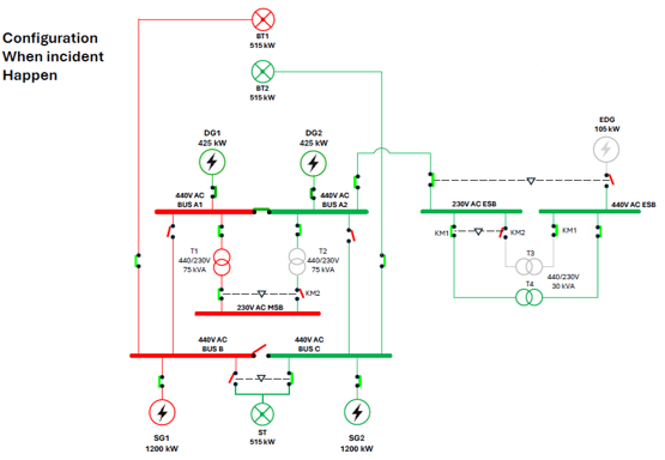
Vessel configuration at time of event
2.2 What happened?
At 15:00 hrs, DG1 and DG2 were operating in parallel under a load of approximately 130–150 kW. The cargo hose was connected at 18:40 hrs. Bulk Compressor No. 2 was started at 18:50 hrs, followed by Bulk Compressor No. 1 at 18:52 hrs to accelerate pressure build-up in the cargo tanks.
At 18:54 hrs, the air circuit breaker for the DG2 incomer tripped, disconnecting the generator from the 440 Vac electrical distribution system while it remained running. DG1 automatically accepted the full load and tripped at 18:55 hrs. Power to the downstream 230 Vac switchboard was subsequently lost, resulting in the loss of both port and starboard steering systems. The vessel temporarily lost position, although the main engines and all three thrusters remained operational.
The emergency diesel generator started within approximately 25 seconds and restored power. At 18:59 hrs, the Second Engineer changed over from the emergency generator to DG2, restoring power to the steering systems and enabling manual control. The cargo hose was disconnected at 19:23 hrs and the vessel cleared the 500 m safety zone at 19:25 hrs.
2.3 Findings
The investigation identified the following key findings:
- The vessel was operating in DP mode with DG1 and DG2 paralleled on the 440 Vac switchboard supplying the cargo load and the downstream 230 Vac switchboard, while SG1 and SG2 supplied the thrusters. This did not comply with the vessel’s DP Operations Manual, CAMO, ASOG, FMEA, power-management or load-analysis requirements.
- The documented DP configuration required SG1 and SG2 to supply the thruster and cargo systems, with DG1 and DG2 on automatic standby and separated across bus sections A1 and A2. The arrangement used during the event removed the intended separation between redundant groups.
- The documented DP configuration required SG1 and SG2 to supply the thruster and cargo systems, with DG1 and DG2 on automatic standby and separated across bus sections A1 and A2. The arrangement used during the event removed the intended separation between redundant groups.
- The shaft generators were not used to feed the 230 Vac switchboard because of a previous governor issue that could have caused a reduction in main-engine speed and a shaft-generator trip.
- DG2 had a known defect recorded in the vessel’s maintenance system: low fuel-pump pressure prevented it from accepting a load above 130 kW. Starting the cargo compressors increased the load and DG2 tripped.
- Because DG1 and DG2 were operating in parallel, DG1 accepted the transferred load when DG2 disconnected and subsequently tripped. This caused loss of power to the steering systems and a temporary loss of position.
- DG2 had a known defect recorded in the vessel’s maintenance system: low fuel-pump pressure prevented it from accepting a load above 130 kW. Starting the cargo compressors increased the load and DG2 tripped.
- Corrective actions recorded in the event form included repairing and testing the generators, revising procedures and standing instructions, providing additional training, and re-briefing DP personnel on the correct CAMO and power-load configuration for cargo operations.
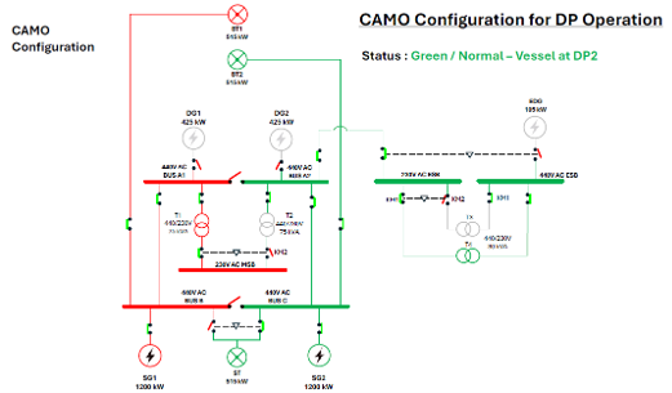
CAMO configuration while the vessel was under DP2 operations
2.4 Conclusion
The event resulted from a known defect in DG2 being combined with a power configuration that did not comply with the vessel’s DP Operations Manual, CAMO, ASOG, FMEA, power-management or load-analysis requirements. Operating DG1 and DG2 in parallel on a common bus removed the intended separation between redundant groups, allowing the trip of DG2 to transfer the load to DG1, which also tripped. This caused loss of power to the steering systems and a temporary loss of position.
The event demonstrates the importance of maintaining the approved DP power configuration, addressing known defects before equipment is relied upon during DP operations, and ensuring DP personnel understand how changes to the generating arrangement can affect redundancy and failure propagation.
2.5 Primary references
Latest DP incidents
-
The domino effect
The event demonstrates the importance of maintaining the approved DP power configuration, addressing known defects before equipment is relied upon during DP operations, and ensuring DP personnel understand how changes to the generating arrangement can affect redundancy and failure propagation
DPE 03/26
19 October 2026
Incident
-
Lost in calibration
During activity associated with calibration of a vessel Vertical Reference Unit (VRU), the DP control system experienced degradation of its attitude reference arrangement. Shortly afterwards, the vessel generated an Off Position Warning followed by an Off Position Alarm
DPE 03/26
19 October 2026
Incident
-
Watch what you are pressing
While transiting away from a wind farm, the Master of a DP equipment class 2 vessel observed that the vessel was operating in Backup Mode and queried this with the bridge team and attending electrician
DPE 03/26
19 October 2026
Incident
-
The UPS and downs
While a vessel was transiting in DP mode, the DPO observed the loss of Gyros 2 and 3 together with alarms from a 230V backup power supply. The telephone system remained powered but was inoperable.
DPE 03/26
19 October 2026
Incident
-
DP drill scenario – Consequence Analysis Class DP2 & DP3
DP drill scenario – Consequence Analysis Class DP2 & DP3
DPE 03/26
19 October 2026
Drill Scenario
The case studies and observations above have been compiled from information received by IMCA. All vessel, client, and operational data has been removed from the narrative to ensure anonymity. Case studies are not intended as guidance on the safe conduct of operations, but rather to assist vessel managers, DP operators, and technical crew.
IMCA makes every effort to ensure both the accuracy and reliability of the information, but it is not liable for any guidance and/or recommendation and/or statement herein contained.
Any queries should be directed to DP team at IMCA. Share your DP incidents with IMCA online. Sign-up to receive DP event bulletins straight to your email.