The UPS and downs
- DP Event
- Published on 19 October 2026
- Generated on 19 October 2026
- DPE 03/26
- 4 minute read
Incident
4.1 Overview
A DP equipment class 2 vessel was transiting within an offshore wind farm. Four of its five thrusters were selected to DP, with three of four generators running, the bus ties closed and two redundant groups available. Two GNSS position reference systems were selected to DP, together with three gyros, three wind sensors and three motion reference sensors. Visibility was 12 nautical miles, with a significant wave height of 1.5 m, wind speed of 22 knots and a real current of 0.6 knots.
4.2 What happened?
At approximately 07:53 hrs, while the vessel was transiting in DP mode, the DPO observed the loss of Gyros 2 and 3 together with alarms from a 230V backup power supply. The telephone system remained powered but was inoperable. The Master contacted the engineering team for a status update while the bridge team stopped the vessel and maintained control in DP1. The client was informed of the delay and the vessel’s downgraded DP status.
The ETO had been following up a previous recurring UPS alarm and, in accordance with the manufacturer’s instructions, attempted to reduce demand on the unit by enabling ECO mode. During the changeover, the batteries did not provide the required power, and a momentary interruption caused dependent systems, including the telephone system and gyros, to reboot.
The vessel informed shore management and moved out of the field to restore full DP2 status. All systems were reinstated approximately one and a half hours later, after which the DP setup checklist was completed before the vessel re-entered the field.
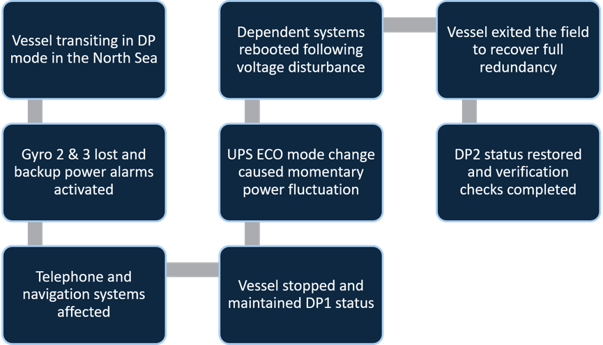
Sequence of events during the incident
4.3 Findings
The event form identified the following key findings:
- The loss of Gyros 2 and 3 first alerted the bridge team to the event.
- The event was categorised as a power-distribution failure, with an electrical component failure and battery condition recorded as underlying factors.
- The ETO did not inform the bridge before changing the UPS to ECO mode because a smooth transition was expected.
- Changing the UPS operating mode caused an unexpected interruption to dependent systems, including the gyros, and reduced the vessel to DP1.
- The manufacturer’s instructions did not indicate that changing to ECO mode could cause a power fluctuation or interruption while the UPS remained supplied by normal power.
- The event form recorded a hardware failure associated with lack of maintenance and identified the need for repair and procedural changes.
- Following the event, the vessel was moved to a safe position and a function test was completed using the DP setup checklist. The event was closed out and the lessons learned were shared internally and externally.
4.4 Conclusion
The event resulted from work on a critical UPS being undertaken without the bridge team being informed or the effect on dependent equipment being fully understood. Although the ETO intended to reduce demand on a UPS whose batteries required replacement, the change to ECO mode caused an unexpected interruption that affected the gyros and other dependent systems, reducing the vessel to DP1.
The event demonstrates that no work, equipment status change or operating-mode change should be undertaken on UPS equipment supplying DP-critical or communication systems during critical DP activity without prior notification to the bridge, confirmation of the equipment supplied by the UPS, and an assessment of the operational consequences. Even a change perceived as routine, such as selecting a different UPS mode, can interrupt dependent systems and affect DP capability. Battery condition, maintenance arrangements and manufacturer guidance should also be reviewed so that similar interruptions are identified and controlled before any change is made.
4.5 Primary references
Latest DP incidents
-
The domino effect
The event demonstrates the importance of maintaining the approved DP power configuration, addressing known defects before equipment is relied upon during DP operations, and ensuring DP personnel understand how changes to the generating arrangement can affect redundancy and failure propagation
DPE 03/26
19 October 2026
Incident
-
Lost in calibration
During activity associated with calibration of a vessel Vertical Reference Unit (VRU), the DP control system experienced degradation of its attitude reference arrangement. Shortly afterwards, the vessel generated an Off Position Warning followed by an Off Position Alarm
DPE 03/26
19 October 2026
Incident
-
Watch what you are pressing
While transiting away from a wind farm, the Master of a DP equipment class 2 vessel observed that the vessel was operating in Backup Mode and queried this with the bridge team and attending electrician
DPE 03/26
19 October 2026
Incident
-
The UPS and downs
While a vessel was transiting in DP mode, the DPO observed the loss of Gyros 2 and 3 together with alarms from a 230V backup power supply. The telephone system remained powered but was inoperable.
DPE 03/26
19 October 2026
Incident
-
DP drill scenario – Consequence Analysis Class DP2 & DP3
DP drill scenario – Consequence Analysis Class DP2 & DP3
DPE 03/26
19 October 2026
Drill Scenario
The case studies and observations above have been compiled from information received by IMCA. All vessel, client, and operational data has been removed from the narrative to ensure anonymity. Case studies are not intended as guidance on the safe conduct of operations, but rather to assist vessel managers, DP operators, and technical crew.
IMCA makes every effort to ensure both the accuracy and reliability of the information, but it is not liable for any guidance and/or recommendation and/or statement herein contained.
Any queries should be directed to DP team at IMCA. Share your DP incidents with IMCA online. Sign-up to receive DP event bulletins straight to your email.