MAIB: Step-ladder failure (LTI)
- Safety Flash
- Published on 6 February 2025
- Generated on 5 July 2025
- IMCA SF 02/25
- 2 minute read
A crew member was working while stood on the top step of a small folding stepladder when the step gave way.
What happened?
A crew member was working while stood on the top step of a small folding stepladder when the step gave way, causing the crew member to fall to the ground. The impact resulted in back and head injuries, leading to a brief loss of consciousness and severe back pain. After medical attention on board, the crew member was deemed to be unfit for work for 72 hours. The crew member was subsequently transferred to hospital for further comprehensive medical evaluation.
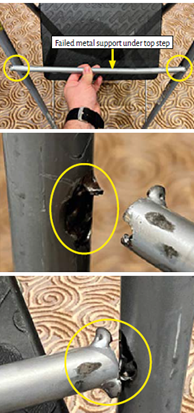
What went wrong?
Investigation established that the incident was caused by the failure of the welds securing the stepladder’s top step supporting rod to the frame.
MAIB considered it unlikely that the weight of the crew member would have been sufficient to cause the catastrophic failure of a metal support on a new stepladder. The stepladder used in this incident was of an indeterminate age but was not being overloaded so it is almost certain that the damage to the metal support was pre-existing.
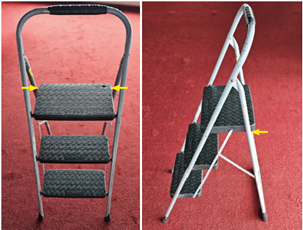
Stepladder, showing the location of the failed metal support
Lessons learned
- Check and inspect equipment thoroughly before use. Work equipment should also be maintained in good repair and, where applicable, with maintenance and inspection logs kept up‑to‑date.
- Accidental damage to equipment can sometimes occur. A just culture working environment balances fairness, learning and shared accountability and supports staff to adopt an open and honest approach to reporting incidents. Where damaged equipment could affect the next user, a just culture is essential to understand why the failure occurred and how to prevent it happening again.
Related Safety Flashes
-
IMCA SF 12/22
12 May 2022
-
IMCA SF 03/20
30 January 2020
-
IMCA Safety Flashes summarise key safety matters and incidents, allowing lessons to be more easily learnt for the benefit of the entire offshore industry.
The effectiveness of the IMCA Safety Flash system depends on the industry sharing information and so avoiding repeat incidents. Incidents are classified according to IOGP's Life Saving Rules.
All information is anonymised or sanitised, as appropriate, and warnings for graphic content included where possible.
IMCA makes every effort to ensure both the accuracy and reliability of the information shared, but is not be liable for any guidance and/or recommendation and/or statement herein contained.
The information contained in this document does not fulfil or replace any individual's or Member's legal, regulatory or other duties or obligations in respect of their operations. Individuals and Members remain solely responsible for the safe, lawful and proper conduct of their operations.
Share your safety incidents with IMCA online. Sign-up to receive Safety Flashes straight to your email.