LTI - Finger injury during davit test
- Safety Flash
- Published on 18 January 2023
- Generated on 22 October 2026
- IMCA SF 03/23
- 2 minute read
A worker suffered a serious finger injury when his hand got caught between a painter rope under tension and the handrail.
What happened?
The incident occurred during testing of the rescue boat davit.
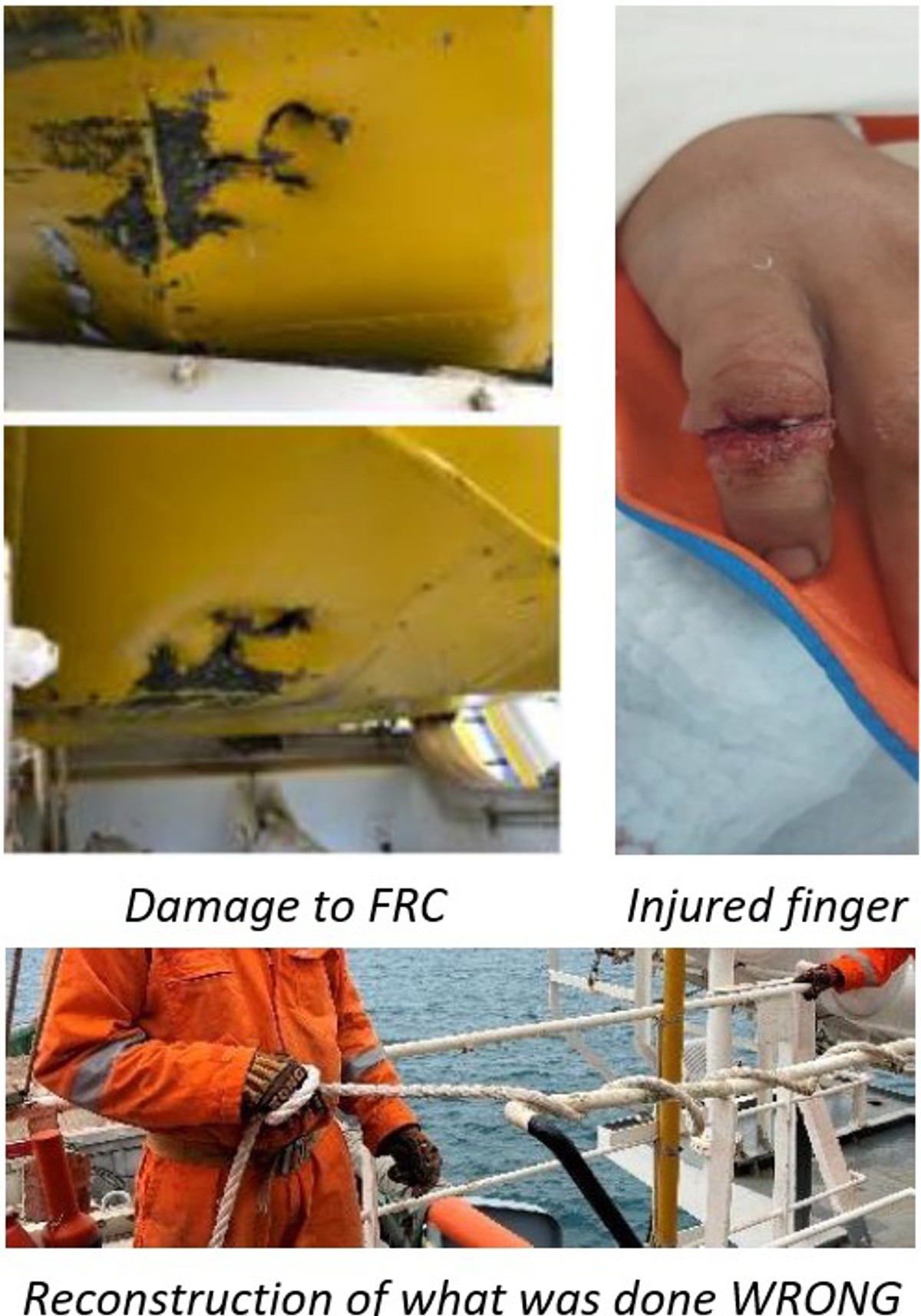
The crew member was holding the painter line, which was hitched to the handrail, coiled around his right hand. During the test, the winch brake system failed. This caused the fast rescue craft (FRC) to fall.
The crew member’s hand was stuck between the painter rope and the handrail. He suffered serious lacerations and compound fractures to his baby finger. The FRC was damaged.
What went wrong?
- The brake failed causing the FRC to fall. This was not anticipated.
- The injured person coiled the painter line around his hand, and was not wearing appropriate safety gloves.
- The crew members involved in the task were unaware of the risks involved and did not even fully understand the aim of the operation.
- The person in charge did not appropriately supervise the operation. The toolbox talk did not communicate sufficient information.
Lessons learned
- Be aware of the risks around you – stay out of the “bight” of ropes that might come under tension.
- Don’t wind ropes around your hand if they could come under tension.
- Understand what is happening around you. What are the hazards of the task you are doing?
- Wear appropriate PPE.
Our Member went on to ensure that there were specific launch and test procedures for the FRC, and investigated the failure of the brake.
Related Safety Flashes
-
IMCA SF 11/14
8 July 2014
-
IMCA SF 09/14
16 June 2014
-
IMCA SF 13/12
11 December 2012
IMCA Safety Flashes summarise key safety matters and incidents, allowing lessons to be more easily learnt for the benefit of the entire offshore industry.
The effectiveness of the IMCA Safety Flash system depends on the industry sharing information and so avoiding repeat incidents. Incidents are classified according to IOGP's Life Saving Rules.
All information is anonymised or sanitised, as appropriate, and warnings for graphic content included where possible.
IMCA makes every effort to ensure both the accuracy and reliability of the information shared, but is not be liable for any guidance and/or recommendation and/or statement herein contained.
The information contained in this document does not fulfil or replace any individual's or Member's legal, regulatory or other duties or obligations in respect of their operations. Individuals and Members remain solely responsible for the safe, lawful and proper conduct of their operations.
Share your safety incidents with IMCA online. Sign-up to receive Safety Flashes straight to your email.