BSEE: Miscommunication and trapped pressure causes injury during valve maintenance
- Safety Flash
- Published on 13 February 2026
- Generated on 1 April 2026
- IMCA SF 03/26
- 3 minute read
The United States’ Bureau of Safety & Environmental Enforcement (BSEE) has published Safety Alert 509 relating to a gas release incident on an offshore platform.
What happened?
The incident occurred while a worker was performing maintenance on an control valve on a gas line. Residual pressure estimated at 128 psi inside the line was released during disassembly and replacement of the valve’s trim and seat. The sudden release caused the valve’s bonnet flange, weighing approximately 25kg, to be forcefully ejected. The flange struck the worker in the chest and abdomen, knocking the worker backward onto the elevated scaffold platform. The worker was evacuated. Injuries included bruising and abrasions to the left abdomen wall and chest, a laceration behind the left ear, and abrasions to the left knee.
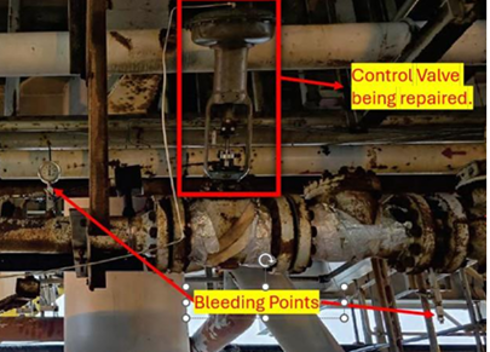
What went wrong (BSEE findings)
- Incomplete job safety analysis (JSA): The JSA was not reviewed or signed by the platform's person in charge (PIC), as per policy.
- Inexperience and procedural gaps: The worker had less than two years of field experience and was unfamiliar with key procedural requirements, including verifying the gas line’s condition through proper isolation checks and ensuring all necessary approvals and safety documentation were complete before starting work.
- Miscommunication: The worker began work without platform management approval and without notifying management. Additionally, the worker had not assigned an operator familiar with the production process to assist. There was no clear discussion of the scope of work or hazards. The worker assumed the gas line and control valve were fully depressurised, based on comments made earlier that morning.
- Unauthorised use of scaffolding: The worker used a scaffold tagged "do not use" due to a missing ladder and kick plates. The worker was also working more than 2m above the main deck without fall protection such as a full-body harness and retractable lifeline.
- Failure to verify zero energy state: An energy isolation permit, required to confirm the gas line was fully depressurised, was not completed. The worker began the task without verifying the line was free of trapped pressure.
- Failure to follow procedures: Original equipment manufacturer (OEM) guidance required at least four nuts should have been left on the studs and partially backed off during bonnet flange maintenance and disassembly. This precaution prevents the flange from being forced upward if trapped pressure is present. In this case, the worker did not keep the safety nuts on the studs.
Recommendations
- Always confirm zero trapped or stored energy before disassembling pressurised equipment.
- Make sure risk assessments and JSA’s are regularly reviewed and up to date.
- Ensure clear communication between all stakeholders – client, management, crew and any third-party contract workers.
- If there are safety-related procedures or instructions from the manufacturer – follow them!
- Consider two-person working on pressurised systems.
Related Safety Flashes
-
IMCA SF 09/23
4 April 2023
-
-
IMCA SF 12/25
3 July 2025
IMCA Safety Flashes summarise key safety matters and incidents, allowing lessons to be more easily learnt for the benefit of the entire offshore industry.
The effectiveness of the IMCA Safety Flash system depends on the industry sharing information and so avoiding repeat incidents. Incidents are classified according to IOGP's Life Saving Rules.
All information is anonymised or sanitised, as appropriate, and warnings for graphic content included where possible.
IMCA makes every effort to ensure both the accuracy and reliability of the information shared, but is not be liable for any guidance and/or recommendation and/or statement herein contained.
The information contained in this document does not fulfil or replace any individual's or Member's legal, regulatory or other duties or obligations in respect of their operations. Individuals and Members remain solely responsible for the safe, lawful and proper conduct of their operations.
Share your safety incidents with IMCA online. Sign-up to receive Safety Flashes straight to your email.