Near-miss: Exposed live electrical cable
- Safety Flash
- Published on 4 April 2013
- Generated on 22 October 2026
- IMCA SF 05/13
- 3 minute read
A member has reported an incident in which a live electrical cable was found exposed.
What happened?
The incident occurred when a vessel had returned to service after a long dry docking. During this period many parts of the vessel were worked on and modifications to the layout of the vessel were made to accommodate new equipment -in particular the fast rescue craft (FRC) and its associated launching davit were removed in order to make room for a new hyperbaric lifeboat (HLB).
A member of the crew working near the new hyperbaric lifeboat noticed an electrical cable which was coiled up and stowed between a handrail and an adjacent bulkhead. The ends of the cable were not terminated but had been separated and wrapped up in electrical insulating tape. It was noted that a small amount of smoke was coming from the end of the cable and some sparking (the cable was in contact with the bulkhead). Realising that the cable was live the crewman immediately contacted the deck electrician and asked him to come and investigate. The electrician subsequently traced the cable and made it safe. The cable was identified as the supply to a halogen flood light originally intended as overboard illumination for the launch station of the vessel’s FRC.
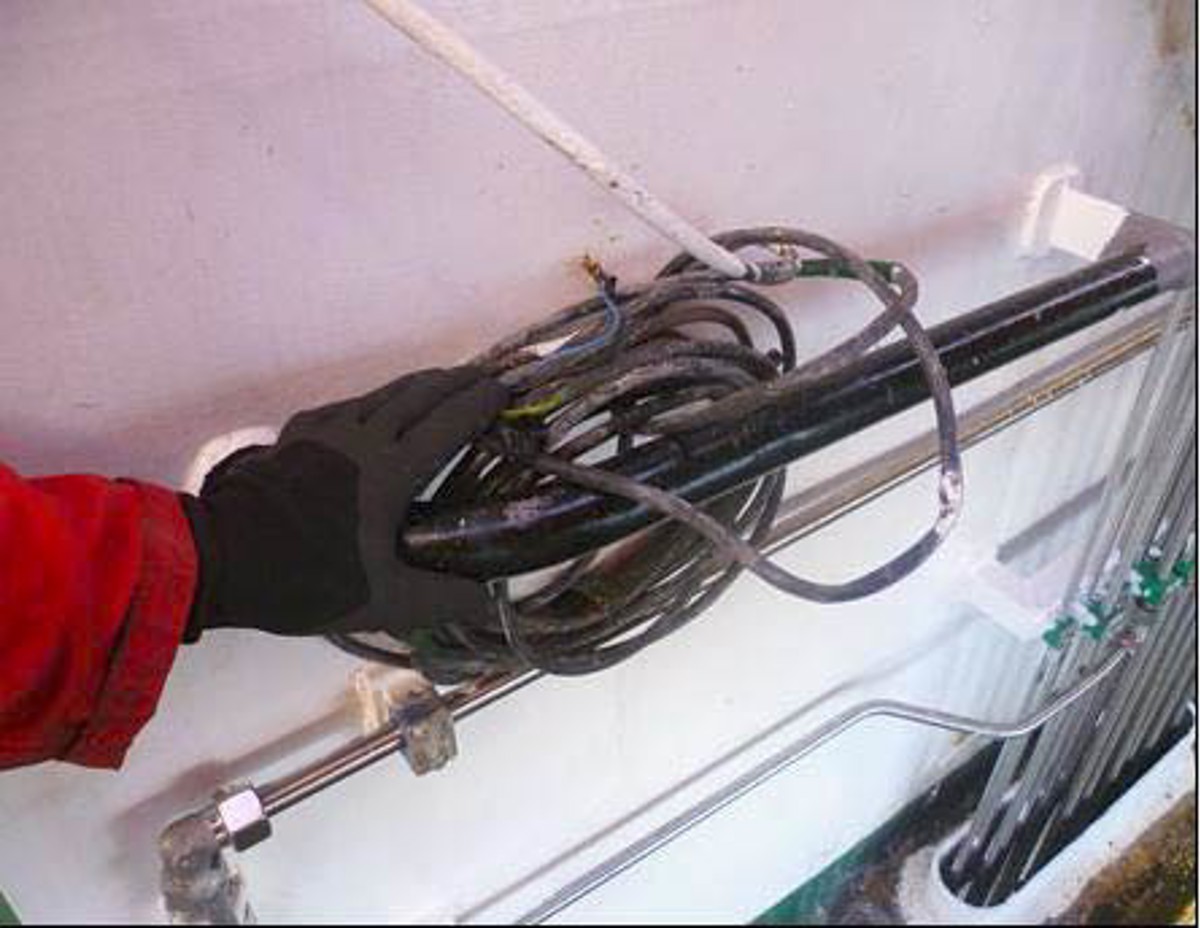
electrical cable and bare live wires
Findings
The company’s investigation revealed that:
- There had been inadequate planning and inadequate supervision of the work.
- The old flood lamp had been removed with no Permit To Work (PTW) or Electrical Isolation (EI) certificates in place.
What were the causes?
The underlying causes associated with the incident were:
- Owing to the high workload of vessel staff and the large number of jobs being undertaken simultaneously, there had been a failure of control, in that it had not been possible for ship’s officers to observe all tasks and thus ensure that vessel policies were followed.
- There was no evidence to suggest that any communication was made to ship yard fitters that live electrical supplies were still present within their work area.
- There had been inadequate planning ahead of the job being undertaken; not all power supplies in the work area were assessed or isolated.
- All services that were required to be isolated and removed prior to the area being handed over to the third party contractor for the installation of the HLB had been successfully completed. The requirement to remove the overboard light was not part of this original scope of work.
- The third-party contractor deviated from their original work scope and removed the flood lamp without the necessary PTW and EI in place.
- The third-party contractor did not follow the Management of Change procedure.
Lessons learnt
Our member identified the following lessons:
- The induction to the vessel during dry dock is to be reviewed and will include additional information regarding the Management of Change procedures
- The use of a single point of contact for each work area was not in place while the vessel was in dry dock. This would have allowed the third-party contractor to approach their contact and arrange the necessary PTW and EI for the additional works they required.
- Although this work area still had additional works to be carried out, the area was not fully surveyed once the initial works had been completed prior to handover.
Further information on shipyard safety can be found in IMCA HSS032 - Guidance on safety in shipyards.
IMCA Safety Flashes summarise key safety matters and incidents, allowing lessons to be more easily learnt for the benefit of the entire offshore industry.
The effectiveness of the IMCA Safety Flash system depends on the industry sharing information and so avoiding repeat incidents. Incidents are classified according to IOGP's Life Saving Rules.
All information is anonymised or sanitised, as appropriate, and warnings for graphic content included where possible.
IMCA makes every effort to ensure both the accuracy and reliability of the information shared, but is not be liable for any guidance and/or recommendation and/or statement herein contained.
The information contained in this document does not fulfil or replace any individual's or Member's legal, regulatory or other duties or obligations in respect of their operations. Individuals and Members remain solely responsible for the safe, lawful and proper conduct of their operations.
Share your safety incidents with IMCA online. Sign-up to receive Safety Flashes straight to your email.