Working in a confined space without a Permit to Work
- Safety Flash
- Published on 17 March 2026
- Generated on 17 March 2026
- IMCA SF 05/26
- 3 minute read
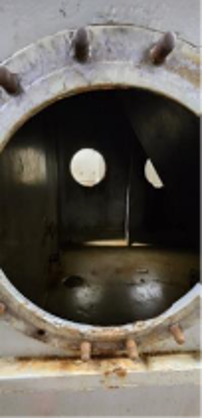
During a safety walk-round, personnel were found working inside a sewage tank, without a Permit to Work.
What happened?
After consulting with the duty engineer it was confirmed that there was no confined space entry permit in place and the work was stopped. Our member regarded the situation as a near miss as the correct safety controls were missing.
 |
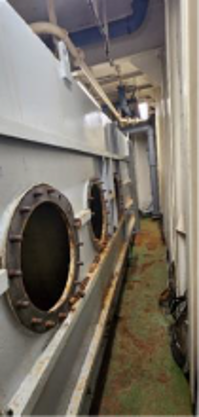 |
| Inside sewage tank | Outside sewage tank |
What led to this situation occurring?
- The cleaning of the tank had already been ongoing for several days, but was performed from outside of the tank, and did not require a confined space entry permit.
- On the day of the incident crew were tasked with removing pipes on the inside of the sewage tank. Because the tank was clean, no signage indicating a confined space, and the removal of the pipes was considered routine, the requirement for a Permit to Work was not recognized, and the absence of the PtW was not questioned.
Investigation revealed that:
- There was no Confined Space Entry Permit in place, no watch over the access point, no rescue plan, no gas monitoring regime.
- There was no lock-out/tag out documented, no formal Permit to Work. The Toolbox Talk did not identify confined space and isolation as hazards to be controlled.
- Assumptions were made regarding the existence and need of a permit.
Why this was dangerous
- Residual hazardous materials: Despite the clean appearance of sewage tank, there could still have been residue of hazardous materials which could have lead to health issues if crew were exposed.
- Deterioration of air quality: Even after cleaning the air quality can drop below the safe threshold due to lack of ventilation or residual substances vaporizing. This deterioration could be very localised within the tank.
- No rescue plan: part of the confined space permit is a rescue plan and a manhole watch, if none is place in the event of an emergency (collapsed person due to lack of oxygen) there could be a delay in an effective rescue response.
- Entrapment: When no permit is issued, its not clear to everyone where work activities are ongoing. This could lead to someone closing the entrance and trapping people inside.
How to prevent this happening
- Follow the procedures – they are there to keep you safe.
- Double check and confirm with supervisors or management if work is to be conducted in a confined space.
Related Safety Flashes
-
IMCA SF 01/19
28 January 2019
-
-
IMCA SF 06/11
14 July 2011
-
IMCA SF 32/17
21 December 2017
-


IMCA Safety Flashes summarise key safety matters and incidents, allowing lessons to be more easily learnt for the benefit of the entire offshore industry.
The effectiveness of the IMCA Safety Flash system depends on the industry sharing information and so avoiding repeat incidents. Incidents are classified according to IOGP's Life Saving Rules.
All information is anonymised or sanitised, as appropriate, and warnings for graphic content included where possible.
IMCA makes every effort to ensure both the accuracy and reliability of the information shared, but is not be liable for any guidance and/or recommendation and/or statement herein contained.
The information contained in this document does not fulfil or replace any individual's or Member's legal, regulatory or other duties or obligations in respect of their operations. Individuals and Members remain solely responsible for the safe, lawful and proper conduct of their operations.
Share your safety incidents with IMCA online. Sign-up to receive Safety Flashes straight to your email.