BSEE: Crane incident leads to serious facial injuries
- Safety Flash
- Published on 24 March 2026
- Generated on 31 March 2026
- IMCA SF 06:26
- 3 minute read
The United States’ Bureau of Safety and Environmental Enforcement (BSEE) has published Safety Alert 512 relating to a crane incident during well abandonment which led to a worker being struck and suffering serious facial injuries.
What happened?
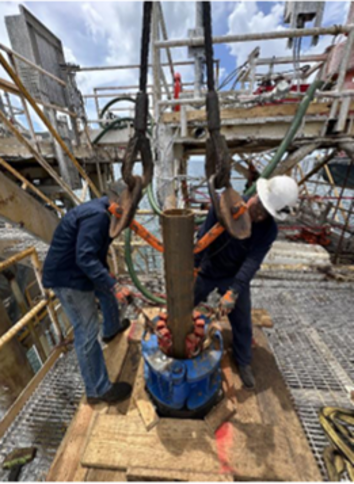
The crew onboard a lift boat (jack-up barge)were using the crane and rigging, to pull a 18cm (7”) casing from a well. They drilled holes in the casing, inserted a lifting pin, and attached it to the crane’s auxiliary hoist line with a two-part sling and D-rings. The crane lifted the casing until it got stuck. After setting the slips, the crew cut and removed a section, drilled new holes, and re-inserted the lifting pin for another lift. They then used the crane’s main hoist to try to pull the stuck casing. The lifting pin was attached to the main block, and two workers stood next to the casing, ready to remove the slips when the casing moved upward.
 |
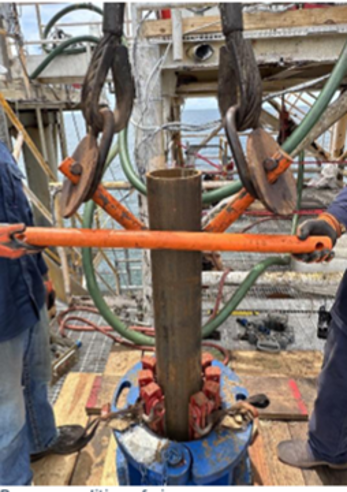 |
| Reenactment of position of injured person and other worker at time of incident. | Proper condition of pin |
When the crane operator raised the casing, the lifting pin failed, bent upward, and struck one worker in the face, causing him to fall. He suffered a subdural hematoma, facial trauma, an open skull fracture, and several facial bone fractures.
What went wrong? (BSEE findings)
- Mistakes were made - human errors led to the lifting pin failure and the worker’s injury.
- The crew installed a spool riser with a 28 cm (11”) inside diameter onto the wellhead, on top of a seal ring that was 29 cm (11.44 inches) in diameter. This stopped the casing from being pulled out.
- The crane operator lifted more than the approved safe lifting plan’s 11 ton (24,255 pounds) weight limit and exceeded the lifting pin’s 27 tons (60,000 pound) safe working load. Tests suggested that up to 46 tons may have been applied to the pin during the incident.
- The crew did not place the D-rings of the sling right next to the casing; they were about 5cm (2”) away. Procedures required that the pull linkages be as close as possible to reduce bending on the pin;
- An inappropriate procedure was used. The procedure used was meant for a drilling rig with a top drive and bails, not for a crane on a liftboat. It also wrongly listed the lifting pin’s capacity as 30 tons (67,000 pounds), when the safe limit was 27 tons (60,000 pounds).
Recommendations
- Always check that the load is free and not “stuck” before starting crane operations. Don’t use a crane to pull or lift a load that is not free.
- Ensure the equipment used is clearly identified in procedures. Don’t use procedures if they do not match the situation or equipment.
- Use the right tools and equipment for the job in hand – don’t improvise.
- Use Stop work authority if something looks or is unsafe.
- Ensure correct rigging is used for all lifts and that it is installed as described in the lifting plan.
- Ensure that procedures for lifting operations properly cite safe working loads for all rigging and devices.
- Ensure everyone is aware of hazards and keeps a safe distance from equipment during lifts.
Related Safety Flashes
-
IMCA SF 14/25
14 August 2025
-
-
IMCA SF 11/24
3 June 2024
-
IMCA Safety Flashes summarise key safety matters and incidents, allowing lessons to be more easily learnt for the benefit of the entire offshore industry.
The effectiveness of the IMCA Safety Flash system depends on the industry sharing information and so avoiding repeat incidents. Incidents are classified according to IOGP's Life Saving Rules.
All information is anonymised or sanitised, as appropriate, and warnings for graphic content included where possible.
IMCA makes every effort to ensure both the accuracy and reliability of the information shared, but is not be liable for any guidance and/or recommendation and/or statement herein contained.
The information contained in this document does not fulfil or replace any individual's or Member's legal, regulatory or other duties or obligations in respect of their operations. Individuals and Members remain solely responsible for the safe, lawful and proper conduct of their operations.
Share your safety incidents with IMCA online. Sign-up to receive Safety Flashes straight to your email.