Dropped object – strop parted over sharp edge
- Safety Flash
- Published on 24 March 2026
- Generated on 31 March 2026
- IMCA SF 06:26
- 3 minute read
A cylinder was lifted to a height of approximately 6 metres over deck of the vessel, the sharp steel edges of the cylinder cut through the firehose protection and caused the strop to part.
What happened?
During a yard stay, a spare crane cylinder weighing 8.6 tons was being lifted by the yard crane. The rigging arrangement consisted of a 5-ton soft strop (round sling) laid double, using a firehose as a "sock" for edge protection. When the cylinder was lifted to a height of approximately 6 metres over deck of the vessel, the sharp steel edges of the cylinder cut through the firehose protection and caused the strop to part. The cylinder fell to the main deck, went straight through it and landed in the cement room below. Whilst no personnel were injured, painters were working near the open moonpool nearby, resulting in a high-potential near miss.
Why did it happen?
The wrong equipment was chosen for the task in hand, and significant risks were not properly identified.
- A Permit to Work should have been raised for this lift; because there was no PTW raised, no-one identified the simultaneous operation of the painting crew working in the drop zone.
- The firehose protection was insufficient to withstand the cutting force and friction generated by the 8.6-ton load against the sharp edges.
- It was easier to do it wrong, than it was to do it right: By choosing soft strops rather than hard rigging (shackles), operational convenience was chosen ahead of safety.
- The lifting capacity of the soft strops was not reduced to account for the sharp edges. Our members’ standard working practice required a 50% reduction in Safe Working Load (SWL) when straps are used against sharp edges.
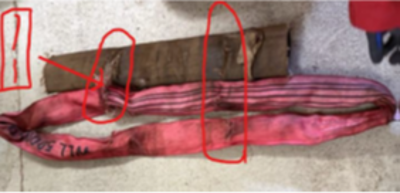
Failed soft sling after lift – the 5-ton round sling was cut through by sharp cylinder edges despite firehose protection, resulting in complete sling failure and dropped load.
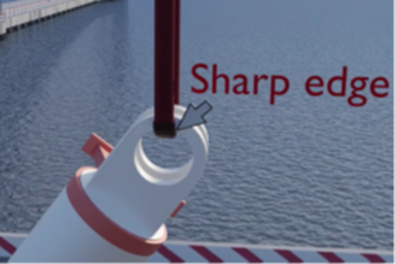
Lessons learned
- Soft lifting equipment is highly vulnerable to friction and abrasion. "Rule of thumb" protections like firehoses may fail catastrophically under heavy loads.
- Operational convenience should never override the selection of the safest possible rigging method.
- A Permit to Work introduces a critical safety barrier of checking for other personnel (SIMOPS) in the danger zone.
- Risk Awareness: A lifting method safe for a light load is not automatically safe for a heavy load. Re-assess risks when weight or conditions change.
- Ensure there is thorough Control of Work: Work on vessel equipment, even by yard personnel, may require a vessel Permit to Work (PTW) to ensure conflicting activities (SIMOPS) are identified and personnel are moved to safety.
- To prevent similar incidents:
- Use hard rigging first: Soft strops/slings ought not be used for lifting items with sharp edges if shackles or other hard rigging options exist.
- Capacity Reduction: If soft straps are the only option, adequate cut-resistant protection should be used, and the strop’s capacity should be considered reduced by 50%.
Members may wish to refer to:
Related Safety Flashes
-
IMCA SF 11/24
3 June 2024
-
-
IMCA SF 10/13
25 June 2013
IMCA Safety Flashes summarise key safety matters and incidents, allowing lessons to be more easily learnt for the benefit of the entire offshore industry.
The effectiveness of the IMCA Safety Flash system depends on the industry sharing information and so avoiding repeat incidents. Incidents are classified according to IOGP's Life Saving Rules.
All information is anonymised or sanitised, as appropriate, and warnings for graphic content included where possible.
IMCA makes every effort to ensure both the accuracy and reliability of the information shared, but is not be liable for any guidance and/or recommendation and/or statement herein contained.
The information contained in this document does not fulfil or replace any individual's or Member's legal, regulatory or other duties or obligations in respect of their operations. Individuals and Members remain solely responsible for the safe, lawful and proper conduct of their operations.
Share your safety incidents with IMCA online. Sign-up to receive Safety Flashes straight to your email.