Mooring near miss: Guide roller pin suffered material failure
- Safety Flash
- Published on 1 April 2022
- Generated on 25 October 2026
- IMCA SF 08/22
- 2 minute read
A deck stand guide roller pin suffered material failure.
What happened?
A deck stand guide roller pin suffered material failure at its foundation whilst a vessel was mooring. Weather, wind and tide conditions were gentle at the time of the incident and the vessel was being held in position using thrusters with no appreciable movement or excessive loads which could have contributed to this incident.
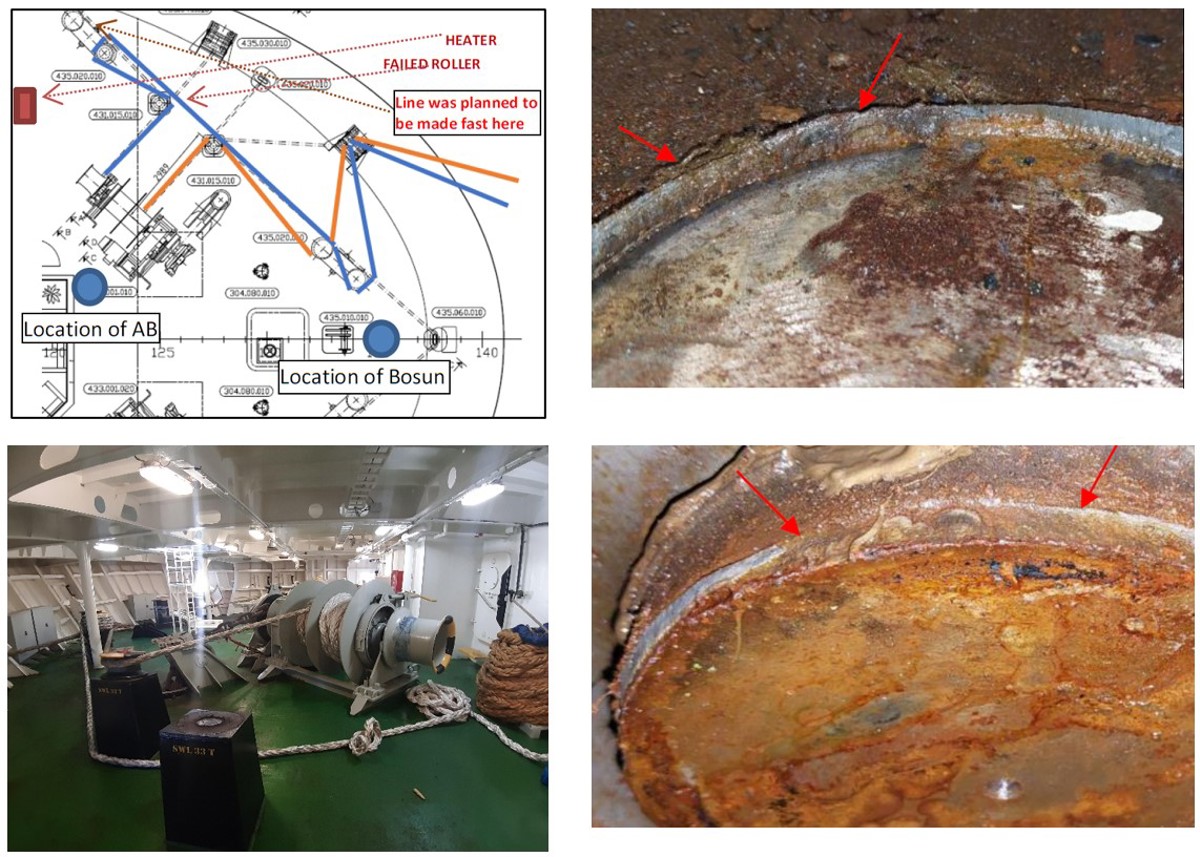
During mooring operations at the forward station when the 3rd head line (blue line in diagram below) was being heaved up using the warping head (the plan was to make it fast on a bollard to the aft of the failed roller) the deck stand roller pin parted from it’s base and hit a heater located just aft of this position.
There were no injuries. However, it is evident that any crew member standing in the line of fire of the damaged roller would have been seriously injured. The winch pulling force was 12 tonnes, the roller stand SWL was 33 tonnes.
What were the causes?
- The mooring layout on this vessel was complicated and also did not follow accepted and recommended practice, which caused overloading of structures;
- The routing of the mooring line caused an increase of axial forces on the roller;
- On further investigation it was noticed that roller pin was already in the process of degradation and at least some part of the welded structure had already disengaged from the base. The roller had not been inspected thoroughly;
- Multiple turns over various fittings increase the complexity of the mooring systems and introduce additional hazards such as complex snap back zones and overloading of structures.
Lessons learned
- Our member arranged to add to their Planned Maintenance System, dismantling and overhauling of deck stand guide rollers every third year;
- Ensure mooring plans use the most suitable and appropriate mooring arrangements;
- Avoid multiple turns which introduce complex snap back zones and additional hazards. Always discuss such risks as part of the daily planning and toolbox meeting;
- Be aware of your surroundings and of the line of fire.
Members may wish to refer to:
The following IMCA Safety promotional material and safety guidance is available to members:
Mooring practice safety guidance for offshore vessels when alongside in ports and harbours
In the line of fire
Mooring incidents
Line of fire
Related Safety Flashes
-
IMCA SF 03/19
27 February 2019
-
IMCA SF 15/18
20 July 2018
-
IMCA Safety Flashes summarise key safety matters and incidents, allowing lessons to be more easily learnt for the benefit of the entire offshore industry.
The effectiveness of the IMCA Safety Flash system depends on the industry sharing information and so avoiding repeat incidents. Incidents are classified according to IOGP's Life Saving Rules.
All information is anonymised or sanitised, as appropriate, and warnings for graphic content included where possible.
IMCA makes every effort to ensure both the accuracy and reliability of the information shared, but is not be liable for any guidance and/or recommendation and/or statement herein contained.
The information contained in this document does not fulfil or replace any individual's or Member's legal, regulatory or other duties or obligations in respect of their operations. Individuals and Members remain solely responsible for the safe, lawful and proper conduct of their operations.
Share your safety incidents with IMCA online. Sign-up to receive Safety Flashes straight to your email.