Offshore platform decommissioning near miss
- Safety Flash
- Published on 3 September 2024
- Generated on 24 October 2026
- IMCA SF 18/24
- 2 minute read
The Department of Energy, Mines, Industry Regulation and Safety of Western Australia (DEMIRS) has published Significant Incident Summary No. 6 relating to the unexpected movement of the Sinbad topsides during its removal in 2021. The summary can be found here.
What happened?
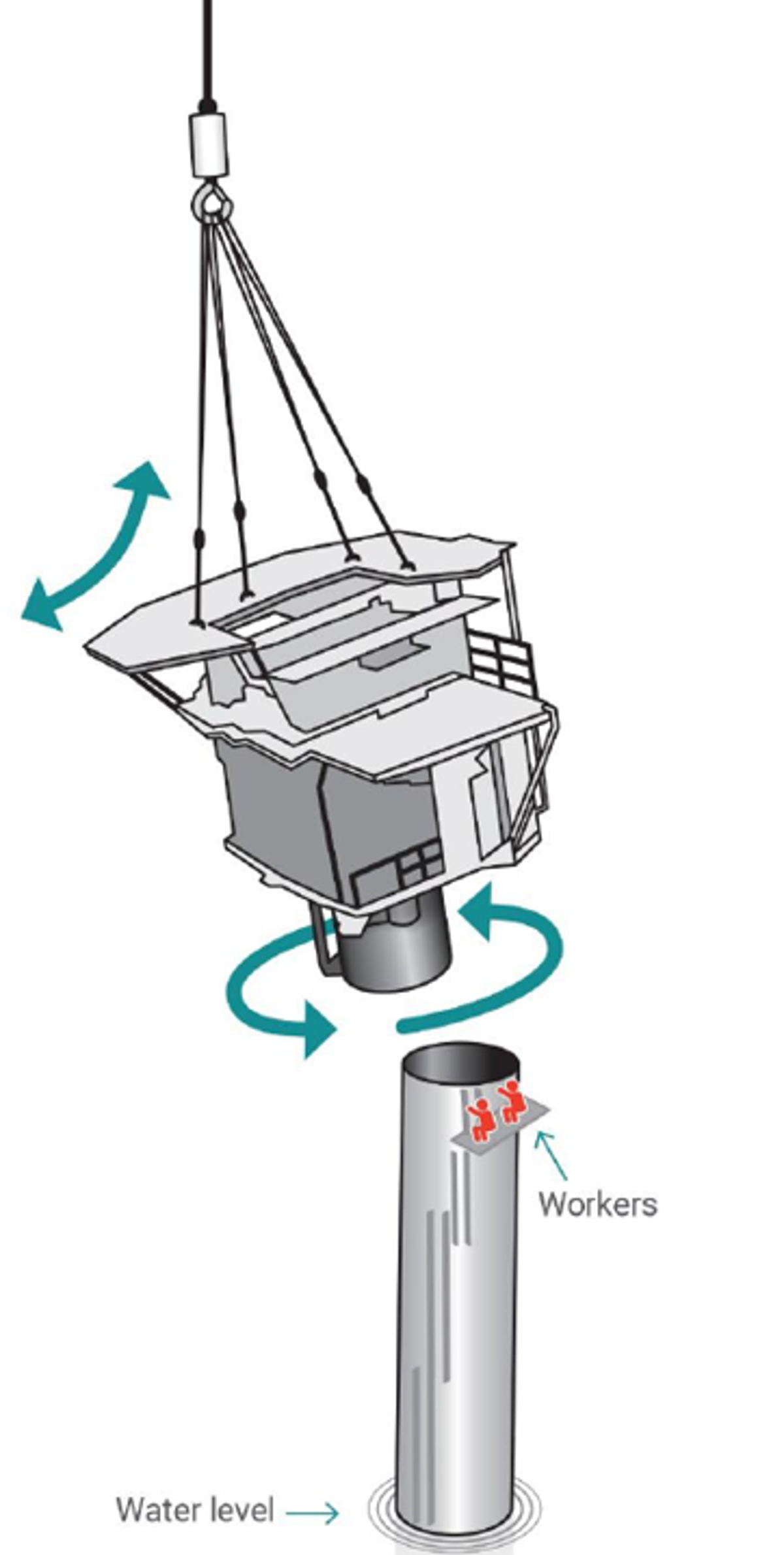
In 2021, there was a near miss incident for two workers beneath a swinging suspended load while decommissioning part of a monopod offshore platform in the northern waters of Western Australia. The workers were cutting through the monopod’s main leg (caisson) when the topside, which was rigged to a crane on a vessel, unexpectedly moved and detached from the supporting monopod and swung over the workers. The crane operator quickly manoeuvred the topside away from the workers, lowering it into the water to control its motion. The workers disembarked from the main leg to the designated crew safety vessel without incurring any injuries. The topside platform was safely retrieved onto the crane vessel.
Contributory factors
Factors assessed as having contributed to the incident included:
- Dynamic forces that could be applied to a rigged load while a crane was in auto-tensioning mode were inadequately understood or considered when developing the lift plan.
- The requirement for pre-load tension was not subject to adequate technical assessment.
- The platform rotated on separation; the engineering assessment did not identify the turning motion induced by pre-load tension.
- An over-reliance of previously successful methodologies rather than the analysis of their suitability to the specific tasks of this activity.
Actions
DEMIRS outlined the following measures to minimise the risk of a similar incident while conducting decommissioning activities:
- A technical assessment of lift plans to identify and consider all forces acting on a load, including forces which may be unintentionally applied due to automatic settings and crane modes.
- Use of castellated cut designs where a possibility of rotation (turning moment) of the load exists.
- Consider and assess the whole of life design, including commissioning and decommissioning procedures.
- Ensure workers are not under suspended loads.
Related Safety Flashes
-
IMCA SF 27/21
1 October 2021
-
IMCA Safety Flashes summarise key safety matters and incidents, allowing lessons to be more easily learnt for the benefit of the entire offshore industry.
The effectiveness of the IMCA Safety Flash system depends on the industry sharing information and so avoiding repeat incidents. Incidents are classified according to IOGP's Life Saving Rules.
All information is anonymised or sanitised, as appropriate, and warnings for graphic content included where possible.
IMCA makes every effort to ensure both the accuracy and reliability of the information shared, but is not be liable for any guidance and/or recommendation and/or statement herein contained.
The information contained in this document does not fulfil or replace any individual's or Member's legal, regulatory or other duties or obligations in respect of their operations. Individuals and Members remain solely responsible for the safe, lawful and proper conduct of their operations.
Share your safety incidents with IMCA online. Sign-up to receive Safety Flashes straight to your email.