BSEE: poorly maintained crane components cause multiple injuries during personnel transfers
- Safety Flash
- Published on 22 October 2026
- Generated on 22 October 2026
- IMCA SF 18/26
- 4 minute read
The United States Bureau of Safety and Environmental Enforcement (BSEE) has published Safety Alert 517 relating to poorly maintained crane components.
What happened?
The Bureau of Safety and Environmental Enforcement investigated two incidents involving injuries to offshore personnel during basket transfers. In both incidents, a crane’s auxiliary line descended unexpectedly while personnel were being transferred. The incidents show the importance of timely maintenance, correcting known deficiencies, using stop-work authority, communicating clearly during transfers, and planning for medical evacuations before work begins.
 |
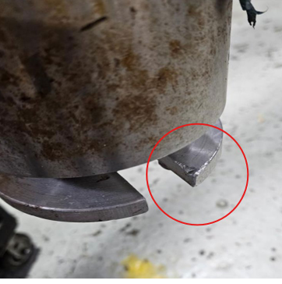 |
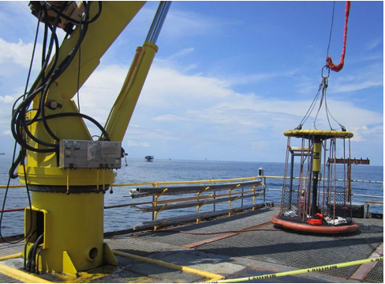
| Crane and personnel basket type involved in incident 1 | Incident 1: Scarring observed on the anti-two block |
Incident 1:
During a personnel transfer, a crane operator was lowering a worker in a rigid-type personnel basket to the deck of a motor vessel when the crane’s auxiliary line suddenly and uncontrollably dropped 2-3m before coming to an abrupt stop approximately 8m above the water. The worker remained in the basket but suffered injuries to the back and leg. The injured worker needed medical evacuation.
Incident 2:
During another personnel transfer using a platform crane and personnel basket, three workers were injured when the crane experienced repeated uncontrolled, rapid descents. As the basket cleared the handrail, it suddenly dropped approximately 30cm. Personnel inside the basket noticed the abnormal movement, and one passenger lost his footing. Personnel in the basket tried to signal the concern to the crane operator, but the crane operator continued lowering the basket to the motor vessel below. As the personnel basket approached the deck of the motor vessel, the crane operator could not control the descent. The basket rapidly dropped another 2.2m and landed abruptly on the deck, injuring personnel.
After the incident, the crane was not immediately taken out of service. The crane operator later attempted to use the crane’s auxiliary line for diesel filling operations. The auxiliary brake slipped again, causing the diesel tote tank to descend uncontrollably. Only then, did the crane operator take the crane out of service.
BSEE’s investigation found that the uncontrolled descent was caused by a loss of braking control on the auxiliary line because the auxiliary hoist braking system needed adjustment. The loose brake band allowed the hoist drum to rotate under load, resulting in the uncontrolled descent of the personnel basket and diesel tote tank. Facility personnel did not invoke Stop Work Authority (SWA) after the first uncontrolled descent.
Actions
The Bureau of Safety and Environmental Enforcement recommends that operators and their contractors, as appropriate, consider the following:
- Follow all manufacturers recommended maintenance intervals and complete repairs identified by certified maintenance technicians without delay.
- Correct previously identified crane deficiencies promptly and ensure maintenance and inspection records accurately reflect repair status.
- Increase awareness of aging, worn, or neglected crane components during inspections, especially brake systems, sheaves, bearings, and wire ropes.
- Train personnel to recognize brake band slippage, including early warning signs, periodic maintenance requirements and proper tightening practices.
- Conduct thorough pre-use inspections before personnel transfers, including verification that brakes respond properly under load.
- Verify during pre-use inspections that the auxiliary wire rope's dead-end loop is not fouling on the anti-two-block device. Consider installing a striker plate on the auxiliary line above the dead-end loop to help prevent fouling and damage to the anti-two-block device or wedge socket. Reinforce stop-work authority. Stop operations immediately after any uncontrolled or abnormal crane movement, and resume lifts only after qualified personnel inspect the crane and correct any deficiencies.
- Strengthen communication protocols during personnel transfers by using designated channels, call and response confirmations, and pre-job briefings. Ensure personnel understand the importance of properly responding to signals given by personnel.
IMCA Safety Flashes summarise key safety matters and incidents, allowing lessons to be more easily learnt for the benefit of the entire offshore industry.
The effectiveness of the IMCA Safety Flash system depends on the industry sharing information and so avoiding repeat incidents. Incidents are classified according to IOGP's Life Saving Rules.
All information is anonymised or sanitised, as appropriate, and warnings for graphic content included where possible.
IMCA makes every effort to ensure both the accuracy and reliability of the information shared, but is not be liable for any guidance and/or recommendation and/or statement herein contained.
The information contained in this document does not fulfil or replace any individual's or Member's legal, regulatory or other duties or obligations in respect of their operations. Individuals and Members remain solely responsible for the safe, lawful and proper conduct of their operations.
Share your safety incidents with IMCA online. Sign-up to receive Safety Flashes straight to your email.