Diver injured foot during high pressure water jetting
- Safety Flash
- Published on 22 October 2026
- Generated on 22 October 2026
- IMCA SF 18/26
- 3 minute read
A diver suffered a foot injury whilst working with high pressure water jetting (HPWJ) equipment.
What happened?
The incident occurred during saturation diving operations on an Underwater Wellhead Completion (UWC) at a depth of 34m. The task involved using handheld high pressure (8000psi) water jetting equipment to remove marine growth in preparation for inspection and pressure testing. The diver momentarily lost body position when the hogging line slipped off the UWC. As this happened, the HPWJ lance/nozzle passed across the diver’s left foot, causing a high-pressure injection injury and an approximately 4 cm laceration to the left big toe.
The dive was aborted immediately, the diver returned to the bell, and medical support was initiated.
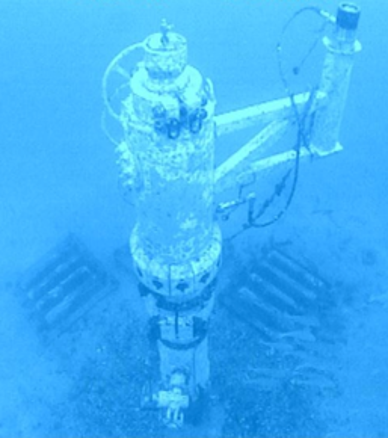 |
| Overview of Underwater Well Head Completion and the worksite |
What went wrong?
- The HPWJ lance/nozzle passed across the diver’s left foot while operating close to the diver’s lower limbs.
- The diver’s hogging line was placed on an outer/open edge of the UWC and slipped free, causing loss of body position.
- The diver’s foot and lower-leg protection was inadequate for handheld HPWJ work; neoprene wetsuit boots were used as standalone protection.
- The procedures and task-specific JSA for high pressure water jetting did not clearly specify IMCA D049 PPE requirements, safe working distance, prohibited body/lance positions, or stop-work triggers.
- The Dive Supervisor had repeatedly identified the same exposure hazard, but the activity was not stopped for reassessment, repositioning, or a change in work method.
Lessons learned
- Operate handheld high pressure water jetting equipment in such a way that the lance/nozzle can NEVER pass across any part of the diver’s body, especially hands, feet, and lower legs.
- Ensure that hard protection for hands, feet, and lower legs is specified, verified, and worn for handheld high pressure water jetting, in line with IMCA D049.
- Secure diver positioning is a critical control; hogging line routing and anchoring should be carefully checked before making the HPWJ “hot”.
- STOP the JOB: repeated verbal reminders about the same critical hazard are a stop-work signal, not a normal method of control.
Actions taken
- Revised the HPWJ procedure and HPWJ JSA template to fully incorporate IMCA D049 requirements, including mandatory hard hand, foot, and lower-leg protection.
- Defined minimum safe working distance/exclusion distance, prohibited lance/body positions, and mandatory stop-work triggers for HPWJ operations.
- Introduced a HPWJ critical control checklist covering PPE, pressure setting, “dead-man” function, nozzle type, safe working distance, worksite access, diver positioning, and emergency response before each HPWJ dive.
Members may wish to refer to:
Related Safety Flashes
-
IMCA SF 15/18
20 July 2018
-
-
IMCA SF 09/17
3 May 2017
-
-
IMCA SF 03/15
3 March 2015


IMCA Safety Flashes summarise key safety matters and incidents, allowing lessons to be more easily learnt for the benefit of the entire offshore industry.
The effectiveness of the IMCA Safety Flash system depends on the industry sharing information and so avoiding repeat incidents. Incidents are classified according to IOGP's Life Saving Rules.
All information is anonymised or sanitised, as appropriate, and warnings for graphic content included where possible.
IMCA makes every effort to ensure both the accuracy and reliability of the information shared, but is not be liable for any guidance and/or recommendation and/or statement herein contained.
The information contained in this document does not fulfil or replace any individual's or Member's legal, regulatory or other duties or obligations in respect of their operations. Individuals and Members remain solely responsible for the safe, lawful and proper conduct of their operations.
Share your safety incidents with IMCA online. Sign-up to receive Safety Flashes straight to your email.