LTI – worker fractured arm during mooring line handling
- Safety Flash
- Published on 3 October 2023
- Generated on 17 March 2026
- IMCA SF 23/23
- 2 minute read
A mooring rope (weighing 2.9 kg per metre) hit a crew member and broke their arm.
What happened?
A mooring rope (weighing 2.9 kg per metre) hit a crew person and broke their arm.
The incident occurred as crew were preparing to unmoor and move a barge.
The operation was proceeding as planned when one of the forward mooring station winches in use tripped out.
The mooring crew at the forward station informed the Chief Officer about the winch tripping, using UHF.
The mooring crew at the aft mooring station, on hearing this information, decided to stop the barge by adding an additional coil on the bollard.
Whilst one of the crew was attempting to coil the rope on the bollard, due to a sudden increase of tension on the line, control of the rope was lost, and the rope hit the worker on the left forearm causing the injury.
The injured person received first aid treatment promptly and was subsequently evacuated by helicopter.
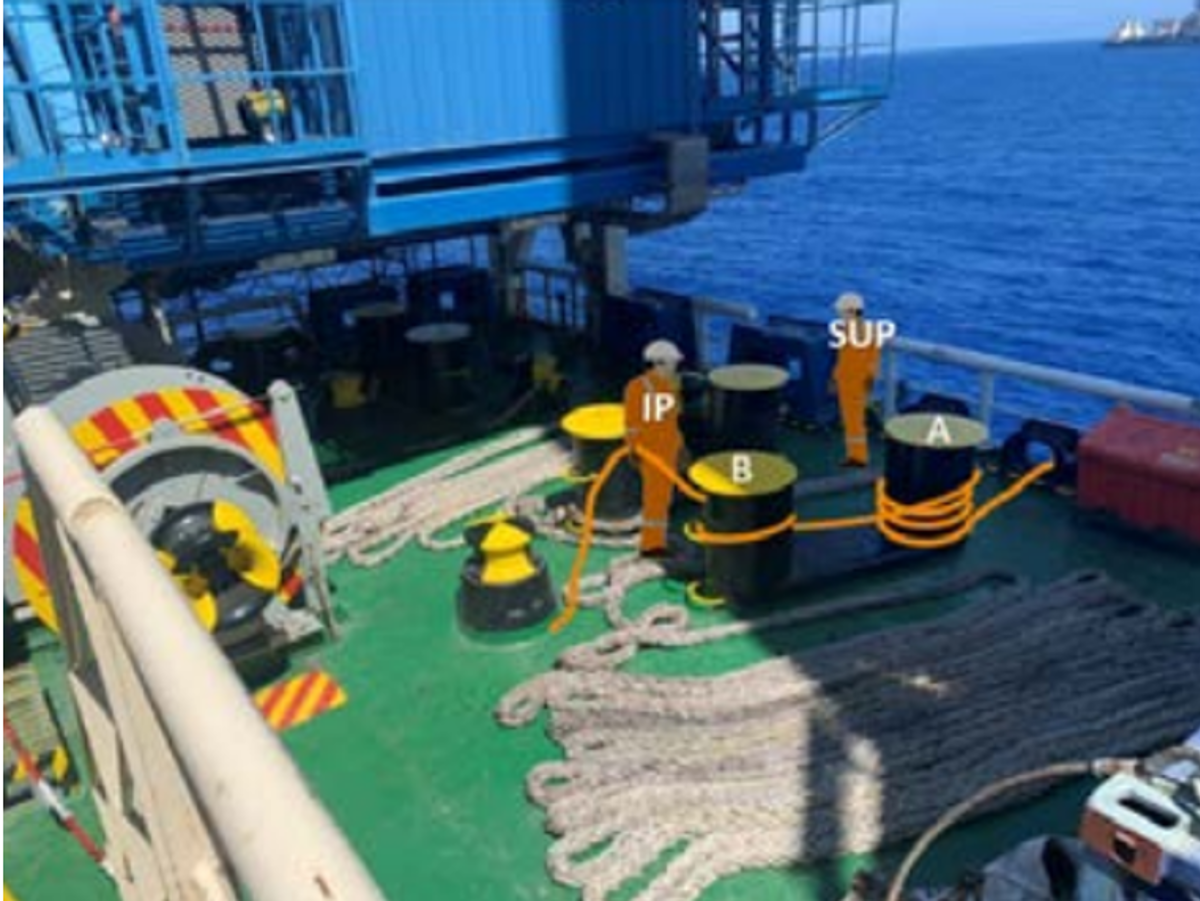
LTI – worker fractured arm during mooring line handling
What went wrong?
Confusion, because there was a lack of clear communication with no proper instructions during the operation.
The radio communication addressing the tripped winch was misunderstood at the aft mooring station as an "ALL STOP" signal.
Instructions were given to secure the mooring rope "in slack" by adding another loop into the bollard.
However, the barge was already moving and the mooring line came under tension due to that movement.
The injured person was in an unsafe position, with his arm in the line of fire.
Lessons and actions taken
- Over-confidence may lead to poor judgement and making mistakes – if in any doubt, follow the instructions.
- Minimise confusion and ensure there are clear and properly understood communications.
- Our member arranged:
- further training on Line of Fire risks
- refresher training for marine crew regarding hazards in mooring operation
- awareness sessions customised to the role and responsibility of the Team Leaders and Supervisors, addressing the key elements of their duties.
- further training on Line of Fire risks
Related safety flashes
-
IMCA SF 23/22
24 October 2022
-
-
IMCA SF 04/10
14 July 2010
-
IMCA SF 09/03
1 August 2003
IMCA Safety Flashes summarise key safety matters and incidents, allowing lessons to be more easily learnt for the benefit of the entire offshore industry.
The effectiveness of the IMCA Safety Flash system depends on the industry sharing information and so avoiding repeat incidents. Incidents are classified according to IOGP's Life Saving Rules.
All information is anonymised or sanitised, as appropriate, and warnings for graphic content included where possible.
IMCA makes every effort to ensure both the accuracy and reliability of the information shared, but is not be liable for any guidance and/or recommendation and/or statement herein contained.
The information contained in this document does not fulfil or replace any individual's or Member's legal, regulatory or other duties or obligations in respect of their operations. Individuals and Members remain solely responsible for the safe, lawful and proper conduct of their operations.
Share your safety incidents with IMCA online. Sign-up to receive Safety Flashes straight to your email.