Crush injury to hand while attempting to secure crane hook
- Safety Flash
- Published on 22 November 2019
- Generated on 21 October 2026
- IMCA SF 27/19
- 3 minute read
While attempting to secure a crane hook to the deck handrail with a polypropylene rope, a rigger’s right hand was caught between the hook shank and the handrail.
What happened?
The rigger sustained a severe crush injury to hand and wrist, which required medical evacuation and multiple surgery.
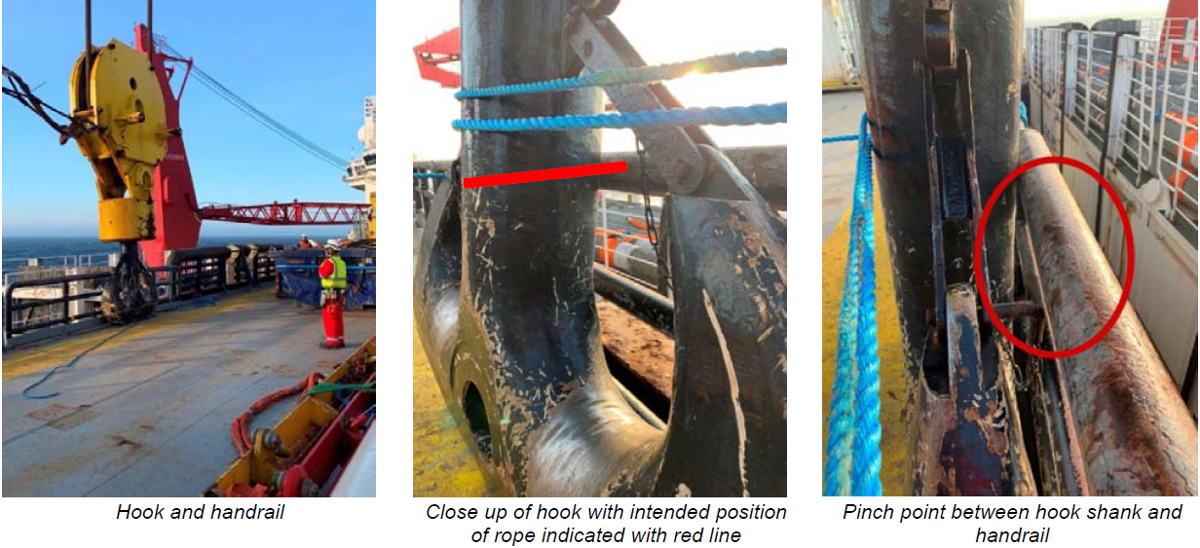
The task involved moving the auxiliary block (weight: 26Te) of the main crane to a location on deck where it could be handled for rigging purposes. The team decided to secure the block to the handrail.
The auxiliary block was banked into a position above the deck, before being lowered and slewed left to touch the hand railing.
Once the block was looking steady, the rigger moved in to secure the hook to the hand railing with a polypropylene rope.
This brought his right hand, which was now behind the shank, in the line of fire of the hook, which slowly moved towards the railing due to vessel rolling motion. His hand was then entrapped between the handrail and the hook shank. At the time of the incident environmental conditions were marginal but within operating limits.
What went wrong?
- The method chosen to stabilise the hook was not correctly evaluated or safely engineered and the hook was still moving; this placed the rigger in the line of fire.
- The crane block was not sufficiently stabilised.
- The rigger moved in to secure the block before a clear signal was given from the Banksman.
- The banksman did not stop or call back the rigger when he approached the load prior to clear signal.
What actions were taken?
- Ensure all high-risk sub-activities are risk assessed prior to start of work.
- Ensure that loads are stabilised before starting to work on them.
- Ensure rigging team members comply with their roles and responsibilities.
What lessons were learned?
- Risk management:
- Ensure that all high-risk activities are risk assessed and properly controlled. In particular, generic worksite task risk assessments should be reviewed, to evaluate if relevant sub-activities are adequately assessed.
- Stop the job if you believe a job cannot be executed safely – do not assume that others will do so.
- Ensure that all high-risk activities are risk assessed and properly controlled. In particular, generic worksite task risk assessments should be reviewed, to evaluate if relevant sub-activities are adequately assessed.
- Team performance:
- ensure all team members understand their roles and responsibilities
- follow the instructions you have been given
- exercise the authority that you have been given.
- ensure all team members understand their roles and responsibilities
IMCA publishes a wide range of [safety promotional material] which is applicable in this instance, including videos, pocket cards and safety posters.
Members may wish to refer to:
- IMCA D060, HSS019, LR006, M187 – Guidelines for lifting operations
Featured Safety Flashes
-
IMCA SF 28/16
18 October 2016
-
IMCA SF 13/12
11 December 2012
-
IMCA SF 05/11
29 June 2011
-
IMCA SF 03/05
1 March 2005
IMCA Safety Flashes summarise key safety matters and incidents, allowing lessons to be more easily learnt for the benefit of the entire offshore industry.
The effectiveness of the IMCA Safety Flash system depends on the industry sharing information and so avoiding repeat incidents. Incidents are classified according to IOGP's Life Saving Rules.
All information is anonymised or sanitised, as appropriate, and warnings for graphic content included where possible.
IMCA makes every effort to ensure both the accuracy and reliability of the information shared, but is not be liable for any guidance and/or recommendation and/or statement herein contained.
The information contained in this document does not fulfil or replace any individual's or Member's legal, regulatory or other duties or obligations in respect of their operations. Individuals and Members remain solely responsible for the safe, lawful and proper conduct of their operations.
Share your safety incidents with IMCA online. Sign-up to receive Safety Flashes straight to your email.