Line of fire near miss – almost a head injury
- Safety Flash
- Published on 15 October 2021
- Generated on 25 October 2026
- IMCA SF 28/21
- 3 minute read
During cable trans-spooling operations, a crew member almost suffered a very serious head injury.
What happened?
Whilst a messenger rope (a mooring line) was being pulled across from a cable vessel to a barge, a crew member was standing near the chute to visually monitor the operation.
Due to the height difference between vessel and barge, the messenger rope crept up as the pull tension increased, until it reached the top of the chute wall and exited the chute.
Due to the angle between vessel and barge, the rope violently shot sideways, striking the helmet of the crew member, knocking his helmet off his head. Had the rope been 10 cm lower (or the crew member have been 10 cm taller), he would have been hit on the head with potentially very serious (if not fatal) consequences.
Our member notes “that three weeks later, almost exactly the same thing happened on another vessel while offloading a cable to shore. Again, purely down to luck, a serious injury was prevented.”
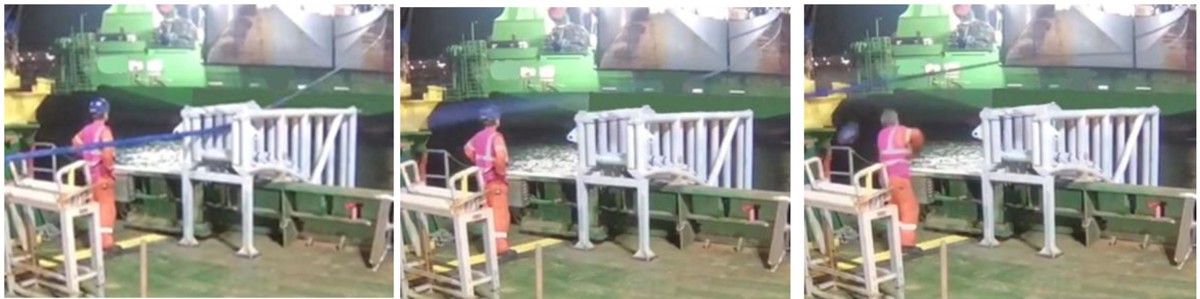
Stills from CCTV footage of the actual occurrence show the rope striking the crew member's helmet
Lessons learned
-
The angle and height difference between the vessel and the barge were not identified as hazards.
-
Identify risks for each separate operation, and use the Management of Change process if things change.
-
-
There was a difference between spooling speeds on each cable tank – they were not synchronised. This allowed tension to build up and caused the “climbing up” of the rope in the chute.
-
Ensure communication is clear and that everyone clearly understands what their role is.
-
Consider a practice or a dry run!
-
-
There was poor management of the cable tension between the two chutes. Had there been more slack this would have prevented this occurrence.
-
Follow the procedure and pay attention particularly when moving cable, rope or wire between winches.
-
-
A total of 12 crew members were watching the operation from different positions; nobody stopped the job!
-
Speak up! Dare to call an ALL STOP.
-
-
There was nothing to stop the rope exiting the chute.
-
Our contractor has modified all their chutes, adding a bar across the top to totally enclose the chutes during similar operations – safety by design.
-
-
Our Member notes:
-
Be aware of your surroundings.
-
Stay out of the line of fire of ropes under tension.
-
Do the Last Minute Risk Assessment prior each job.
-
Members may wish to refer to:
- In the line of fire (IMCA HSS036, video)
- Short video (“Be prepared to work safely”) Line of fire
Related Safety Flashes
-
IMCA SF 20/19
23 August 2019
-
-
IMCA SF 17/19
16 July 2019
-
IMCA Safety Flashes summarise key safety matters and incidents, allowing lessons to be more easily learnt for the benefit of the entire offshore industry.
The effectiveness of the IMCA Safety Flash system depends on the industry sharing information and so avoiding repeat incidents. Incidents are classified according to IOGP's Life Saving Rules.
All information is anonymised or sanitised, as appropriate, and warnings for graphic content included where possible.
IMCA makes every effort to ensure both the accuracy and reliability of the information shared, but is not be liable for any guidance and/or recommendation and/or statement herein contained.
The information contained in this document does not fulfil or replace any individual's or Member's legal, regulatory or other duties or obligations in respect of their operations. Individuals and Members remain solely responsible for the safe, lawful and proper conduct of their operations.
Share your safety incidents with IMCA online. Sign-up to receive Safety Flashes straight to your email.