Always be prepared – Erroneous relative GPS heading input jeopardises follow target operations
- DP Event
- Published on 1 August 2025
- Generated on 5 October 2026
- DPE 02/25
- 4 minute read
Incident
The DP equipment class 3 accommodation vessel was operating in good visibility, with 14 kts of wind, 0.8 DP current and approx. 1.3m waves. The vessel was operating with all six thrusters running and two of six generators connected to open busbars.
The vessel is equipped with multiple position reference systems, 2 DGNSS and relative reference systems included CyScan, Radius, Gangway sensors, and Relative GPS (DARPS).
The vessel was operating in DP follow-target mode with gangway connected to the FPSO. The DP was set to follow position and heading relative to the FPSO.
At 09:30, the DP system on the vessel experienced an unforeseen heading change of 20 degrees from the relative GPS system, although the FPSO did not actually change heading. At this time, the gangway was open for traffic with a green light, and the weather was calm.
The DPOs observed that the vessel started to move starboard while the DP system adjusted to an ‘assumed’ heading change of the FPSO to port. This unexpected alteration in heading and position caused a change in the gangway azimuth and shortened the distance between the installations. Consequently, the FPSO Central Control Room (CCR) was contacted to verify their heading. The FPSO Central Control Room confirmed a steady heading at 280° and reported no heading change.
Due to the increased heading difference between calculated transponder-based heading and relative GPS based heading, the DP system rejected the transponder-based heading input and used the relative GPS as the only heading reference. Subsequently, the vessel followed an incorrect heading change to port with 20 degrees. After verifying that the vessel was stationary and the FPSO was steady, the decision was made to switch to AutoPos mode. The vessel returned to its normal work position in AutoPos, confirming a total move of 29 metres. The closest distance steel-to-steel was estimated to be 26 metres (below seawater level).
The following operational measures were taken immediately:
- The gangway traffic system was switched to red and gangway cabin was manned.
- FPSO heading and position were confirmed with the Central Control Room through VHF radio.
- When the movement stopped, the relative GPS was deselected from DP system and the vessel moved back to original position through DP Auto positioning (AutoPos) mode.
- All personnel living on the accommodation vessel were called back.
- The gangway was disconnected, and the vessel moved to stand by position and initiated investigation of the recent occurrence.
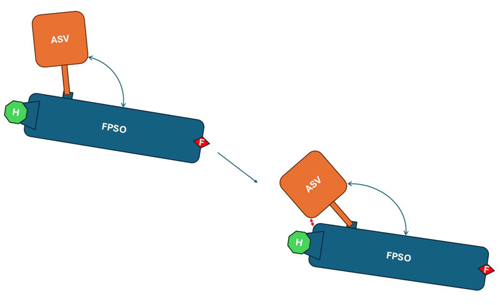
On investigation, the following was found:
- FPSO heading sensor used a single frequency receiver (L1) which was sensitive to noise.
- The FPSO heading sensor was the primary input in to the Relative GPS used for target heading.
- Due to disturbances on the GPS signals, the FPSO heading sensor started to drift, which resulted in an incorrect heading value for the vessel.
- It has been estimated that the FPSO experienced a faulty heading change by 20 degrees to port.
- It was confirmed that throughout the event the FPSOs actual heading remained steady.
The DP system on the vessel was designed to use two of the heading inputs, when partaking in follow target operations. So though the vessel was equipped with multiple relative position reference systems only two were utilised by the DP control system, a relative transponder-based (CyScan or RADius) and a relative GPS (DARPS). Each contributes equally, with a 50/50 weight distribution to calculate the estimated target heading. This is used for “follow heading” in follow target operations.
Both transponder and relative GPS were rejected when the deviation from estimated target heading exceeded 5°, only the relative GPS (with faulty heading) was recognised by the DP system with a valid status and accepted by the DP as target heading input. The DP follow target software design had neither been developed nor tested in a scenario comparable to the one experienced during the event.
Following the event and subsequent investigations the organisation discovered that the verification or engineering evaluation on the integration of the relative GPS to the FPSO heading sensor system was lacking. Based on the event, the DP system manufacturer initiated a process to update the DP follow target software to include a functionality with improved weight handling of target heading inputs.
The company identified the need to:
- Implement stricter validation processes for inputs to the DP system to prevent incorrect data from being used.
- Increase awareness about the DP system’s limitations and the importance of being aware of any unexpected movements or actions.
- Include the event into the rotation of DP drill scenario’s and advanced Bridge Resource Management (BRM) DP simulator training for vessels crew.
- Review and update DP Follow Target practices and procedures.
Latest DP incidents
-
Know your equipment, or at least where to find the answers
During an update in the Follow Target Mode, the crew noticed an anomaly with joystick control.
DPE 02/26
1 September 2026
Observation
-
New equipment, unexpected consequences
During the operation, a loss of DGNSS correction signals was experienced across multiple vessel DGNSS units.
DPE 02/26
1 September 2026
Incident
-
A chain of small failures leads to a major consequence
While conducting cargo operations on DP a vessel experienced a partial blackout caused by an unexpected shutdown of generator 3
DPE 02/26
1 September 2026
Incident
-
Holding position, losing references
While approaching a turret-moored, weather-vaning offshore installation (FPSO), in preparation for cargo operations, a DP equipment class 2 vessel experienced significant rolling of up to 15–20° due to a long-period swell close to the vessel’s natural roll period, resulting in a resonance effect
DPE 02/26
1 September 2026
Observation
-
DP drill scenario – Loss of seawater cooling pump redundancy
Exercise scenario – Loss of seawater cooling pump redundancy
DPE 02/26
1 September 2026
Drill Scenario
The case studies and observations above have been compiled from information received by IMCA. All vessel, client, and operational data has been removed from the narrative to ensure anonymity. Case studies are not intended as guidance on the safe conduct of operations, but rather to assist vessel managers, DP operators, and technical crew.
IMCA makes every effort to ensure both the accuracy and reliability of the information, but it is not liable for any guidance and/or recommendation and/or statement herein contained.
Any queries should be directed to DP team at IMCA. Share your DP incidents with IMCA online. Sign-up to receive DP event bulletins straight to your email.