LTI – back injury
- Safety Flash
- Published on 12 January 2026
- Generated on 12 April 2026
- IMCA SF 01/26
- 4 minute read
A member of the crew of a crew transfer vessel (CTV) badly pulled their back whilst helping with mooring operations.
What happened?
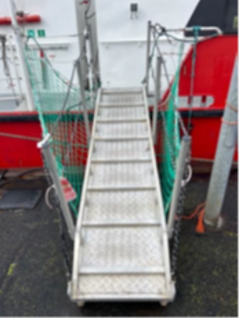
A member of the crew of a crew transfer vessel (CTV) badly pulled their back whilst helping with mooring operations during a vessel departure from port for an offshore wind farm. The Master was on the bridge conducting pre-departure checks, while the mate and the Able Seaman were on deck. The Mate was at the mooring station preparing to release the vessel’s lines, and Able Seaman was stowing the vessel’s gangway.
During normal operations, the gangway is stored on the quay while the vessel is operating in the field. After removing the lashings and securing ropes, the Able Seaman used a line to lower the raised end of the gangway down onto the quay. While doing this, the AB experienced a sudden and severe pain in the lower back, and cried out in pain. The job was stopped and the AB was assisted to a chair for assessment and rest.
Throughout the night, the AB’s condition worsened, and the following morning, medical attention was requested. After examination by a doctor, a suspected herniated disc (lumbago/lower back injury) was diagnosed. Subsequently, a medical professional declared the AB unfit for duty, and they were sent home.
What went right?
- The weather and light were appropriate for the kind of work being done.
- There was no slip hazard present.
- There was no time pressure nor operational constraint influencing the crew’s actions.
- The AB was well-trained, experienced and qualified.
- There were no obvious equipment failures nor maintenance issues contributing to the incident.
What went wrong?
Some notes from our member’s report:
- The task of removing or stowing the gangway prior to sailing was not specifically addressed within the risk assessment.
- The risk associated with manual handling during gangway operations was underestimated or insufficiently controlled.
- The absence of mechanical lifting aids, combined with single-person execution resulted in conditions which led to an injury.
- Statement provided by the Master indicated that the IP has said the injury was caused due to an awkward movement made while attempting to lower the gangway to the quay.
Due to the vessel’s crane configuration, the final positioning, securing, and rigging of the gangway must be completed through manual handling rather than by crane.
What was the cause?
The injury occurred due to insufficient procedural controls and risk assessment for gangway handling, combined with unclear gangway weight information and single-person execution, which exposed personnel to a risk of injury.
· Why did the AB get injured? Because of lone manual handling of a gangway in such a way as caused sudden strain to the lower back;
· Why was the gangway manually handled by one person only? Because the task was performed without mechanical aids and no other personnel were assigned to assist;
· Why were mechanical aids or additional personnel not used? Because existing procedures and risk assessments did not explicitly require two-person handling and alternative lifting methods for gangway rigging were not possible due to crane position;
· Why did procedures and risk assessments not address gangway handling adequately? Because the task was not previously recognised as a high-risk operation requiring specific controls. Previous risk reviews had not fully considered the combination of task frequency, vessel layout constraints, and uncertainty regarding gangway weight.
Lessons learned
- Ideally have two person handling for all gangway operations when mechanical aids cannot be used.
- Review and update all relevant risk assessments to explicitly include gangway handling, specifying safe handling limits and required personnel.
- Record and verify the exact weight of all gangways across the fleet.
- Can the task be done in a better, smarter way – e.g. can the gangway access can be moved to the bow?
Related Safety Flashes
-
IMCA SF 26/22
23 November 2022
-
IMCA SF 11/22
4 May 2022
-
IMCA SF 14/21
20 May 2021
-
-
IMCA SF 11/21
16 April 2021
-
IMCA Safety Flashes summarise key safety matters and incidents, allowing lessons to be more easily learnt for the benefit of the entire offshore industry.
The effectiveness of the IMCA Safety Flash system depends on the industry sharing information and so avoiding repeat incidents. Incidents are classified according to IOGP's Life Saving Rules.
All information is anonymised or sanitised, as appropriate, and warnings for graphic content included where possible.
IMCA makes every effort to ensure both the accuracy and reliability of the information shared, but is not be liable for any guidance and/or recommendation and/or statement herein contained.
The information contained in this document does not fulfil or replace any individual's or Member's legal, regulatory or other duties or obligations in respect of their operations. Individuals and Members remain solely responsible for the safe, lawful and proper conduct of their operations.
Share your safety incidents with IMCA online. Sign-up to receive Safety Flashes straight to your email.