Lifting post failure on survey equipment
- Safety Flash
- Published on 4 April 2012
- Generated on 15 October 2026
- IMCA SF 03/12
- 3 minute read
A Member has reported an incident in which a lifting post fractured completely, leaving equipment hanging overboard by only a hold-back safety tether and electrical umbilical.
What happened?
The incident occurred during a planned dive when survey equipment was being deployed subsea to the seabed. The vessel was set up to give a 30 metre (m) over-boarding safe zone from subsea assets. At the time the survey equipment was being over-boarded from the port side using the Cherry Picker crane, the divers were under their bell on the stand-off stage as per standard procedure.
The design lift point for the equipment was a central lifting post which was bolted onto the equipment. This had a plate on it rating it to a safe working load (SWL) of 500 kilograms (kg) and was issued with a test certificate in October 2010, when it was tested to twice the SWL. The central lifting post consisted of two pieces of aluminium box section with one section being welded inside the other (see images). A short rope hold back safety tether was also attached, connecting the equipment to the Cherry Picker hook, which was to restrain the load on failure of the lifting post. The total weight of the unit in air was 270kg.
As the lift commenced there was a moderate sea state with a 1.25 to 2.5m swell. As the equipment was lowered through the splash zone, at about 5m depth, the lifting post fractured completely. This left the equipment hanging on the hold-back safety tether and the electrical umbilical.
The operation was halted immediately and the bridge and Divers informed of the situation. The equipment was lowered to the seabed where the divers re-rigged it with a four point lifting bridle (4 x 2 ton x 3m slings). The equipment was then successfully recovered to the deck. There were no injuries and, apart from the failed lifting post, no damage to equipment.

Equipment
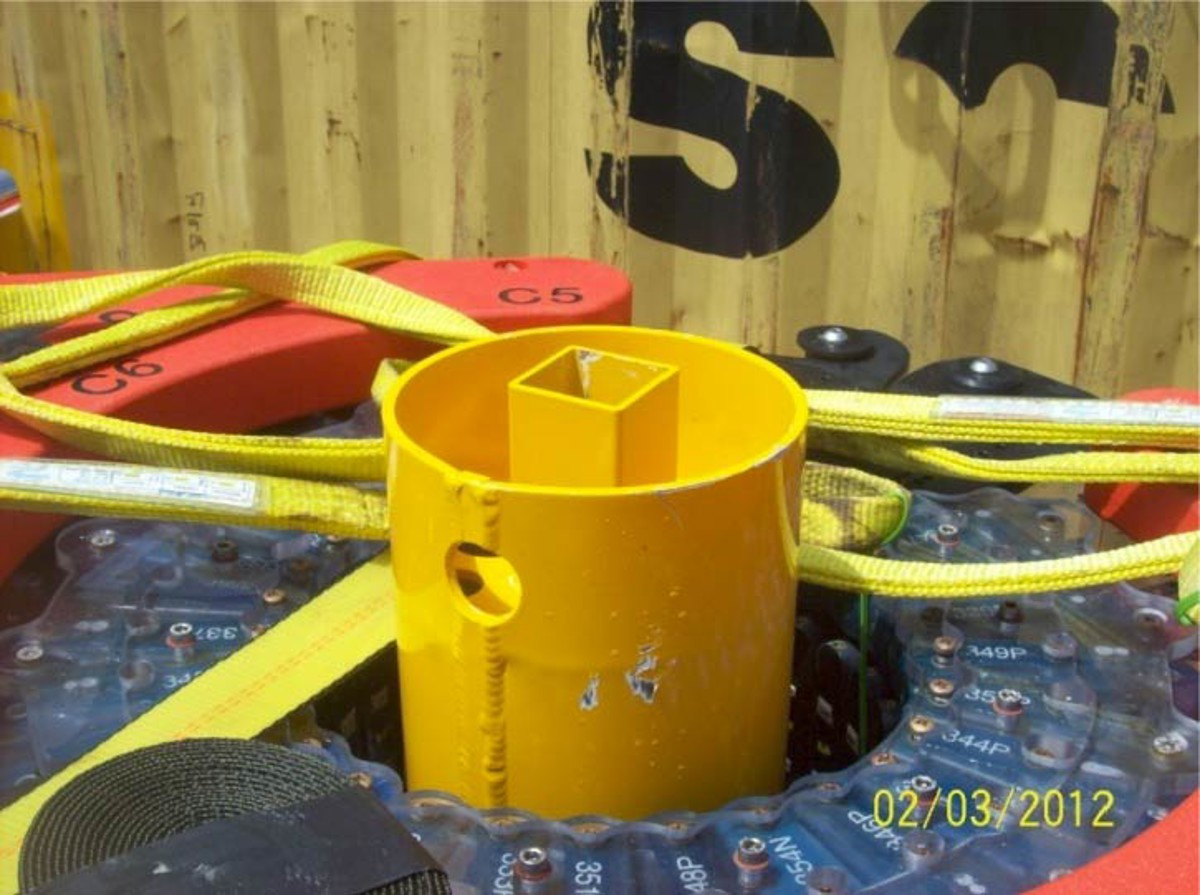
Attachment point

Failed lifting post

Failed lifting post
Following an inspection and investigation, the following points were noted:
- The central lifting post had failed where the lower box section entered the upper box section. This area was not a welded joint. The weld connection was above this on all four sides through cut outs in the upper box section.
- The lifting arrangement for the equipment was inadequate for deployment subsea, as the additional forces of the splash zone had not been sufficiently factored into the design.
The following actions were taken:
- Stopped use of this lifting arrangement until a new and safer design could be developed.
- Quarantine of spare lifting post and equipment owner informed that the Lifting certificate should be withdrawn.
- Check with other projects and with IMCA member’s to see if they are using similar equipment, and quarantine as necessary.
- Until suitable lifting points are designed and tested, all lifting of the tool shall be via basket with certified lifting points.
IMCA Safety Flashes summarise key safety matters and incidents, allowing lessons to be more easily learnt for the benefit of the entire offshore industry.
The effectiveness of the IMCA Safety Flash system depends on the industry sharing information and so avoiding repeat incidents. Incidents are classified according to IOGP's Life Saving Rules.
All information is anonymised or sanitised, as appropriate, and warnings for graphic content included where possible.
IMCA makes every effort to ensure both the accuracy and reliability of the information shared, but is not be liable for any guidance and/or recommendation and/or statement herein contained.
The information contained in this document does not fulfil or replace any individual's or Member's legal, regulatory or other duties or obligations in respect of their operations. Individuals and Members remain solely responsible for the safe, lawful and proper conduct of their operations.
Share your safety incidents with IMCA online. Sign-up to receive Safety Flashes straight to your email.