Low pressure mud hose parted
- Safety Flash
- Published on 19 April 2011
- Generated on 23 October 2026
- IMCA SF 04/11
- 2 minute read
A Member has reported an incident in which a low pressure mud hose parted.
What happened?
The incident occurred during the disconnecting and lifting of the mud hose from a vessel to a platform.
The mud hose was disconnected from the vessel manifold, and the vessel banksman gave a signal to the crane operator to lower the sling. The hose was attached to the sling and a signal was given to raise the hose. The intent was that the crane should take the weight of the hose and then the securing line from the vessel to the hose could be more easily disconnected. However, the crane operator misunderstood the hand signals and continued to lift whilst the hose was still lashed to the vessel. As a result the coupling and hose parted.
As transfer of mud had stopped, there was no spill and there were no injuries.
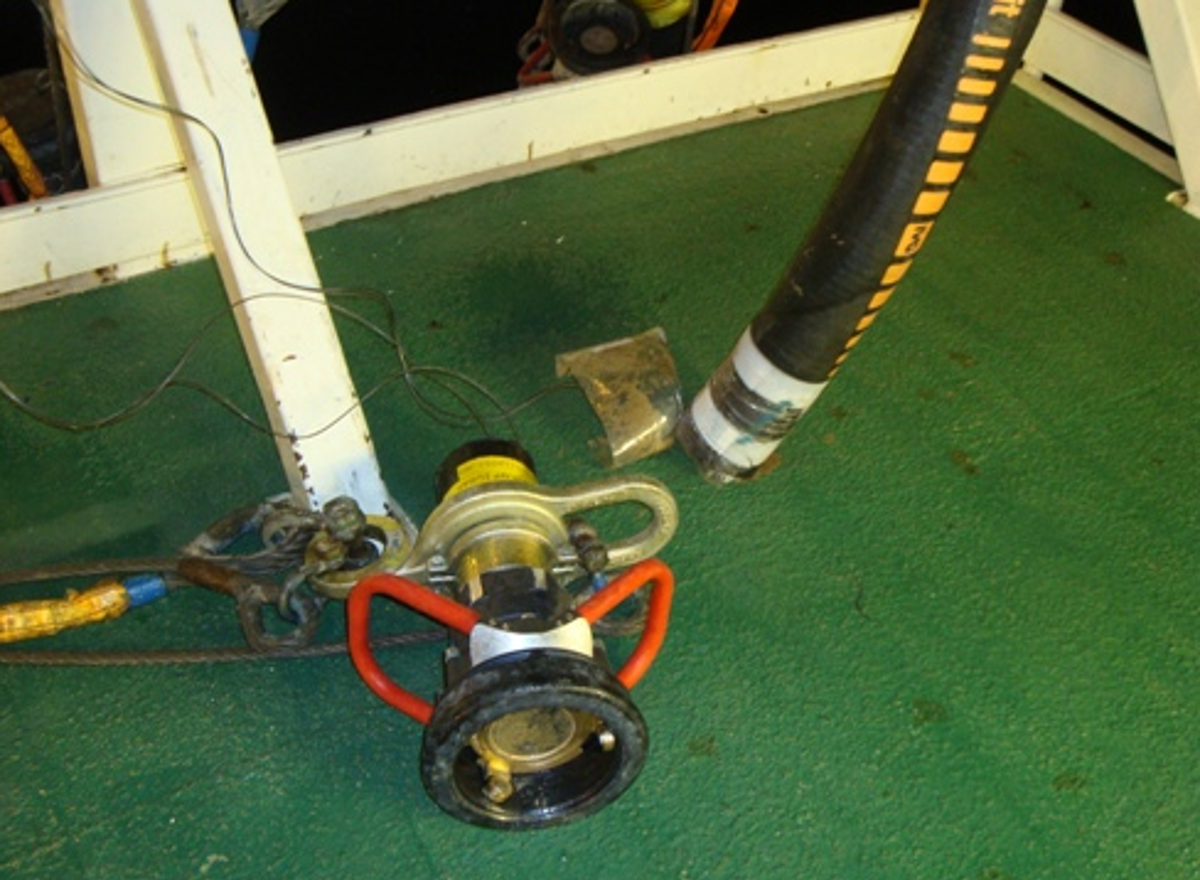
mud hose and connector following incident
What were the causes?
Our member investigated and noted the following immediate causes of the incident:
- Procedures not understood.
- The crane operator may not have been aware that the hose was lashed to the vessel.
- There was poor visibility at the time of the incident owing to heavy rain.
The following root causes were identified:
- Communication between work groups was not effective . poor visibility noted at the time of the incident, and the crane driver may not have seen the stop sign by the banksman.
- The banksman did not have direct very high frequency (VHF) communication with the crane operator.
Lessons learnt
The following lessons were learnt:
- There should be clear and continuous radio communication between vessel master and the crane operator and banksman during lifting operations.
- Hand signals can be used provided the banksman can always be clearly seen by the crane operator. In conditions of poor visibility, radio communication between banksman and crane operator should be clear and continuous.
With regard to communications during lifting operations, Members may wish to review IMCA’s guidance on this topic:
IMCA Safety Flashes summarise key safety matters and incidents, allowing lessons to be more easily learnt for the benefit of the entire offshore industry.
The effectiveness of the IMCA Safety Flash system depends on the industry sharing information and so avoiding repeat incidents. Incidents are classified according to IOGP's Life Saving Rules.
All information is anonymised or sanitised, as appropriate, and warnings for graphic content included where possible.
IMCA makes every effort to ensure both the accuracy and reliability of the information shared, but is not be liable for any guidance and/or recommendation and/or statement herein contained.
The information contained in this document does not fulfil or replace any individual's or Member's legal, regulatory or other duties or obligations in respect of their operations. Individuals and Members remain solely responsible for the safe, lawful and proper conduct of their operations.
Share your safety incidents with IMCA online. Sign-up to receive Safety Flashes straight to your email.