BSEE: Falling corroded crane component results in near miss
- Safety Flash
- Published on 3 March 2026
- Generated on 3 March 2026
- IMCA SF 04/26
- 3 minute read
The United States’ Bureau of Safety and Environmental Enforcement (BSEE) has published Safety Alert 511 relating to a near-miss dropped object incident on an offshore platform during the maintenance and inspection of a platform crane.
What happened?
While the crane was undergoing maintenance, a corroded cable runner on the crane’s boom separated and fell approximately 16m to deck. The cable runner was approximately 1.7m long, 2.5cm in diameter, and weighed approximately 8 kg. When the cable runner separated and fell, it landed on deck approximately 6m from nearby personnel.
A DROPS calculation (see https://www.dropsonline.org/drops-guidance-and-resources/drops-calculator/) indicates that this dropped object posed a threat of serious injury or fatality.
What went wrong?
- Corrosion was found to have compromised the integrity of the cable runner, causing it to separate from the crane’s boom and fall.
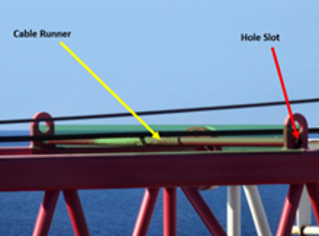
Corroded crane boom cable runner / roller on crane boom.
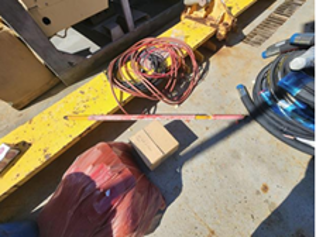
Area where cable roller / runner landed.
- The crane had been out of service for over three years before the incident. The most recent annual inspection of the crane, conducted in 2022, identified significant corrosion on the crane’s boom, including the cable rollers/runners. Before the incident, the operator had failed to carry out the recommended repairs noted in the inspection report.
- During job planning, the team did not identify the crane boom and its components as a hazard. The crane technicians identified only hand tools as falling-object hazards in the job safety analysis (JSA) and overlooked the need for barricades or warning signs for the task.
- The technicians failed to barricade the area underneath the crane before starting operations, and to prevent personnel from entering the area, given the possibility of dropped objects identified in the JSA.
- During the pre-job assessment, supervision failed to ensure that the area where work was to be performed was properly secured and that no unnecessary personnel entered the area with dropped object risks.
Lessons suggested
- Take particular care with potential DROPS hazards when dealing with older equipment and equipment, installations and vessels that are being reactivated after a period of inactivity.
- Having identified a DROPS hazard, establish barriers and other controls to minimize the risk to personnel and equipment below.
- Ensure everyone involved is fully aware of the risks and hazards involved in the job and has had the opportunity to provide input on identifying and mitigating any potential hazards present.
- Emphasize increased awareness of aging and/or previously unmaintained equipment during maintenance, inspections or decommissioning.
Related Safety Flashes
-
IMCA SF 17/25
17 September 2025
-
IMCA SF 05/20
13 February 2020
-
-
IMCA SF 25/22
10 November 2022
IMCA Safety Flashes summarise key safety matters and incidents, allowing lessons to be more easily learnt for the benefit of the entire offshore industry.
The effectiveness of the IMCA Safety Flash system depends on the industry sharing information and so avoiding repeat incidents. Incidents are classified according to IOGP's Life Saving Rules.
All information is anonymised or sanitised, as appropriate, and warnings for graphic content included where possible.
IMCA makes every effort to ensure both the accuracy and reliability of the information shared, but is not be liable for any guidance and/or recommendation and/or statement herein contained.
The information contained in this document does not fulfil or replace any individual's or Member's legal, regulatory or other duties or obligations in respect of their operations. Individuals and Members remain solely responsible for the safe, lawful and proper conduct of their operations.
Share your safety incidents with IMCA online. Sign-up to receive Safety Flashes straight to your email.