MAIB: High pressure oil leak causes a fire in the engine room
- Safety Flash
- Published on 12 June 2023
- Generated on 17 October 2026
- IMCA SF 14/23
- 2 minute read
The UK Marine Accident Investigation Branch (MAIB) has published Safety Digest 1/2023, consisting of lessons from recent Marine Accident Reports.
What happened?
IMCA has reviewed the digest and here passes on for members interest some but not all of the incidents in it.
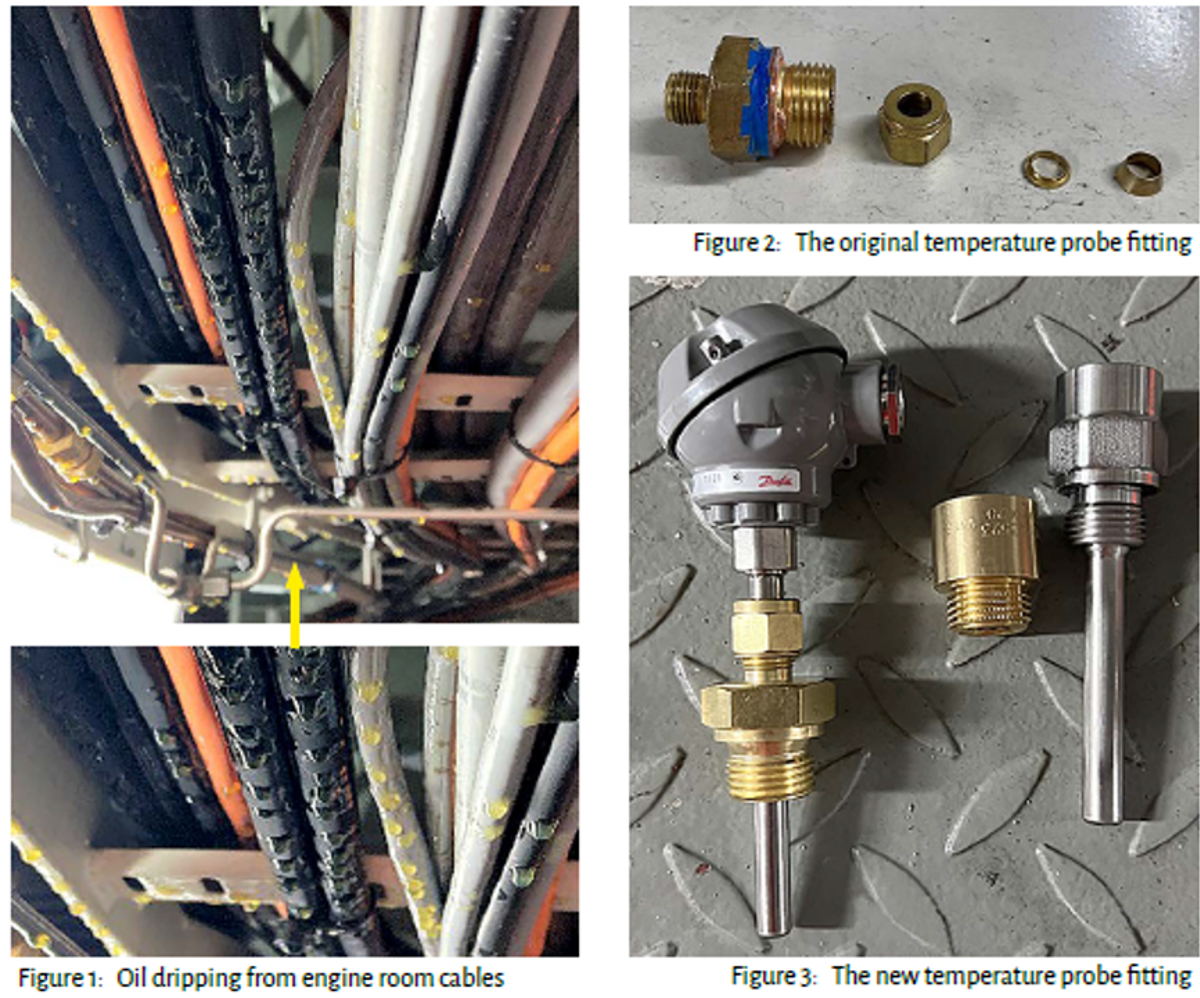
A recently built vessel was on passage when a gearbox temperature probe was ejected from its fitting by oil at 25 bar. A jet of gearbox oil sprayed a major part of the engine room including one of the running main engines.
The gearbox low oil pressure alarm sounded on the bridge; the vessel’s engineers stopped the engines. The Master was informed, and the vessel went to emergency stations; the designated firefighting prepared to fight the fire.
The oil had saturated the main engine exhaust lagging, which had started to smoke. The oil-soaked lagging ignited but was quickly smothered in fire-fighting foam; subsequent small fires were similarly dealt with.
The vessel was able to make its way safely back to port for repairs and cleaning.
What went right?
- The crew responded in a professional way to an unexpected event that could easily have resulted in a major fire.
- Not only did they quickly go to emergency stations but they placed foam extinguishers near the oil‑soaked engine so that lagging fires could be quickly dealt with.
- Knowing your emergency procedures and equipment pays dividends when a real situation occurs.
What went wrong?
Investigation identified that the temperature probe was held in place by a pipe compression fitting that had not been fully tightened during the vessel build.
Once the fitting slackened further, there was nothing to stop the oil pressure forcing the probe out of the gearbox.
Actions
- There’s always a “snag list” in a new vessel or after a dry dock. Some faults will only appear later. Monitor equipment much more closely at such times.
- Safety by design: the design of the probe fitting was insubstantial in terms of the operating environment and the consequences of it coming loose. Poorly designed equipment increases the risk of injury to the crew and can force them into undesirable workarounds. In this case, the manufacturer produced a redesigned fitting and probe housing that would prevent reoccurrence and allow the probe to be changed while the propulsion system was working.
Related safety flashes
-
IMCA SF 08/22
1 April 2022
-
IMCA SF 04/15
20 March 2015
-
IMCA SF 10/14
30 June 2014
IMCA Safety Flashes summarise key safety matters and incidents, allowing lessons to be more easily learnt for the benefit of the entire offshore industry.
The effectiveness of the IMCA Safety Flash system depends on the industry sharing information and so avoiding repeat incidents. Incidents are classified according to IOGP's Life Saving Rules.
All information is anonymised or sanitised, as appropriate, and warnings for graphic content included where possible.
IMCA makes every effort to ensure both the accuracy and reliability of the information shared, but is not be liable for any guidance and/or recommendation and/or statement herein contained.
The information contained in this document does not fulfil or replace any individual's or Member's legal, regulatory or other duties or obligations in respect of their operations. Individuals and Members remain solely responsible for the safe, lawful and proper conduct of their operations.
Share your safety incidents with IMCA online. Sign-up to receive Safety Flashes straight to your email.