LTI during mooring operations
- Safety Flash
- Published on 23 August 2019
- Generated on 5 October 2026
- IMCA SF 20/19
- 2 minute read
During mooring operations in the forward mooring deck of a large vessel, crew were in the process of sending out lines to line handlers ashore.
What happened?
When sending out the last breast line, they lost control and the line was slackened out in force.
Despite shouted warnings to the contrary, the crewman closest to the line tried stopping it with his hands.
The force of the line’s movement resulted in a hairline fracture to his right hand.
Medical treatment was given on-board before signing off the same day/port to recover from his injury.
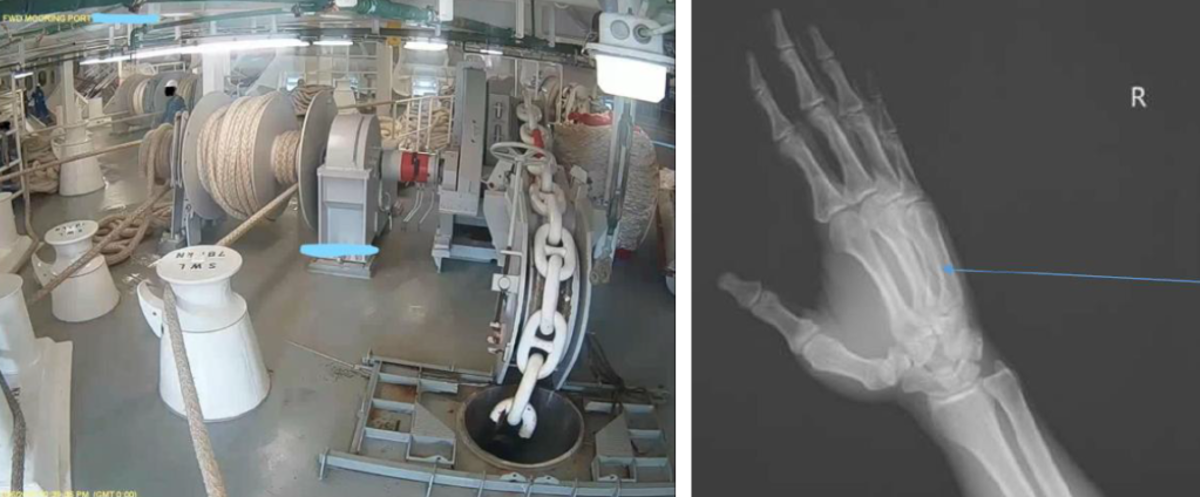
What went wrong?
- Warning: the bosun observed what was happening and shouted out a warning to the crew not to attempt stopping the line. This warning was possibly not heard by the crewman who was closest to the line who tried stopping it with his hands.
- The injured crew member had more than 10 years’ experience as a carpenter on similar vessels/operations, but did not have an STCW A II/5 licence, nor could it be documented that he had received equivalent training on board as required by the company.
- The Bosun oversaw the mooring operation on the forward mooring deck. No Officer was in charge as required by company procedures.
What were the causes?
- The force of the rapidly moving line was misjudged when deciding to attempt stopping it by hand.
- The mooring operations were being conducted without an officer in charge and with crew members lacking appropriate qualification requirements.
- The existing company procedures for mooring operations were neither followed nor enforced.
- The risk of events such as this occurring had not been assessed.
Actions
Members may wish to refer to:
- IMCA HSS029, M214: Mooring practice safety guidance for offshore vessels when alongside in ports and harbours
- IMCA safety promotional video: In the line of fire
- IMCA safety promotional video: Mooring incidents
IMCA Safety Flashes summarise key safety matters and incidents, allowing lessons to be more easily learnt for the benefit of the entire offshore industry.
The effectiveness of the IMCA Safety Flash system depends on the industry sharing information and so avoiding repeat incidents. Incidents are classified according to IOGP's Life Saving Rules.
All information is anonymised or sanitised, as appropriate, and warnings for graphic content included where possible.
IMCA makes every effort to ensure both the accuracy and reliability of the information shared, but is not be liable for any guidance and/or recommendation and/or statement herein contained.
The information contained in this document does not fulfil or replace any individual's or Member's legal, regulatory or other duties or obligations in respect of their operations. Individuals and Members remain solely responsible for the safe, lawful and proper conduct of their operations.
Share your safety incidents with IMCA online. Sign-up to receive Safety Flashes straight to your email.