Crane contact with pipelay tower resulting in dropped object
- Safety Flash
- Published on 19 August 2021
- Generated on 26 October 2026
- IMCA SF 23/21
- 2 minute read
A crane made contact with a pipelay tower handrail during a routine lifting operation, resulting in a serious dropped object event; there were no injuries.
What happened?
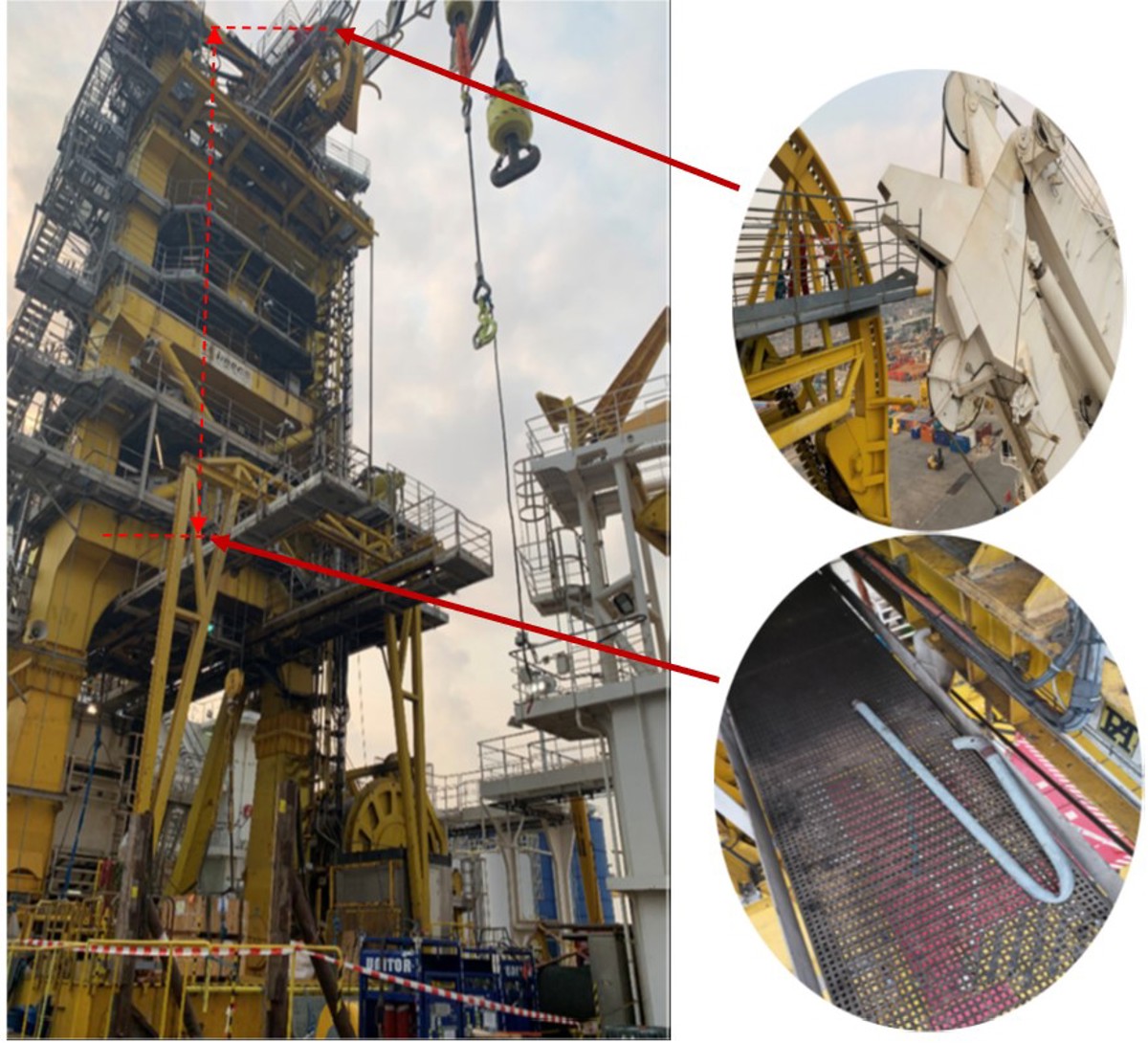
The incident occurred during repositioning of a chain link clump weight on the main deck using a 250T crane whip line.
The boom rest landing section on the boom knuckle came into contact with the top gutter walkway guardrails on the pipelay tower. A section of the rail (approx. 1.2 m and 5.5 kg) broke off and fell approximately 22 m to a walkway below.
What went wrong?
This incident is currently under investigation - however, the following preliminary findings were identified:
- There was a lapse in concentration due to distractions during the operation.
- The banksman was primarily focused on the load and its travel path rather than on the crane itself.
- The crane operator’s view was obstructed by the knuckle boom.
- The crew were new to the vessel:
- There was a lack of awareness of possible clash points and were not highlighted in the deck induction.
- The crew were not familiar with the vessel set-up when working in close proximity to tower.
- There was a lack of awareness of possible clash points and were not highlighted in the deck induction.
- There was an unidentified hazard (i.e. deck structure clash points).
- There were no engineering controls to warn the crane operator of close proximity to a structure.
Our member notes that further actions will be communicated on conclusion of the investigation.
Actions
- Are we out of the line of fire? Discuss what key controls you have in place to remove yourself and your team members from the potential line of fire.
- Ensure drop zones are identified for any potential clash points when performing lifting operations in close proximity to other structures or equipment.
- Ensure there is a robust and effective barrier management process used to manage all drop zones.
- Ensure all potential crane collision points are identified and included in worksite inductions, toolbox talks and risk assessments.
- Where applicable, ensure additional ‘spotters’ are used to assist the banksman.
Related Safety Flashes
-
IMCA SF 29/20
9 October 2020
-
IMCA SF 26/20
4 September 2020
-
-
IMCA SF 09/20
6 March 2020
-
-
IMCA SF 07/11
19 July 2011
IMCA Safety Flashes summarise key safety matters and incidents, allowing lessons to be more easily learnt for the benefit of the entire offshore industry.
The effectiveness of the IMCA Safety Flash system depends on the industry sharing information and so avoiding repeat incidents. Incidents are classified according to IOGP's Life Saving Rules.
All information is anonymised or sanitised, as appropriate, and warnings for graphic content included where possible.
IMCA makes every effort to ensure both the accuracy and reliability of the information shared, but is not be liable for any guidance and/or recommendation and/or statement herein contained.
The information contained in this document does not fulfil or replace any individual's or Member's legal, regulatory or other duties or obligations in respect of their operations. Individuals and Members remain solely responsible for the safe, lawful and proper conduct of their operations.
Share your safety incidents with IMCA online. Sign-up to receive Safety Flashes straight to your email.