LTI – Shoulder strain when crew member was descending the stairs
- Safety Flash
- Published on 20 August 2026
- Generated on 19 November 2026
- IMCA SF 15/26
- 2 minute read
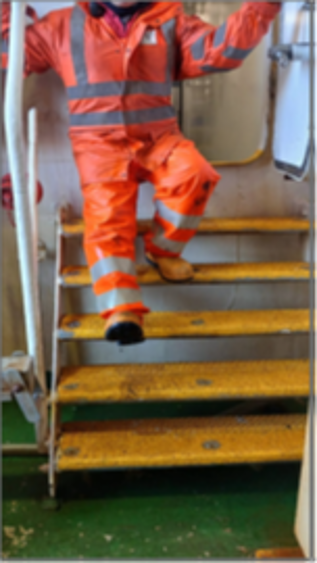
A crew member sustained an injury to their shoulder as they were descending a flight of stairs into an ROV hangar.
What happened?
Whilst stepping over the coaming of the weather tight door, they lost their footing on the top step at which point they reached out grabbing the door mechanism to try and stabilize themselves. As their hand remained fixed to the mechanism, both legs and lower body slipped off the top step. This resulted in their entire body weight pulling abruptly against their stationary left arm. The sudden drop created stress and a severe "wrenching" force on the shoulder joint, resulting in the injury.
Why did it happen?
- Task Demands – Perceived time pressure (in a hurry) – A request was made for the individual to investigate a burst freshwater line. The crew member was rushing – even with good intentions, this increases exposure to hazards.
- Work Environment – The ROV hanger is open to the external elements. As a result of this, the area gathers condensation, contributing to slippery conditions. Slippery conditions in open hangars are a known persistent risk.
- Work Environment – Changes / Departures from routine. The crew member entered the ROV hangar by a route not routinely used during operations.
What do we learn?
- Don’t rush, even during urgent tasks
- Could urgency affect your judgement and behaviour?
- Be aware of the hazards of stepping over high coamings while coming down the stairs
- Maintain three points on contact when using stairs
- Be aware of how environmental conditions (condensation, moisture) can make surfaces slippery
- Do you know all the different ways in and out of your workplace, and are you aware of any possible hidden risks?
Related Safety Flashes
-
IMCA SF 21/25
17 November 2025
-
IMCA SF 16/23
1 July 2023
-
-
IMCA SF 16/23
1 July 2023
-
IMCA SF 21/21
30 July 2021
IMCA Safety Flashes summarise key safety matters and incidents, allowing lessons to be more easily learnt for the benefit of the entire offshore industry.
The effectiveness of the IMCA Safety Flash system depends on the industry sharing information and so avoiding repeat incidents. Incidents are classified according to IOGP's Life Saving Rules.
All information is anonymised or sanitised, as appropriate, and warnings for graphic content included where possible.
IMCA makes every effort to ensure both the accuracy and reliability of the information shared, but is not be liable for any guidance and/or recommendation and/or statement herein contained.
The information contained in this document does not fulfil or replace any individual's or Member's legal, regulatory or other duties or obligations in respect of their operations. Individuals and Members remain solely responsible for the safe, lawful and proper conduct of their operations.
Share your safety incidents with IMCA online. Sign-up to receive Safety Flashes straight to your email.