LTI: serious finger injuries during crane operations
- Safety Flash
- Published on 18 November 2026
- Generated on 18 November 2026
- IMCA SF 20/26
- 3 minute read
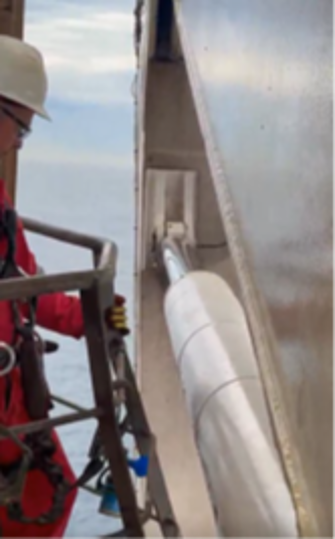
The boom of a 12 tonne crane moved towards the pipelay tower, and trapped the spotter’s left hand against a handrail.
What happened?
During the transfer of materials onboard a large offshore vessel, the boom of a 12 tonne crane moved towards the pipelay tower, and trapped the spotter’s left hand against a handrail.
The crane operator required support from the rigging crew to manoeuvre the crane boom close to the lay tower. A spotter positioned within the tower provided guidance during the final crane movements. During the final approach, the boom moved unexpectedly towards the spotter, trapping the spotter’s fingers against the tower handrail. Three fingers were broken, one of the broken fingers was subsequently partially amputated in hospital.
What went wrong?
- The team used a restricted platform as an unofficial spotting position, placing the spotter within the crane-to-tower line of fire.
- The lift was not correctly classified or planned using appropriate company processes and forms required.
- The operation required the crane operator to balance effective load control with precise close positioning to the lay tower, creating challenging operational demands that were difficult to achieve using the existing crane control arrangements.
- The inherent risk of repeatedly moving the crane close to the tower, with restricted visibility and limited tolerance for error, was not adequately controlled.
- Previous crane-to-tower contacts were not consistently reported, collectively reviewed or escalated into effective organisational action.
What do we learn?
- Plan for the actual risk: The operation involved repeated close-clearance movements, restricted visibility and limited tolerance for error. The task was perceived as routine because it had been completed many times previously, however, the risk profile required a higher level of planning and control.
- Follow the procedures – they are there for a purpose: The correct lift classification, planning process and associated forms were not applied. Consequently, the lifting documentation did not adequately address restricted clearance, visibility limitations, spotting arrangements or repeated exposure.
- Act on warning signs: Previous crane-to-tower contacts and close-clearance events had occurred, although not all were reported. The events were not collectively reviewed and acted upon at an organisational level, allowing the underlying risk to remain.
- Verify work as performed, not work as assumed: The task had moved away from the intended arrangements. Spotters searched for the best vantage point and a restricted platform became an unofficial spotting location without leadership or supervisory awareness.
- Design close-clearance operations with sufficient tolerance: A task is not routine when doing it safely depends on repeated precision, restricted visibility and a person standing near a closing interface. Close-clearance activities require operational and engineering controls that allow for normal variation and keep personnel away from line of fire.
Related Safety Flashes
-
IMCA SF 05/23
16 February 2023
-
IMCA Safety Flashes summarise key safety matters and incidents, allowing lessons to be more easily learnt for the benefit of the entire offshore industry.
The effectiveness of the IMCA Safety Flash system depends on the industry sharing information and so avoiding repeat incidents. Incidents are classified according to IOGP's Life Saving Rules.
All information is anonymised or sanitised, as appropriate, and warnings for graphic content included where possible.
IMCA makes every effort to ensure both the accuracy and reliability of the information shared, but is not be liable for any guidance and/or recommendation and/or statement herein contained.
The information contained in this document does not fulfil or replace any individual's or Member's legal, regulatory or other duties or obligations in respect of their operations. Individuals and Members remain solely responsible for the safe, lawful and proper conduct of their operations.
Share your safety incidents with IMCA online. Sign-up to receive Safety Flashes straight to your email.