MSF: Someone’s finger trapped in the door
- Safety Flash
- Published on 18 November 2026
- Generated on 18 November 2026
- IMCA SF 20/26
- 1 minute read
The Marine Safety Forum (MSF) has published Safety Alert 26-15 relating to a finger caught in a door.
What happened?
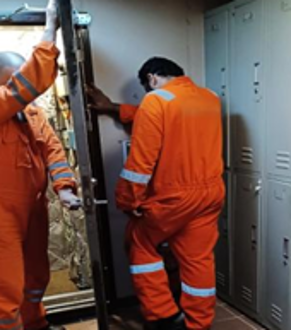
After finishing work, a crew member was in the changing room, located next to the Engine Room access door - a heavy fire door. The crew member was standing in the gap between the lockers and the door which opened into the room. The crew member, without looking, happened to place their right hand with the middle finger overlapping the door frame and the door (see image, a re-enactment). At almost the same time, another crew member opened the door from the engine room door and let it go. The door closed fast, catching the first crew members’ middle finger, causing a severe injury.
Useful questions
- Are fire door self‑closing devices adjusted to the correct closing speed?
- Am I aware of where I am putting my hands and fingers – particularly when near or passing through doors?
- Am I always handling doors using the handle or knob, not the door frame or edge?
Take a moment to look around you and think before you place your hands anywhere.
Related Safety Flashes
-
IMCA SF 19/24
25 September 2024
-
-
IMCA SF 09/23
4 April 2023
-
-
IMCA SF 06/22
11 March 2022
-
IMCA Safety Flashes summarise key safety matters and incidents, allowing lessons to be more easily learnt for the benefit of the entire offshore industry.
The effectiveness of the IMCA Safety Flash system depends on the industry sharing information and so avoiding repeat incidents. Incidents are classified according to IOGP's Life Saving Rules.
All information is anonymised or sanitised, as appropriate, and warnings for graphic content included where possible.
IMCA makes every effort to ensure both the accuracy and reliability of the information shared, but is not be liable for any guidance and/or recommendation and/or statement herein contained.
The information contained in this document does not fulfil or replace any individual's or Member's legal, regulatory or other duties or obligations in respect of their operations. Individuals and Members remain solely responsible for the safe, lawful and proper conduct of their operations.
Share your safety incidents with IMCA online. Sign-up to receive Safety Flashes straight to your email.