Man overboard in port: Seaman falls from quay access ladder
- Safety Flash
- Published on 18 December 2025
- Generated on 7 April 2026
- IMCA SF 23/25
- 2 minute read
A crew member fell overboard during operations alongside.
What happened?
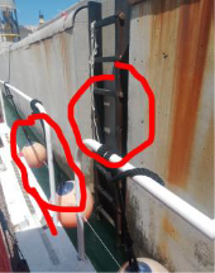
The incident occurred while a crane was being used to unload a smaller waste container on the vessel to a larger one on the quay. To access the quay from the vessel, it was necessary to use a fixed ladder on the wall of the quay. This was in poor condition, and was missing a step halfway up. While the crew member was climbing up the ladder, the crew member was distracted by movement of the vessel’s mooring lines, just at the point of placing a foot where the missing step should have been. The crew member lost balance, fell onto the gunwale, and then into the water. There was an immediate activation of the vessel’s emergency response procedure, and the crew member was safely recovered without serious injury.
 |
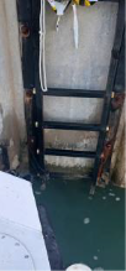 |
| Location and condition of access ladder on side of quay | |
What could have gone better?
- The access ladder was in visibly poor condition and had a missing step, yet it remained in use;
- Both port management and vessel management might well have looked to address this.
- The crew member was aware of the missing step and could have reported it or exercised the Stop Work Authority.
- Crew had been using the ladder earlier without incident, and kept on doing so without stopping and thinking about it – is this actually safe?
- Whilst climbing a ladder it is a good idea to concentrate and avoid being distracted.
What can we learn?
- Focus and concentrate: sometimes, small distractions can add up to big disasters;
- What distraction could take your mind off the job for just an instant, that could kill you or your workmates?
- Is there a better, safer way to do what we need to do? Can alternative access be arranged?
- Take into account quayside conditions—such as ladders, lighting, and quay movement—in pre-job risk assessments and toolbox talks.
- If something is broken, deteriorated, or in poor condition, don’t just accept it and carry on – stop the job, report it, and see what can be done to fix the problem.
Related Safety Flashes
-
IMCA SF 02/24
22 January 2024
-
-
IMCA SF 16/19
5 July 2019
-
-
IMCA SF 28/21
15 October 2021
-
IMCA Safety Flashes summarise key safety matters and incidents, allowing lessons to be more easily learnt for the benefit of the entire offshore industry.
The effectiveness of the IMCA Safety Flash system depends on the industry sharing information and so avoiding repeat incidents. Incidents are classified according to IOGP's Life Saving Rules.
All information is anonymised or sanitised, as appropriate, and warnings for graphic content included where possible.
IMCA makes every effort to ensure both the accuracy and reliability of the information shared, but is not be liable for any guidance and/or recommendation and/or statement herein contained.
The information contained in this document does not fulfil or replace any individual's or Member's legal, regulatory or other duties or obligations in respect of their operations. Individuals and Members remain solely responsible for the safe, lawful and proper conduct of their operations.
Share your safety incidents with IMCA online. Sign-up to receive Safety Flashes straight to your email.