BSEE: Unsafe crane working practices result in injury
- Safety Flash
- Published on 10 November 2022
- Generated on 21 October 2026
- IMCA SF 25/22
- 3 minute read
The United States Bureau of Safety and Environmental Enforcement (BSEE) has published Safety Alert #446 relating to an injury caused by unsafe crane working practices.
What happened?
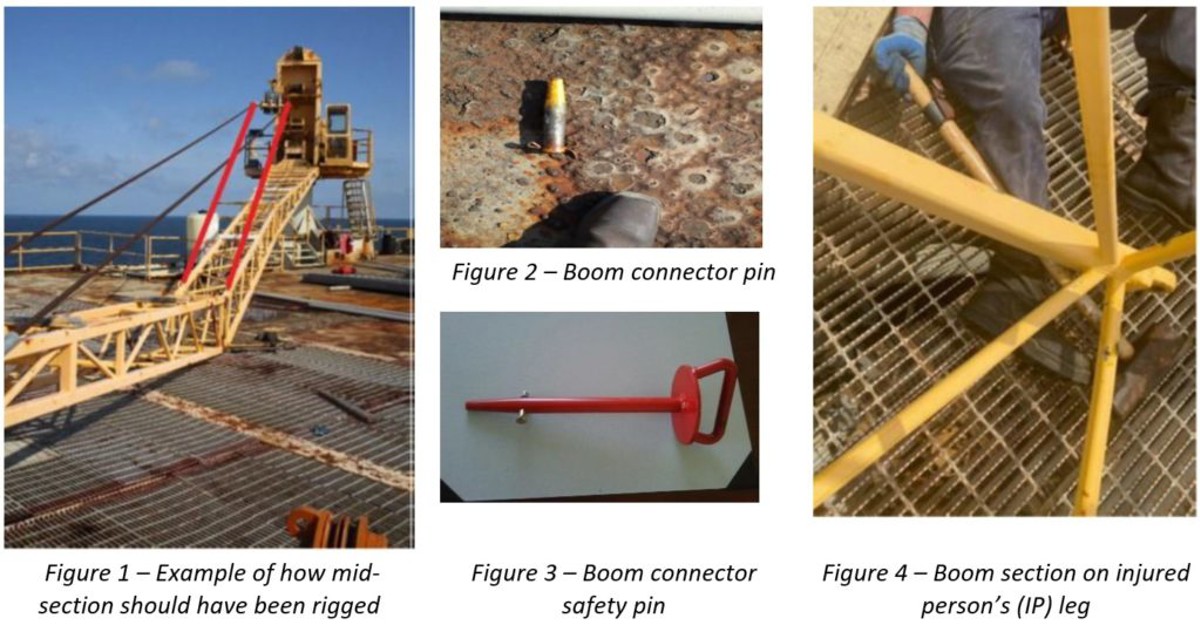
A lead mechanic suffered a severe leg injury while performing a boom tip changeout on an offshore pedestal crane. He and his assistant deviated from the planned scope of work, failed to rig up the mid-section to the bridle (Figure 1) prior to removing the mid-section to boom tip connector pins (Figure 2), and failed to use boom connector safety pins (Figure 3). After removing the bottom right pin, both employees assumed the bottom left pin would be difficult to remove since it was bearing the weight of the boom section. When the lead mechanic struck the remaining connector pin, it unexpectedly ejected, causing the boom to drop and pinning his leg against a sledgehammer and grating (Figure 4), fracturing his tibia.
Facility personnel used a pallet jack, a piece of two-inch pipe, and a two-by-four piece of wood to lift the boom tip and pull the lead mechanic from under the boom tip and then administered appropriate first aid.
What went right
The response of the facility personnel was critical in providing lifesaving interventions until treatment could be provided at the hospital on shore.
What went wrong?
The company’s incident investigation found that the root causes were:
- The Job Safety Analysis (JSA) was only completed by one employee and did not include rigging up the mid-section to the bridle prior to removing pins or the use of safety boom connector pins. In addition, the lead mechanic signed off on the JSA without actually reviewing it.
- There was no requirement for onshore management or the crew to review the JSA before starting work.
Recommendations
- Review of policies and procedures, ensuring compliance with the JSA requirements.
- Reinforcing the use of Stop Work Authority particularly when the scope of work changes.
- Understanding the importance of staying out of the line of fire when working near heavy equipment and considering all possible pinch points when walking down the job.
- Verifying all safety equipment is available and in place before the job starts.
- Providing specific written procedures to individuals disassembling cranes.
- Ensure that you do actually review the paperwork, risk assessment, JSA etc before you sign off on it and before you start the job!!
- Ensuring specialized contractors create and maintain written procedures and checklists for common jobs.
- Conducting drills based on realistic injury and first-aid scenarios and inspect medical supplies and kits at the facility level.
Related Safety Flashes
-
IMCA SF 09/18
24 April 2018
-
-
IMCA SF 10/13
25 June 2013
IMCA Safety Flashes summarise key safety matters and incidents, allowing lessons to be more easily learnt for the benefit of the entire offshore industry.
The effectiveness of the IMCA Safety Flash system depends on the industry sharing information and so avoiding repeat incidents. Incidents are classified according to IOGP's Life Saving Rules.
All information is anonymised or sanitised, as appropriate, and warnings for graphic content included where possible.
IMCA makes every effort to ensure both the accuracy and reliability of the information shared, but is not be liable for any guidance and/or recommendation and/or statement herein contained.
The information contained in this document does not fulfil or replace any individual's or Member's legal, regulatory or other duties or obligations in respect of their operations. Individuals and Members remain solely responsible for the safe, lawful and proper conduct of their operations.
Share your safety incidents with IMCA online. Sign-up to receive Safety Flashes straight to your email.